

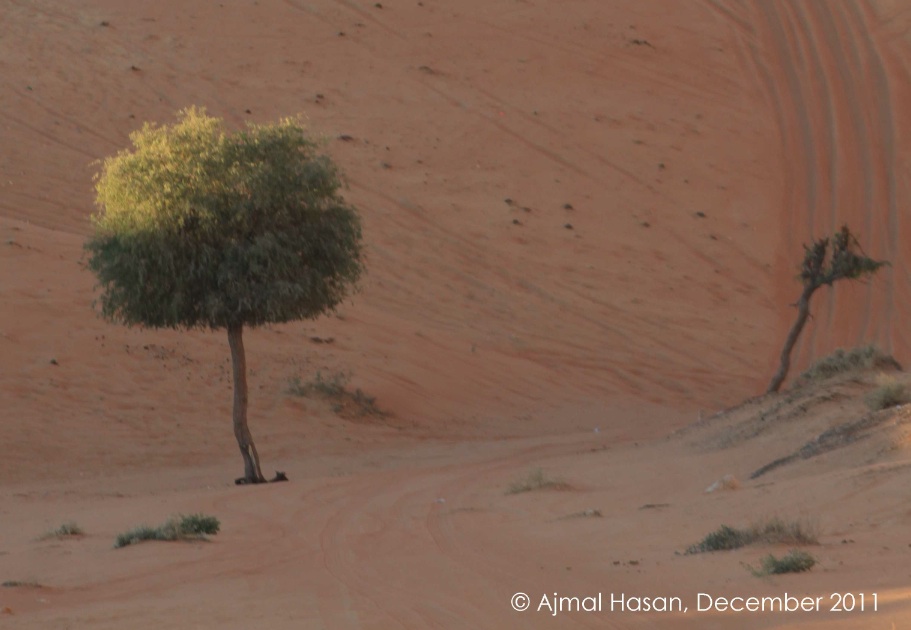
 Ajmal spends his weekends scouting for animals and life in the desert. Here is his trip to Fossil Rock.
I’ve always known that much of the Arabian peninsular mountains, especially those in the United Arab Emirates and Oman were at one point in time, millions of years ago, under the ocean. The Tethys sea to be precise. But when I recently heard there could be fossils of ancient sea creatures in the middle of the desert in Sharjah, this sounded almost unbelievable.
So I set out last Saturday to explore a small rocky limestone outcrop aptly called ‘Fossil Rock’ on the outskirts of Sharjah.
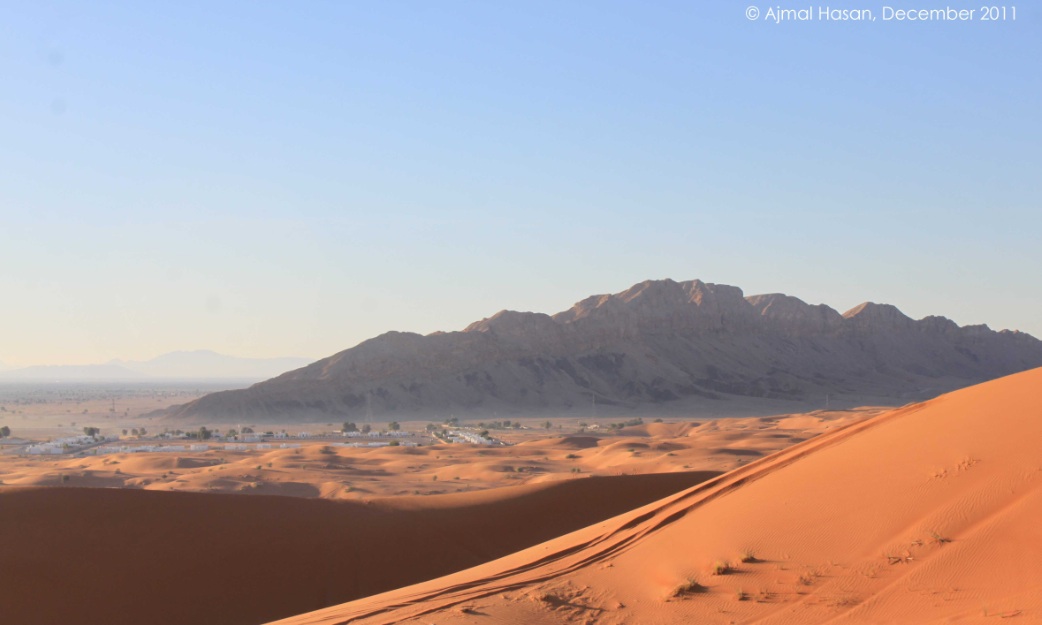
Geographically, this area lays where the desert sands meet the mountain rocks of the Western Hajar mountain range that begin at Maleiha (Sharjah) and continues onto the Eastern coast of the United Arab Emirates and Oman before they spill into the Gulf of Oman.
It was still pretty much dawn when I reached Jebel Maleiha (or Mountain of Maleiha) and as I approached the mountain, it was apparent that this was where the mountains took over from deserts. All along the highway till this point were sandy deserts and gravel plains.
I estimated the whole mountain to be not more than 300 meters high and 1200 to 1500 meters long. My last trip here was in February this year when I was more keen on documenting desert life and completely overlooked searching for fossils. This time I decided it to be the opposite.
In February, I basically only hiked around Maleiha scaling the mountain occasionally to look for desert eagle owls. This time around I would still follow a similar hiking path but would get onto the smaller jebels (or lesser mountains/rocky limestone outcrops) that lay further south of the larger Maleiha.
One of these lesser jebels is commonly termed ‘Fossil Rock’ for the fossils that can be easily found embedded along its slopes.
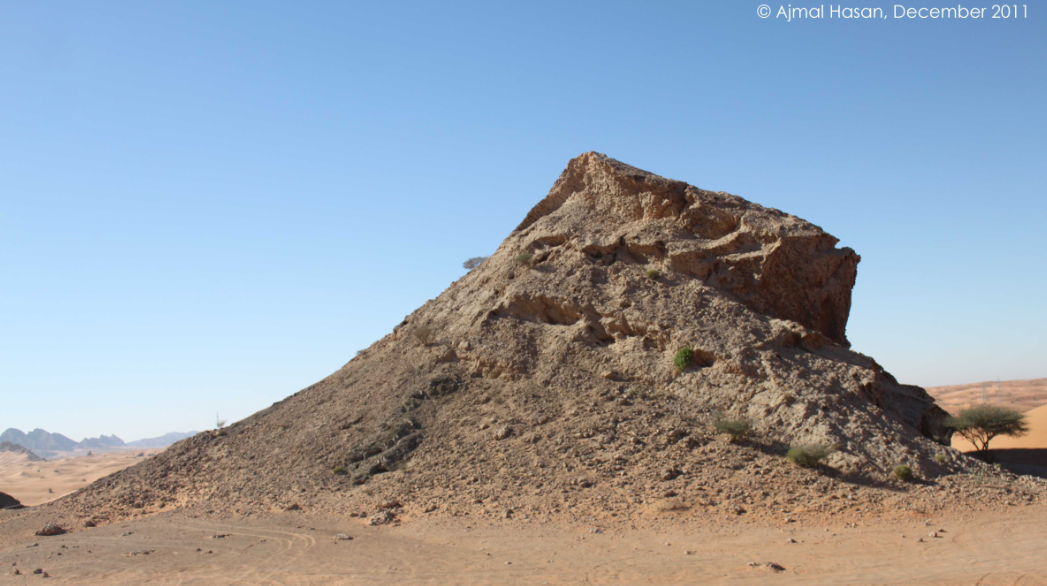
As I wound my way ahead across the sand dunes that circled the mountain, I could see tons of 4×4 and dune buggie tracks all along the desert sand.
This place obviously was a favorite with picnickers and dune bashers.
Nonetheless, as I headed along I saw a pair of African asses in the distance. Extremely shy creatures, I only had a fleeting glance as they galloped away into the distance disappearing from sight.
A herd of tame camels were busy chomping on khimp (Leptidenia pyrotechnica) desert bushes further ahead. The sand was getting finer now and a lot more difficult to walk across. In some areas I was sinking in, the sand covering up to my ankles. So, I changed track and started walking around the crest of the dunes where the sand was firmer.
In the distance were 4x4s driven by enthusiastic drivers up and down the big dunes. I had a task in hand now to stay away from being below the crest of the dunes where it would be potentially dangerous for me. In other words, I had to trek on the crest of dunes or atop the dunes so that I had a constant birds-eye view of my fellow beings just so I didn’t get run down.
Finally after a good two hours of trekking across the sand, I reached the end of Maleiha Mountain and right ahead of me lay the most strenuous part of my journey – scaling a good 50 plus meter dune.
Gulping down on water, I moved on determined to reach the summit from where I knew I would have an excellent view of what lay ahead and could plan my further journey.
Now, I always carry at least 2 liters of water with me at any given instant and it amazes me how quickly I end up finishing them. A quick backpack stock taking and I was ok to go – I still had a liter left, phew.
I also take a lot of breaks in my journey. Walking across fine dune sand drains you out, literally! Once atop this big dune, which in a decade or two is destined to bury the northern side of this mountain, I looked out ahead into the distance and immediately in front of me lay this black rock with white striations all across it.
This could not be Fossil Rock, I thought, as fossils usually form in softer rock or limestone. I climbed this rock which was easily scalable and surveyed my surroundings. Ahead about a 100 meters away lay another rocky formation that was lighter in color and seemed more fossil-bearing to me. I moved on.
It became immediately apparent that this limestone outcrop had fossils as I found one almost as soon as I began closely examining the limestone.
A fossil novice, I had no clue what kind of ancient creatures were embedded in the rock but I could see some distinct sea creature shapes.
I started taking pictures and exploring further. Most of the rock was ragged limestone and devoid of fossils but as I circled around it, I found an area of limestone that had fossils all over it.

I took many photographs of this rock, hoping to be able to identify the fossils later through some serious referencing. There were different kinds of fossils as the images here show. I found it really amazing that millions of years ago this rock was under the Ocean having surfaced only recently (in human terms).
Further in the distance, I could see the mountain of Jebel Al Faya in between which were smaller rocky outcrops, one of which is called ‘Camel Rock’. Again, the name is apt as it indeed does look like a camel resting in the sand with a distinct camel-like head and hump.
My initial goal was to trek to this rock but considering I had already trekked a good 4 to 5 kilometers and had the same amount to trek back to reach the highway, I gave up my plan and headed back at this point, content on having found and photographed many fossils. Camel Rock can wait another day for this explorer to give it a visit, I thought, as I turned around circling Jebel Maleiha back to the highway.
An hour and a half later as I set foot on man-made ground, I felt relieved not because I was heading back to civilization again but because I had spent a few beautiful hours with nobody but Mother Nature for company. The feeling is indescribable.

That could be inferred if we ignore volcanos, earthquakes, oil wells, coal mines, fracking for natural gas, etc. Corporations need a growing Earth and a growing human population to accomodate their growing economy and the growing wealth they’re so addicted to, so they ignore any evidence to the contrary. “A growing economy is a healthy economy” regardless of consequences. This is how our planet is being polluted to death.
JTR – much of the land surface was formed under the sea (limestone / ophiolite) and is now above the sea’s surface. Perhaps you might infer that the earths surface is expanding.
There are many such places on the Earth where desert was once under sea water. This indicates the Earth is slowly shrinking and not growing to accomodate humanity’s instictive desire to expand its economy.