
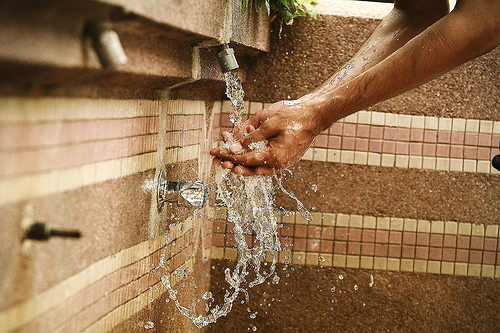


Wudu ritual washing in Islam Zaufishan gives some tips for making wudu greener
It was over five years ago when I first learned about a wudu that was environmentally friendly. Despite being a keen Eco-Muslim, I didn’t see how clean water for ritual ablutions could get, well, any cleaner. After one Hajj pilgrimage in 2005 and many cold water washes however, here is proof that wudu really can be part of the active green faith.
Borrowing a chapter title from Ibrahim Abdal-Matin’s Green Deen book, the wonderful world of wudu begins with a Muslim’s relationship to water.
Wudu (woo-dhoo) is a physical ritual where Muslims immerse themselves in a symbolic purification before prayer and every act of worship. The word itself comes from the Arabic root “wa-da`a” which means to make brighter. Wudu is essential to connecting with God and seeing His signs – water from rain, a lake, small streams becoming oceans, or a running tap.
How to make wudu ablution
The ablution consists of an important routine: rinsing the mouth 3 times, the nose, washing the whole face 3 times, each forearm, the top of your head, behind the ears, neck, feet and between each toe.

Each movement with water physically washes away dirt and in essence the negative actions of that limb. Wudu is a reminder of blessings; it’s a control switch, a health check.
The Prophet Muhammad of Islam said, “cleanliness is part of faith” (tahoor shatril imaan). He also warned against “squandering water” even if next to a river; the Prophet always advocated an eco-wudu.
An eco-Wudu
Muslims make wudu up to five times a day, and the amount of water spilled can add up. Growing an ‘eco-beard‘ can saves masses of water whereas shaving can use up to 11 gallons of water on average per household. Most of this is wasted from keeping the tap running and more energy is eaten up by using hot water instead of cold.
As believers, wudu can be a part of our eco lifestyle and a more conscious effort of resourcefully using one of our most precious blessings from God.
I haven’t perfected my wudu and in those panic-last-minute-prayermoments, I confess that I have left the tap running in the past. No more! Here are several winning ideas that could just make our wudu more wonderful:
Tips for making your wudu green:
Turn tap off: It sounds obvious but closing your taps when making wudu will significantly change how you use water. Fill a pot or bucket for your ablutions. Use a glass to rinse your mouth. Take a jug of water with you outside and perform a spiritual wudu in nature.
- Check your wudu count: For experimental purposes time how long it takes for you to complete wudu while leaving the tap running on normal pressure.
- Next time place a bucket under the tap and leave the tap running for the same amount of time it took for you to do wudu. Measure this water. This is your wudu count. I measured my wudu count which came to nearly 2.5 litres of water. The Prophet Muhammad performed his wudu with 16 handfuls of water! It isn’t a scientific test but it’s useful for directly seeing your water impact, and as the idea creator Ibrahim Abdal-Matin said, “Having a number can help you determine a goal for reducing that number.”
- Water saving toilets: Install a toilet with an inlet valve that reduces the water volume used to flush clean, saving up to 25%.
- Personal hygiene is fundamental to the wudu but does not come with practical solutions, especially in public restrooms. That awkward moment when someone walks in on you with your foot in the sink… You can buy water carrying pouches created specifically for such scenarios. One can hold 1 litre of water, is ergonomically designed with spout and folds away for discretion. The product can save water and save a lot of public bother
Wudu with dust
These suggestions can be implemented in our homes and mosques. With enough awareness I hope to see a change in our value system so that while others have to perform their wudu in dust – known as tayammum, we’re not pouring away our blessings with water.
More on water management:
How Islam Could Help Fight Water Scarcity
The Story of Hajjar: Muslim Women and Water Conservation
Water & The Middle East At A Glance (Infographic)



 is a Muslim's ritual wash before any act of worship. Wudhu is a control switch, a health check, a reminder of liquid blessings. But how can wudhu make the Islamic faith even greener?)
(by the way, great article and practical tips!)
Just wondering… didn’t the Prophet (s) use 1 “madd” for wudhu (not 16 handfuls)? E.g. where 1 madd = 1 pair of hands cupped together. (Source: Sahih al-Bukhari; Sahih Muslim; Tirmidhi)
Thank you kindly Arwa, in Arabic, Shukran!
Cool! thanks for this amazing article Z
Arwa