Water & The Middle East At A Glance (Infographic)

This infographic by Carboun tells you everything you ever wanted to know about water and the Middle East but couldn’t be bothered to read

Building on the blossoming debate on water and its complexities and Carboun’s first infographic on the carbon emissions from the region, comes this second infographic which aims to decode the water situation in the Middle East and North Africa region. At first glance, it’s not as easy to read as Carboun’s previous infographic but this simply reflects the intricacy of the water situation in the Middle East.

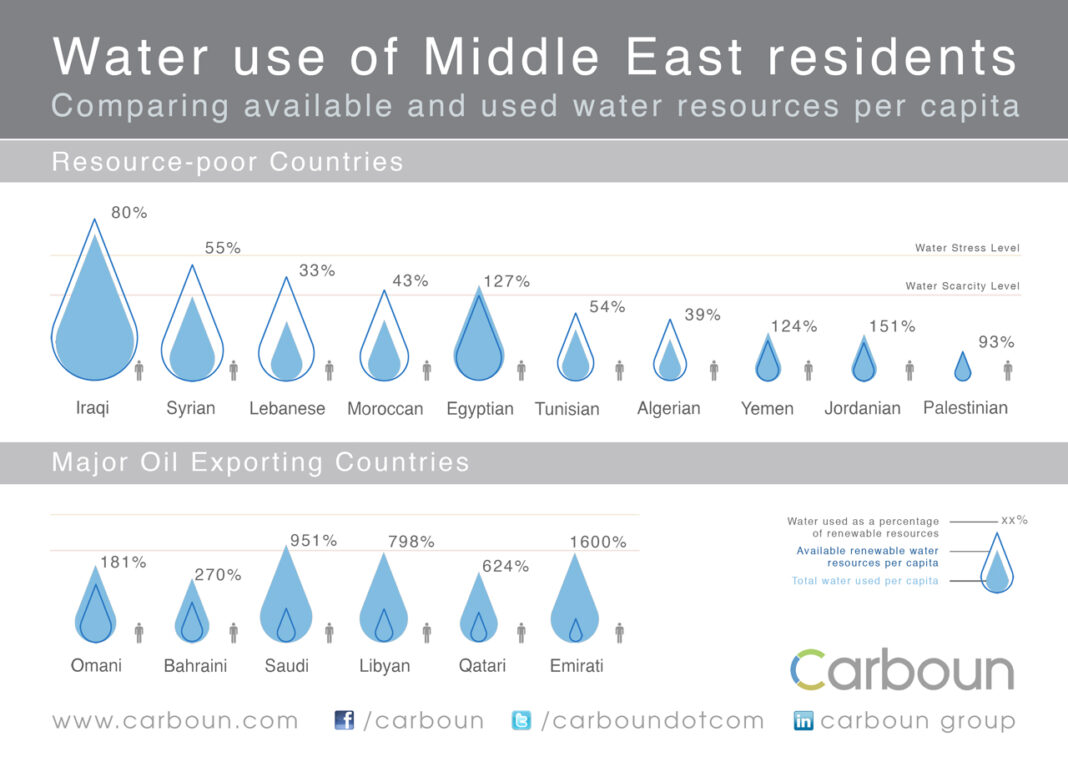
The first you need to get your head around is the key. The percentage above all the water drops represents the amount of water a nation uses from the renewable resources available to it. So, if the percentage is 100% or less than that the country is using, respectively, all or less of its renewable resources but if this is over 100% than the country is using more water than it actually has which is clearly a bad thing.

Overused and Overstretched- Water In MENA

Unsurprisingly, it is the major oil-exporting nations that are blowing their water budget with Emiratis using a whopping 1600% more, Saudis using 951% of their available resources, Qataris using 624% and Libyans overusing water by 798%. Of the resource poor nations in the Middle East and North Africa region, Egyptians used 127%, Yemenis used 121% of their renewable water resources whilst Jordanians used 51% more water than was currently available to them at 151%. All of the remaining ‘resource-poor’ nations such as Syria, Iraq and Algeria used below their budget with Lebanon, which is known for its high water wastage, using the least at just 33% of its renewable water resources.

Getting The (Water) Balance Right

The infographic uses a water drop per nation to illustrate this balance of water consumption and water availability per capita. A dark blue outlines represents the water available and a light blue water drop represents the actual amount of water used – as such, any nation with a light blue water drop bigger than the outline means its overusing. Whilst any nation with a light blue water drop smaller/within the dark blue outline means it’s using water within its means. A quick glance at the infographic should help you make sense of all this.

Water Scarcity Impacting Resource-Poor & Resource-Rich Nations

Another useful bit of information which the infographic by Carboun, an organisation which promotes sustainability in the Middle East, includes is water scarcity. There is a water scarcity level line on the resource-poor nations which is quite hard to make out (maybe next time the line should be in black than light pink) which illustrates that many of the nations such as Tunisia and the Palestinian Territories are already dealing with water scarcity. Gulf nations such as Oman and Bahrain and also within the water scarcity level although unlike the poorer nations they are able to buy their way out of their problems with water desalination technologies.
Iran and Israel Still Missing

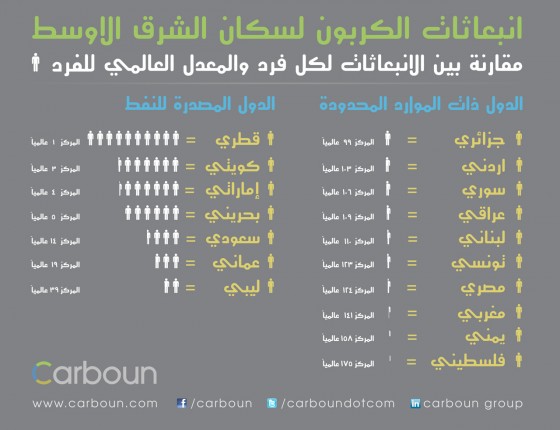
What’s also useful is that an Arabic version of the original infographic on carbon emissions has been produced which makes it a great resource for locals in the region. Again Israel and Iran are not included in this infographic so it’s good that Green Prophet recently published its own guide to Israel and water although the situation in Iran still needs to be highlighted. To find out more on Carboun see their website or follow them on twitter.

:: Data for the infographic via World Bank.

For more on water in the Middle East:

Water and Israel- The Facts

Trouble In Paradise: Water Failure At Luxury Apartments In Dubai

Syria Launches Water Scarcity Park

Israel Commits Itself To More Desalination

Iraqi Sheikh Threatens To Demonstrate If Kurds Don’t Share Water
Middle East Water Security Worries The Prince Of Jordan

Arwa Aburawa
Arwa Aburawahttp://www.greenprophet.com
Arwa is a Muslim freelance writer who is interested in everything climate change related and how Islam can inspire more people to care for their planet and take active steps to save it while we can. She is endlessly suspicious of all politicians and their ceaseless meetings, especially as they make normal people believe that they are not part of the solution when they are the ONLY solution. Her Indian auntie is her model eco-warrier, and when Arwa is not busy helping out in the neighborhood alleyway garden, swap shopping or attempting fusion vegetarian dishes- with mixed success, she’d like to add- she can be found sipping on foraged nettle tea.
2 COMMENTS
  1. Agreeing with Karen here, and very interested in everything Arwa writes about water in the Middle East. Well done articles on a crucially important topic!

  2. We need to produce our own infographics with Iran and Israel. Ignoring both these countries is like saying the world is still flat. Just shows how far stupid politics will drive people. I care about what’s happening in Iran, because I care about our planet, not one that has chunks of land annexed from it.

LEAVE A REPLY

Please enter your comment!
Please enter your name here

TRENDING

Astro uses AI to help procure land for renewable energy

For oil-rich, environmentally vigilant Gulf states, Astro isn’t just another startup story. It is a blueprint for accelerating an energy transition that is now existential, not optional.

Sink holes from over-watering farmers’ fields

Sinkholes are rapidly appearing in Turkey’s central Anatolian farming region, particularly around Konya and Karapınar. These giant gaping holes in the ground in areas of farmland, known locally as obruk, are not random geological events. They are linked to prolonged drought, climate-driven heat stress, and heavy groundwater extraction for agriculture in one of the country’s most important breadbaskets.

Oil pollution in Basrah’s soil is 1,200% higher than it should be

Soil pollution levels in parts of Basra are 1,200% to 3,300% higher than those typically measured in cities like Toronto or New York, according to new comparative soil data. It's getting into water.

Peace hospital opens between Jordan and Israel

The proposed medical centre, described by Emek HaMaayanot Regional Council head Itamar Matiash as “a centre for cancer treatment, so that people from Jordan or further away could come and receive treatment,” would become the flagship of a wider cluster of medical, academic and innovation-based services planned for the Israeli half of the zone.

Travel Morocco with teens at the Kasbah du Toubkal’s magical mountain retreat

Walking well-trodden mountain pathways, eating fresh local food, and learning about the transformative work embedded in the Kasbah’s approach to tourism has now been imparted to our children. We hope, in turn, these experiences will serve to inform their contributions in the world as they continue to grow. Don’t wait, Morocco is on everyone’s bucket list. Growth and change are inevitable. 

Qatar’s climate hypocrisy rides the London Underground

Qatar remains a master of doublethink—burning gas by the megaton while selling “sustainability” to a world desperate for clean air. Wake up from your slumber people.

How Quality of Hire Shapes Modern Recruitment

A 2024 survey by Deloitte found that 76% of talent leaders now consider long-term retention and workforce contribution among their most important hiring success metrics—far surpassing time-to-fill or cost-per-hire. As the expectations for new hires deepen, companies must also confront the inherent challenges in redefining and accurately measuring hiring quality.

8 Team-Building Exercises to Start the Week Off 

Team building to change the world! The best renewable energy companies are ones that function.

Thank you, LinkedIn — and what your Jobs on the Rise report means for sustainable careers

While “green jobs” aren’t always labeled as such, many of the fastest-growing roles are directly enabling the energy transition, climate resilience, and lower-carbon systems: Number one on their list is Artificial Intelligence engineers. But what does that mean? Vibe coding Claude? 

Somali pirates steal oil tankers

The pirates often stage their heists out of Somalia, a lawless country, with a weak central government that is grappling with a violent Islamist insurgency. Using speedboats that swarm the targets, the machine-gun-toting pirates take control of merchant ships and then hold the vessels, crew and cargo for ransom.

Leopoldo Alejandro Betancourt López Turned Ocean Plastic Into Profitable Sunglasses

Few fashion accessories carry the environmental burden of sunglasses. Most frames are constructed from petroleum-based plastics and acrylic polymers that linger in landfills for centuries, shedding microplastics into soil and waterways long after they've been discarded. Leopoldo Alejandro Betancourt López, president of the Spanish eyewear brand Hawkers, saw this problem differently than most industry executives.

Why Dr. Tony Jacob Sees Texas Business Egos as Warning Signs

Everything's bigger in Texas. Except business egos.  Dr. Tony Jacob figured...

Israel and America Sign Renewable Energy Cooperation Deal

Other announcements made at the conference include the Timna Renewable Energy Park, which will be a center for R&D, and the AORA Solar Thermal Module at Kibbutz Samar, the world's first commercial hybrid solar gas-turbine power plant that is already nearing completion. Solel Solar Systems announced it was beginning construction of a 50 MW solar field in Lebrija, Spain, and Brightsource Energy made a pre-conference announcement that it had inked the world's largest solar deal to date with Southern California Edison (SCE).

Related Articles

Popular Categories