

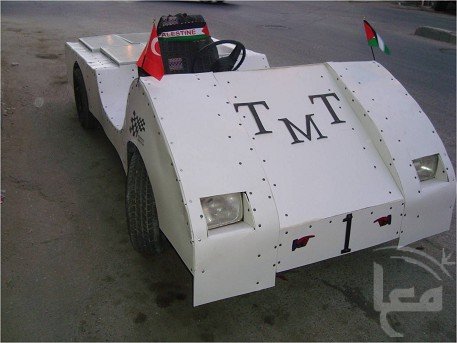
 The Palestinian electric car isn’t much to look at, and it couldn’t carry a large Arab family, but it is solar powered!
Just when we all thought Shai Agassi’s Better Place electric car company had the electric car technology field sewed up in this part of the world, some university students in the Palestinian West Bank city of Hebron have come up with someelectric car innovation of their own, reports Maan News.
Although not as sophisticated as Agassi’s technology, which involves developing not only a full size electric car, the Renault Fluence, and an exchangeable lithium- ion batter pack to power it; these unknown Palestinians have developed a home-made version of an electric powered vehicles whose batteries are charged by solar energy.
Developed as a school project by engineering students at the Palestine Polytechnic University in Hebron, the golf cart-like vehicle uses 12 batteries, totaling 24 volts, which can power the car for 3 to 5 hours.
Running at its maximum speed of 30 kilometers per hour, the batteries can last for only 100 minutes, but given the short distances around town, that would probably be enough for errands.
Dr Zuhdi Salhab, who supervised the project, told Maan News that sourcing the material to create the alternative energy presented an obstacle, but he praised the students’ creativity. Given the chance, Salhab said, Palestinian students could come up with more “great projects that stimulate global development.”
The batteries are rechargeable, so alternative electricity from a home plug can be used in the winter. The technology is very basic compared to that of “rival” Better Place, and the vehicle the students designed resembles something more out of a “how to” magazine like Popular Mechanics like what we featured in a Green Prophet article back in December 2009.
The main difference here is that the Hebron Polytechnic students have managed to integrate the use of solar energy to provide power for the batteries – as long as the sun shines. And in the Middle East it can shine bright 300 days of the year.
But, unless these students are able to acquire funding to further develop their “project car,” the home made solar power invention will most likely remain a curiosity item in a location where people get around either by gasoline power or more primitive means like donkeys.
It’s doubtful that a UN aid organization or some international entity like the World Bank will take much of an interest in this school project.
But again, when Israel’s Shai Agassi started out a number of years back, he probably had no idea if his concepts would reach the stage where his company was able to acquire funding of hundreds of millions of dollars.
Up to now, the cars being designed by Better Place do not have solar energy panels incorporated into their cars, as the batteries have to be either recharged by standard electrical current or exchanged when they reach the 160 km cruising limit.
 The designers of the Palestinian vehicle – the TMT – have to decide whether they want to continue innovating their design, and eventually try to market it; or let it be relegated to being just a glorified self powered donkey cart.
Maybe countries in the United Arab Emirates or other wealthy oil producing states might lend the students a hand – unless they are afraid this new invention might hurt their sources of wealth; that being the stuff that comes from the ground and is now the source of all the problems in the Gulf of Mexico.
More articles on electric cars:
Maurice Test Drives the Better Place Electric Car
GM’s Volt Vs Renault Better Place Electric Cars

Wow, incredible blog layout! How long have you been blogging for? you made blogging look easy. The overall look of your site is wonderful, let alone the content!. Thanks For Your article about Palestine& .
‘…glorified self powered donkey cart.’ What a condescending douche this writer is.
Good for these engineering students, using the little resources they have to create this vehicle.
Anything that can help save the planet is only good for the planet.
Indeed a nice start with the solar car.
I thought,if they place the solar panels about 1,5 meter or so, higher, the place beneath can be used for seats, and material,
bringing around packages etc.
It resembles small solar-cars driving around on golf-sport resorts.
I think it is a start to congratulate for, and support.
Now I might not know much, but when I see giants like Toyota and Honda jumping head first into the game, we know the electric car has a future: I just didn’t see it as showing in Palestine so fast. As for the home front, so to speak, here’s something I think you might also enjoy: http://www.pressdisplay.com/pressdisplay/showlink.aspx?bookmarkid=M2J9P29Q7LH1&preview=article&linkid=f4e13387-35c7-4097-9d67-3f6f5e3f4837&pdaffid=ZVFwBG5jk4Kvl9OaBJc5%2bg%3d%3d
So if you have a minute, this one’s not a bad read 🙂
Good start. Now from cars to everything else.
You may know “The solar cooking archive” and the ‘Villager sun oven’
(1200 meals a day), and 30.000 meals by solar energy in India by the use of Scheffler mirrors on the roof of a temple. The remaining
energy is sold as green energy. You can find more about Scheffler mirrors at Solare Bruecke. How to build a mirror you can see in the
manual for a 2.7 m3 mirror at Solare Bruecke. Maybe you can
replace the pieces of mirror by a reflecting foil, called Reflectec.
Maybe even paint is possible (X20 paint reflects solar radiation.
About 90 %. Can be used to cool houses)
Look for the work by Jürgen Kleinwächter. He developed a solar pump
working at about 100 degrees C, and a Stirling motor working
at low temperature (220 C)(normal 6-800 degrees). With 2 m3 hot vegetable oil you can work 2 days. See Tamera healing biotope,
Portugal. And other places at the web. Probably you can generate
electricity with it.
A free magazine ‘Mother earth news’ writes about healthy, small
scale, alternative living. E.g. it wrote about a solar pond
(in the Dead Sea. 150 KW.) and thought about small scale examples.
You may know that for Stirling motors you do not need fuel.
Several solar energy devices work with Stirling motors.
The heat is enough to move the piston. They probably are not cheap.
And not easy to make. Look at Youtube solar stirling.
And Youtube making solar panels (1/5 th of the costs)
In the Netherlands the ECN is working on cooling by solar warmth.
You can ask me if you want to know more.
Somewhere I found a chinese instrument, looking as a solar
cooking instrument, that can be used to connect pieces of iron
(weld), where the reflected sunbeams are concentrated
——————————————————–
[ A young man from Palestine, living in the Netherlands, asked me whether someone wanted to buy remains of olive-oil-production to burn for energy. My answer was that, if the kernel is not in it, and it is clean, you can better use it for food, for people and animals – as a paste with solarflower oil and citric acid]
———————————————————–
Friendly greetings
Ad Christiaensen
Well I must say that the design looks awful but coming from a country with such little resources that is a great step forward.