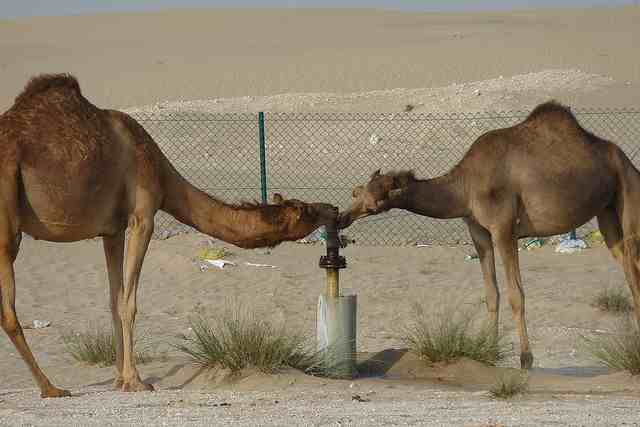

Demand For Water To Double By 2030 In UAE

water-uae-desalination-demand-double-2030Water conservation policies are being promoted in the naturally water poor nation of United Arab Emirates

Considering that the United Arab Emirates is located in harsh and arid desert, the fact that the average resident uses around 364 liters of water a day – way above the global average of 200 litres- is surprising. Natural groundwater is supplemented with desalinated water and treated water to boost supplies and provide a steady supply of clean water to residents (well, most of the time). However, a recent report which found that water demand is likely to double by 2030 in the UAE has got government authorities worried and they are now promoting the benefits of water conservation.

The UAE Environment Ministry has come up with a six-part plan to enhance water security and stem the rising tide of water consumption. “The value of water and the need to conserve it in the UAE cannot be underestimated because of its scarcity and lack of rainfall to replenish wells,” Mariam Al Shenasi at the Ministry of Environment and Water, told Gulf News. The new plan includes initiatives such as controlling supply, improving the efficiency of distribution, and strengthening federal water laws and policies.

Cutting The High Cost of Desalination

Currently, the United Arab Emirates uses 4.5 billion cubic metres of water a year. Over half of that comes from groundwater supplies, whilst 37% comes from the 70 desalination plants scattered across the country. As well as good eco-sense, cutting down the water consumption makes good economic sense as the annual production cost of desalinating water is estimated at around Dh11.8 billion or over US$3 billion.

The main culprits behind the high use of water include the agricultural sector which claims 34% of overall water usage, the domestic sector and industry which uses 32%, and less justifiable ‘landscaping’ and beautification projects which use 11%. Treated sewage water for irrigation meets around 8% of the water need and has helped save around 136 million cubic metres of desalinated water.

Can Nuclear Energy & Water Conservation Mix?

The UAE recently announced that they would be sticking by plans to build four nuclear reactors by 2017 to ensure they meet rising demands for electricity. The rising demand for energy can be attributed to inefficient energy subsidies which keep prices artificially low and also the energy-intensive process of water desalination. Indeed, a report by Carboun estimated that the emirate of Abu Dhabi uses more than half of its domestic energy use in desalination. This makes water conservation even more important as it makes little sense to keep supplying cheap energy if the UAE hasn’t got a handle on its water consumption.

Another related issue is that nuclear energy is known to be water intensive which means that the UAE could end up being trapped in a cycle of needing to produce extra energy to make the extra water which they need for nuclear energy. Consequently, the energy and water equation needs to be carefully balanced so that any hydrological gains aren’t written off by poor energy choices.

:: Gulf News

: Image via Danny McL/flickr.

For more on water issues in the UAE see:

Nuclear-Powered Water For UAE

Trouble In Paradise: Water Failure At Luxury Resort In Dubai

Feeding Abu Dhabi Water From The Air

Arwa Aburawa
Arwa Aburawahttp://www.greenprophet.com
Arwa is a Muslim freelance writer who is interested in everything climate change related and how Islam can inspire more people to care for their planet and take active steps to save it while we can. She is endlessly suspicious of all politicians and their ceaseless meetings, especially as they make normal people believe that they are not part of the solution when they are the ONLY solution. Her Indian auntie is her model eco-warrier, and when Arwa is not busy helping out in the neighborhood alleyway garden, swap shopping or attempting fusion vegetarian dishes- with mixed success, she’d like to add- she can be found sipping on foraged nettle tea.
1 COMMENT
  1. I would say the rather than any of the sectors which are given as “The main culprits behind the high use of water” there is really only one reason

    massive subsidies

    this not onloy encourages consumption but also creates a price barrier to technology which might help recycle water

LEAVE A REPLY

Please enter your comment!
Please enter your name here

TRENDING

10 Proven Israeli Technologies to Help Somaliland Build Food, Water, and Energy Security

Israel’s water and agricultural technologies didn’t emerge from ideal conditions. They were developed under pressure: low rainfall, saline water, political isolation, lack of energy resources, and the constant need to feed a growing population with limited land. Over the years, I’ve written about many of these companies not as miracle-makers, but as problem-solvers. That’s what makes them relevant to places like Somaliland. Israel was the first country in the world to recognize Somaliland as an independent state although Ethiopia has been treating the nation as such for decades.

Dead shark on beach injured by fishing nets

  A dead shark that washed ashore this week at...

Iran’s holiest city about to run dry as terror chosen over water management

Iran’s second-largest city, Mashhad, is facing an acute water emergency after dam reservoirs feeding the city fell below three percent capacity, according to Iranian state and local media. Officials warn that without rainfall or improved inflows from neighboring Afghanistan, the city’s supply could soon collapse.

Investing in the Middle East? These 20 Energy consultants can de-risk your portfolio

For instance is your clean tech firm or company in wastewater treatment considering an office in Riyadh or should you stick with Dubai?  Below is a curated spotlight on 20 firms that shine for their deep expertise and proven ability to manage the complex risks of sustainable energy investment.

Choosing Riyadh over Dubai? What Investors Should Know

Saudi Arabia is deploying capital at unmatched scale to catalyze tourism and advanced industry while rewiring its power-and-water backbone. The investable frontier is widening—especially in renewables, grid storage, water efficiency/desal retrofits, and hospitality operating platforms. Prudent investors will insist on phased delivery, enforceable KPIs (energy, water, biodiversity), and RHQ/zone compliance—while pricing political-economy and reputational risks alongside growth upside.

Qatar’s climate hypocrisy rides the London Underground

Qatar remains a master of doublethink—burning gas by the megaton while selling “sustainability” to a world desperate for clean air. Wake up from your slumber people.

How Quality of Hire Shapes Modern Recruitment

A 2024 survey by Deloitte found that 76% of talent leaders now consider long-term retention and workforce contribution among their most important hiring success metrics—far surpassing time-to-fill or cost-per-hire. As the expectations for new hires deepen, companies must also confront the inherent challenges in redefining and accurately measuring hiring quality.

8 Team-Building Exercises to Start the Week Off 

Team building to change the world! The best renewable energy companies are ones that function.

Thank you, LinkedIn — and what your Jobs on the Rise report means for sustainable careers

While “green jobs” aren’t always labeled as such, many of the fastest-growing roles are directly enabling the energy transition, climate resilience, and lower-carbon systems: Number one on their list is Artificial Intelligence engineers. But what does that mean? Vibe coding Claude? 

Somali pirates steal oil tankers

The pirates often stage their heists out of Somalia, a lawless country, with a weak central government that is grappling with a violent Islamist insurgency. Using speedboats that swarm the targets, the machine-gun-toting pirates take control of merchant ships and then hold the vessels, crew and cargo for ransom.

Leopoldo Alejandro Betancourt López Turned Ocean Plastic Into Profitable Sunglasses

Few fashion accessories carry the environmental burden of sunglasses. Most frames are constructed from petroleum-based plastics and acrylic polymers that linger in landfills for centuries, shedding microplastics into soil and waterways long after they've been discarded. Leopoldo Alejandro Betancourt López, president of the Spanish eyewear brand Hawkers, saw this problem differently than most industry executives.

Why Dr. Tony Jacob Sees Texas Business Egos as Warning Signs

Everything's bigger in Texas. Except business egos.  Dr. Tony Jacob figured...

Israel and America Sign Renewable Energy Cooperation Deal

Other announcements made at the conference include the Timna Renewable Energy Park, which will be a center for R&D, and the AORA Solar Thermal Module at Kibbutz Samar, the world's first commercial hybrid solar gas-turbine power plant that is already nearing completion. Solel Solar Systems announced it was beginning construction of a 50 MW solar field in Lebrija, Spain, and Brightsource Energy made a pre-conference announcement that it had inked the world's largest solar deal to date with Southern California Edison (SCE).

Related Articles

Popular Categories