

 The Arab World’s superstar, Morocco’s longstanding exploitation of natural resources in the Western Sahara casts a dark shadow on the country’s reputation.
Following unprecendented support (nearly 99%) for a draft constitution initiated by Morocco’s King Mohammed VI, the country is being hailed as a model for the rest of the Arab world. And so it should be. Of the handful of mostly Arab countries I’ve visited, this is among the most comfortable and progressive and I can’t make myself leave.
The youth are intelligent, multilingual, well-traveled, and have a lovely curiosity about other people and the rest of the world. And, although it is not advised to speak poorly of the royal family, they genuinely love their King Mohammed VI, who has instituted major reforms since his succession. But there’s a dark side to this enchanting country. And it lies in fish, phosphates, and oil.
Pravda accuses Morocco of not living up to promises brokered by the UN between Moroccans and the Polisario Front, an organization of Sahawaris who have resisted the country’s 1975 annexation of the Western Sahara territory where they live.
The treaty signed in 1991 was supposed to usher in self-determination to this indigenous group, 45% of whom are currently unemployed. Instead, according to Pravda, Morocco continues to occupy the land illegally, and 165,000 Saharawi live as refugees in camps located in what they call an “inhospitable Algerian desert.”
Why, you ask, would Morocco be interested in the Western Sahara? Because the region is rich in fish, phosphates, and probably oil and natural gas. That’s good money for Morocco, and good money for Europe.
This is what Western Sahara Resource Watch says about the situation that most of the world seems to ignore:
A network of organizations and activists who are keeping track of the Western Sahara travesty, WSRW adds that the region is both blessed and cursed with rich natural resources.
WSRW actively campaigns against European companies that attempt to benefit in concert with Moroccan officials from the natural resources that Saharawis should, by international law, be managing themselves. They have managed to chase out many firms, but Morocco is forging ahead with exploration into parts of the occupied territory for other natural resources such as zirconium and uranium.
Every country has skeletons. Morocco occupies Western Sahara and profits from the stash of natural resources nestled there. Subsequently the country is able to provide its citizens with a decent life. Will Morocco continue to look the other way. Will we?
:: Pravda
More stories from Morocco:
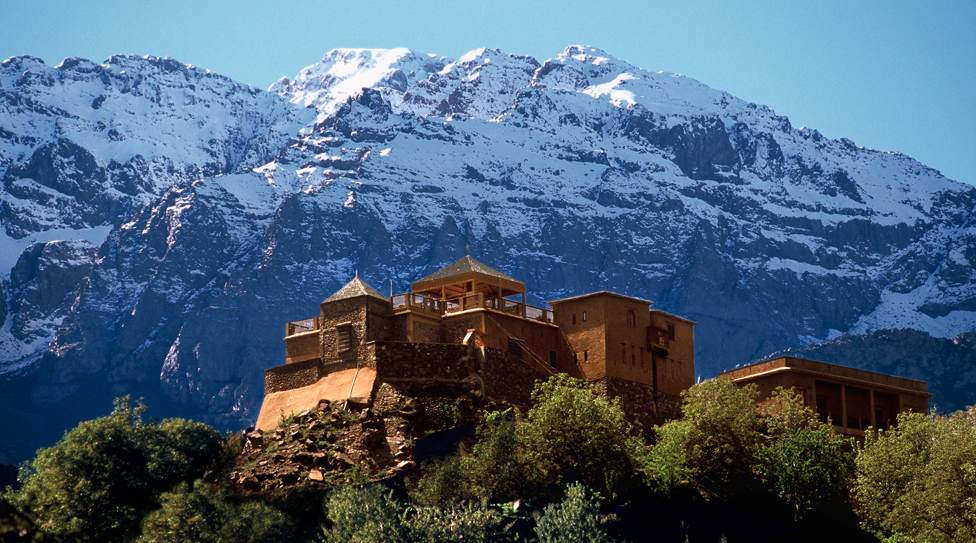
Rocking the “Eco” Kasbah du Toubkal in Morocco
Looks Like Desertec and Morocco’s Government Might Hold Hands
Mt. Toubkal: Chasing Berbers to the Top of North Africa
Moroccan led empires were vast in the past with economical capitals like Fez and Marrakesh. Their influence were vast and reached a large portion of Africa like Mauritania, parts of today Algeria, and Mali among others. Hence, many different ethnicity groups lived under the past empires and sultanates, Berbers, Black Africans, Moors, and Sahrawis alike. So it doesn’t make sense to claim a piece of Morocco for every ethnic group or religious group. If that’s the case then Berbers from Nador would have a separate state as well as Berbers from the South.
Also, just look at Morocco, there are two Spanish enclaves in Moroccan land, why doesn’t Spain give them back or even the Canary Islands. They were inhabited by Berbers first! I feel there is a lot of propaganda and an agenda to divide Arab States because of natural resources. Just look at what is happening in Iraq and other Arab countries. It’s a shame and Arab countries should never bow down for the UN and Western demands.
Human rights in Morocco is better than Algeria and the Polisario
Has Morocco been the only historic state in the area, with cultural, linguistic, religious, and political continuities that have extended through what some are referring to as the “Western Sahara”? Yes most certainly.
Are the boundaries of Western Sahara organic and have they -at any point in history- defined a self-governing entity? Negative! Those boundaries are straight lines made by a colonialist’s ruler and a colonialist’s pen, they are not organic and were invented by Madrid-based aliens and intruders (kinsfolk of those who wiped out millions of native peoples in the Americas). There just simply has never been any pre-figuration of Western Sahara in history.(Basically, history and facts are toxic to Western Sahara activists, so they look to the imaginations of criminals for their arsenals instead.)
In Morocco are Sahraouis treated like other groups in Morocco? Certainly, and even Morocco’s committed enemies would not risk embarrassment by claiming otherwise.
Is the Polisario (“Western Sahara” separatists) democratic? No! Elections are something they avoid altogether. The organisation’s leaders are chosen by Morocco’s neighbour and rival, Algeria.
Does the Polisario respect human rights? Not even for a day, if any of the refugees try to leave the Polisario-run camps they pay dearly. The refugees identities are erased to keep them docile; sadly they are not treated like humans but rather like a stock of sympathy bags each of which the organisation can exchange at the UN for resources. Without the refugees (more accurately hostages), the Polisario would look like a gang of desert vagabonds peddling a scam beaten into the shape of an independence movement.
All I have to say is that greenprophet.com is brutally and unrighteously occupying space on the internet. That space should be immediately freed up in my opinion.
The western Sahara has been Moroccan since at least the Al-Moravid dynasty (which even ruled in the Iberian penninsuala – we have forgone our claims there, therefore early on a great concession was made on our part!) so what is all this dribble about “Western Sahara”? A country by that name has never existed in history, it is an abomination and a lousy geostrategic tool, nothing to do with self-determination or democracy. The leadership of the “Western Sahara” are the Polisario please remember, who have unashamedly given their support – and by support I mean fighters/murderers – to Kaddafi AND HAVE PARTICIPATED IN THE ATROCIOUS CRACKDOWN AGAINST LIBYA’S LIBERATION MOVEMENT! They are terrorists, and anyone who supports them exposes themselves as immoral, naive, and as having a dark side themselves.
The people want the toppling of this site!
The people want the toppling of this site!
The people want the toppling of this site!
IT has No fresh water supplies of any kind.
It has a tiny population in a couple of towns with the rest of the territory empty.
If the guerrilla group decades old took charge, and what would we have – Somalia on the West Coast of Africa.
The notion that such a nation is viable is absurd.
We should be thankful Morocco is taking care of business there.
Otherwise the West would be spending billions trying to stop desperate terrorists from launching attacks from a place where getting lost is very easy.
I’m sorry but what is clear here is that Pravda re-printed a propaganda piece of the Polisario front, an organisation with abysmal records of human rights violations, no political participation at all, let alone a democratic dissent, or any elected body, and a vested interest in twisting facts, and lies, to suit their narrative. By publishing it, and not explaining what it is, Pravda led you to fall in trap: taking it for what it’s not, i.e a piece of journalism.
I am no specialist in economics, nor have I access to data to prove by 1+1 that the entire territory is a draw on the other regions of Morocco, not contributing to the economy, but I’ll try.
Let’s consider what are the resources here: fish and phosphates. And thanks to the active lobbying of their brethren, there are no jobs in either for Sahrawis or others.
Fish, because the money the EU paid, and has been used to upgrade the ports, construct refrigerated warehouses and replace the unhygienic boxes that were used by plastic ones can’t be proven to have benefited exclusively the ethnic Sahrawis, it obviously didn’t. I should mention here there is no consensus on whom is Sahrawi and who’s not, and that is one of the problems dragging on the conflict. Incidentally, the EU will in the end renew the agreement, the jobs of EU citizens always trumps everything else, let alone Spanish fishermen, a sensitive population in a country with 20% unemployment and financial crisis. But because of this, they will get it cheaper. Everyone loses this side of the Mediterranean.
As for the mine, it only contributes between 1 and 2% of the production, for domestic use, not for a lack of capacity, but because of a boycott by several European countries that makes it unsellable. Meanwhile, the OCP maintains a crew and some administrative staff because cutting them and shutting the mine is politically unthinkable. Recently the state in a bid to alleviate unemployment in the Sahara had the OCP hire workers, but the company had to put them to work in Khouribga. That sparkled riots in this city because the natives rightly saw that as an invasion and theft of jobs that belongs to them by right. The conflict is still raging on. Moreover, the city of Laayoune could have benefited from the activity of the port and the industry of transformation of the raw rock into acid and fertilizers. That’s impossible because the mine is on hold.
And by the way, there is no trace of oil or gas, and not for lack of drilling. Morocco is desperate for domestic energy resources. I don’t think even Spain would have gone without a fight if there was any.
What’s on the other hand?
As its name indicates, the sahara is exactly that, a desert. There is no water to grow anything, despite the exposure to the ocean. It relies entirely on food from other regions and imports.
All food, oil and gas are heavily subsidized. Taxes are very low. Civil servants get double the pay, and in majority they are natives of the region. Water is produced by a huge desalination plant, and surprise, it’s paid less than in the north where it actually rains. And people there have a superior fertility rate than the rest of the country to boot.
Nonetheless, civil servants get paid on time, there is running water and electricity 24H, there are free schools and teachers for the kids, hospitals and doctors, no shortage in food stuff, no prohibitive prices for consumers as should logically be, well maintained roads, one of the first places on the country to be slum free. So, who pays for that? Me and the rest of the tax payers.
All that not factoring the cost of controlling the territory lest it becomes infested with drug smugglers and terrorists as is the case in neighbouring Mali and Mauritania, preventing immigrants from reaching the Canaries. The cost of sending all these soldiers there, who otherwise wouldn’t be soldiers at all, the cost of the military equipment we should be spending on infrastructure and education, and the whole growth loss from the bad press and uncertainty of investors. Who do you think is paying for that? The EU with the paltry fishing agreement?
We paid for it with blood too, but that can’t be quantified in dollars and Euros.
I can’t help thinking that we would have been better off without, however, that ship has sailed, and it doesn’t work that way anyway.
The irony of it is that even if the place were to be an independent country, a peaceful and viable one, which is very unlikely, it would lose its citizens to migration because the place is what it is: an inhospitable desert, without the Oil and gas wealth of a Lybia or Saudi Arabia.
And just to shut that Roger type, at least people in Morocco, including Sahraouis vote for mayors and send MPs to the parliament, did the RASD ever have elections, even staged ones? Have its president ever been elected? And the organisations you cite have representations and operate in all legality and freedom here, can you say the same about your pet totalitarian guerilla republic in the desert?
i like your last name laylin the part of lay is diffrent in writing from lie, but they should call you lie-lin or line the lier 🙂 thant you for waisting my time
I welcome constructive comments that bring what is clearly a contentious debate closer to some kind of clarity.
Roger stop please you are misirable, with your comments, what about algeria? why they put saharawis in closed camps like prisoners??
and by the way morocco is not the paradise of human rights but it still better than algeria and polisario camps, you can check the same reports you cited just the part you wanted to.
low cost article sorry, you try to misslead readers by a totally wrong information, the sahara is moroccan you like it or not, ask your algerian sponsors to give you what they promissed to give you for this article
Western Sahara is a part of Morocco, a State founded 1200 years ago. All Moroccans kings, starting with Idriss the 1rst to Mohammed the 6th, have nominating the governors of theses provinces. A North African country is giving a lot of money to a lot of people and a lot of Internet sites in order to tarnish Morocco reputation. It’s a pity. By the way, the content of your site is extremely poor. You are polluting the web. Degagez!
K. E.
Morocco has brought back the 99.99% used by mubareks, aseds, kaddafis and co. In the Western Sahara this kingdom run by a monarch who is religious, economic and executive chief is maintaining a brutal ocupation. In http://www.arso.org you can find human rights watch, amnesty international and the freedom house reports depicting Morocco as one of the worst human rights abusers around the word. Morocco is also is against the free selfdetermination of the people of the western sahara, has a mine wall dividing the territory and expells all christians from its territory and other foreigners who show interest in the western sahara conflict.
how sad that green prophet fell for that bull…..how abt that algeria funds everythin cuz wid independence, western sahara wud be de facto algeria allowing it to have sides on the atlantic n mediterranean which wud explode their gas exports!
I never thought you of all people at Green prophet would fall for that.
Fall for what?
hopefully this link works, otherwise, type it in manually.
http://www.esisc.net/TEWN/pdf/419598541_EN8.pdf
http://www.esisc.net/TEWN/pdf/419598541_EN8.pdf
Most of the “165,000 Saharawi refugees” are held against their will by Polisario-run Tindouf camps, financed by Algeria. Why not let those refugees return to their home in Western Sahara?
Bull article written full of lies and non historic accurencies…propaganda..