
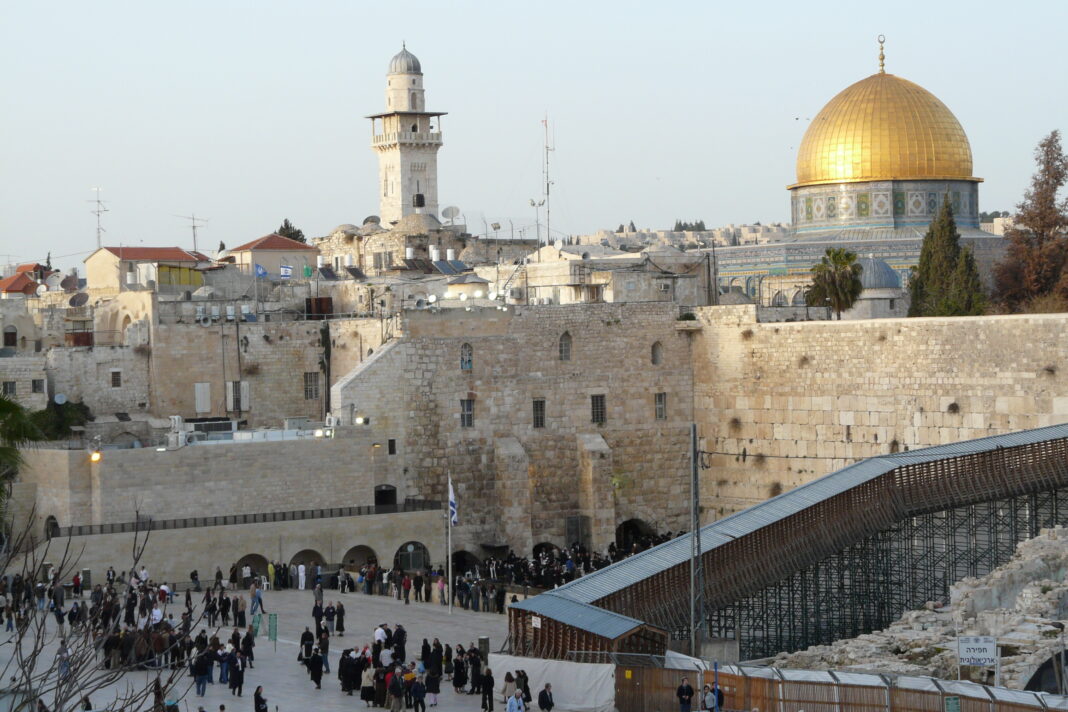

 The Council of Religious Institutions of the Holy Land, which includes Palestinian and Israeli religious organisations, has officially recognized global warming and need for action
Whilst the major world religions can boast some great green principles at their core such as moderation, limiting waste and caring for nature, they have been rather slow to acknowledge human-induced climate change and the need for joint action. Which is why it’s so great to hear that the Council of Religious Institutions of the Holy Land (CRIHL), which represent all recognized religions in the Holy Land, has formally recognized the global challenge of climate change.
In a recent public statement, the CRIHL said, “We acknowledge the scientific basis of human-caused climate change and the threat it poses to human societies and the planet, as articulated by the United Nation’s Intergovernmental Panel on Climate Change. We also recognize the spiritual roots of this crisis, and the importance of a religious response to it.”
Faiths and Planning for the Future
I think the second sentence is particularly important as it acknowledges that religions have a role to play in finding solution to climate change. For all the conflict and wars that faith has caused across the planet, it has also been able to do something which science appears to be failing to do right now: encourage people to look ahead and plan for the future.
Whilst climate scientists are almost in complete unison over the impending dangers of climate change and the need to take action now, it appears that most people are just unable to take the risks we face ahead seriously enough. We seem to be stuck in the world of ‘now’ and incapable of taking action for the benefit of the future which we may not live to see. Planning for the future and seeing the inherent benefit of doing something good is something which many faiths instil in their followers and it this mind-frame which can help humanity take the appropriate action to avoid the worst aspects of climate change.
“Adopt Science-based Targets to Avert Climate Change”
The CRIHL go on to call on all Muslims, Christians and Jews to address the crisis of climate change by re-assessing their spiritual relationship with the God-given planet and how they consume, use, and dispose of the resources extracted from the earth. They also push for people to take personal action to reduce their carbon footprint and to encourage their political leaders to adopt strong, binding and science-based targets to avert the worst of dangers of climate change.
CRIHL also recognises the need for more unity to tackle the global issue of climate change and the possibility that it raises for more inter-religious co-operation and understanding. As they state, “We hope that this threat to our common home of the Holy Land and of Planet Earth will move religious adherents to overcome inter-religious strife and work together for ours and our children’s common well-being.”
:: CRIHL
:: Image via Arwa Aburawa.
For more on Green Faiths see:
‘Muslim For A Month’ Project In Turkey Grows Inter-Faith Seeds
The Do’s and Don’ts of Green Blogging For Muslims
Sefirat HaOmer: 49 Steps Upward
Help Save the World’s First Synagogue



Hi Murtaza,
Thanks for your comment.
In the article I am not trying to say that all wars are caused by religion rather that have played a part in some hence ‘For all the wars they have caused..” Also I don’t say that science has failed to warn us about climate change rather that they have been unable to inspire us into action… yes, there are lots of great scientists who have sounded the alarm over the seriousness of global warming but so far they haven’t been anywhere near..I mean look at the Bonn, Copenhagen.. Check out this link on climate scientists for more: http://www.guardian.co.uk/science/2011/jul/05/scienceofclimatechange-climate-change?CMP=twt_gu
A cycling veggie imam??!? Now, there’s something I’d love to see!:)
Arwa
Quoth Arwa
“For all the conflict and wars that faith has caused across the planet, it has also been able to do something which science appears to be failing to do right now: encourage people to look ahead and plan for the future.”
I think it’s unfair to blame faith for all/most of the world’s faith-based wars/conflicts, which I think are mainly driven by greed and dirty politics under the guise of religion. But I guess this is debatable…
I also think it’s unfair to say that science has failed to do its part to sound the climate change alarm. I think it’s more than done its part: the science community, like any community, has its share of “heroes” who’ve realized the seriousness of anthropogenic climate change enough to realize they must be visible and loud about their stance and about what humankind should do to avert disaster, but again, thanks to greed and dirty politics, and thanks to a largely corporate-driven media, we aren’t likely to find out what they’re saying.
The statement by CRIHL, in comparison to all that scientists have done to warn us, is very minor, but it is an extremely necessary and needed step forward. It’s high time that faith-based communities shared concern for the biosphere. Hopefully in the coming years this translates to priests, rabbis, and imams leading their communities in increased environmental awareness.
I, for one, would love to come across an imam that has committed himself to eating less meat and driving less or not at all… *that* would be awesome.