Limited Power Shackles Armenia to Precarious Nuclear Plant

In bucolic but earthquake-prone Armenia, people both fear and rely on a nuclear power plant that has operated for three decades with no primary containment structure.

In the 1970s, a series of first-generation nuclear reactors were built in the former Soviet Union, all lacking the infrastructure to contain major ruptures in the reactor’s primary circuit. Should a large rupture occur and the facility begin to overheat, the reactor would open to the outside air to cool down, exposing the surrounding environment to its contents and whatever accidents subsequently befell them.

One such nuclear power plant was built in present-day Armenia, in one of the most seismically active areas on the planet, a recent National Geographic article reports. Concerned citizens, scientists and international agencies have called on the Armenian government to shut down the plant, but there’s a snag: The plant supplies more than 40 percent of the power in a country that is exceptionally hard-pressed for energy.

The 31-year-old Metsamor power station is one of just five first-generation VVER 440 nuclear plants that lacks a primary containment structure. The rest are in Russia. The Armenian government has started planning to replace Metsamor’s 750 MW of capacity by 2016, but many are worried about what may happen in the intervening five years.

One-third of Armenia’s population live just 20 miles away, in the capital city of Yerevan. At a time when many countries in the Middle East are charging ahead with plans to develop nuclear power, including Armenia’s neighbor to the west, Turkey, Armenians dread becoming a tragic illustration of the dangers of nuclear technology.

At the same time, however, Armenians, are loath to turn off the plant until an equally large power generator has replaced it. Armenia was cut off by both of its nearest neighbors, Azerbaijan and Turkey, after the dissolution of the Soviet Union, so it relies on fuel imports from more distant countries, mainly Russia. After a 6.8-magnitude earthquake hit Armenia in 1988, the plant was shut down for six years even though it had escaped any damage. Ara Tadevosyan, director of a major Armenian news agency, recalled these years as a time of extreme deprivation in National Geographic:

“There were severe power shortages during the winter months. We had a situation where you had one hour of power a day, and sometimes no power at all for a week. You can imagine—it was as cold in the apartment as it was in the street.”

More than a thousand safety improvements have been made to the plant since it restarted in 1995, but that didn’t stop a United Nations envoy from calling the plant a “danger to the entire region” in 2004, or the United States from underwriting a study that similarly urged the country to replace it.

The European Union required Bulgaria and Slovakia to shut down VVER 440 units in those countries before they could join the EU. Since the EU hasn’t been able to convince Armenia to do the same, it has instead spent more than 59 million euros trying to improve the safety and sustainability of Armenia’s power supply.

Next year, Armenia plans to begin work on a new, $5 billion VVER 1000 nuclear reactor project: first steps toward its emancipation from the aging VVER 440. But that project won’t help relieve Armenia’s dependence on volatile, foreign sources of energy. As Green Prophet recently reported, a huge amount of oil is necessary to extract uranium, the fuel needed to run nuclear power plants.

For true peace of mind, Armenia should seek cleaner, more sustainable sources of energy within its own borders.

:: National Geographic

Read more about nuclear power in the Middle East:

Despite Japan, Turkey Goes Ahead With Nuclear Reactors

Time to Pause: Risks of Nuclear in the Volatile Middle East and North Africa Region

Nuclear Power Continues World Dependence on Middle East Oil

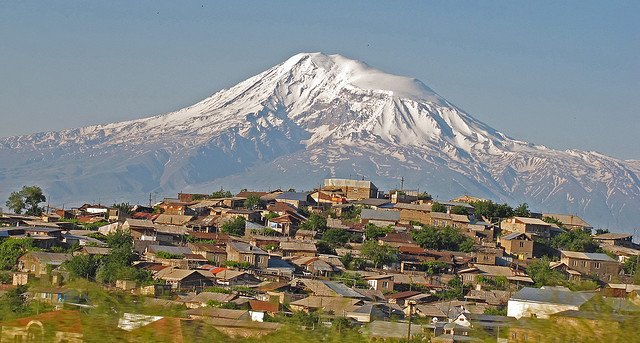
Image via Chuckdad

Julia Harte
Julia Hartehttp://www.greenprophet.com
Julia spent her childhood summers in a remote research station in the Rocky Mountains of Colorado, helping her father with a 25-year-old experiment in which he simulated global warming over a patch of alpine meadow. When not measuring plant species diversity or carbon flux in the soil, she could be found scampering around the forests and finding snowbanks to slide down. Now she is a freelance journalist living in Istanbul, where her passion for the environment intersects with her interest in Turkish politics and grassroots culture. She also writes about Turkish climate and energy policy for Solve Climate News.

LEAVE A REPLY

Please enter your comment!
Please enter your name here

TRENDING

Play spogomi the garbage picking sport and win a World Cup

If the future of environmental action looks less like a lecture and more like a pickup game, that might not be a bad thing at all.

Egypt building nuclear power

Egypt is building a nuclear energy plant, expected to go online in 2026 when countries like Germany have shut down all its domestic nuclear power. The El Dabaa Nuclear Power Plant is the first nuclear power plant planned for Egypt and will be located at El Dabaa, Matrouh Governorate, Egypt, about 320 kilometers northwest of Cairo. 

Ski Japan and skip the cherry blossoms

apan’s winters reveal a quieter magic far from the cherry blossoms — a landscape of deep snow, mountain silence, and steaming hot springs. From Niseko’s legendary powder in Hokkaido to the Olympic slopes of Hakuba and the ancient baths of Nozawa Onsen, Japan offers some of the world’s most sustainable and culturally rich ski experiences. With efficient bullet-train access, renewable-powered resorts, and geothermal onsens under falling snow, this is how to ski Japan responsibly — where tradition, technology, and climate awareness meet on the same mountain.

Armenia’s captive brown bears and how we can stop the illegal practice

From roadside cages in Armenia to wild encounters in Siberia, brown bears reveal both human cruelty and awe. To truly respect them is to keep them free — not captive, not tamed.

How Israel’s Strikes Avert Iran’s Environmental Threat

The strikes on Iran have sparked fierce debate, but from Israel’s perspective, the choice was easy: either accept the risks of a nuclear Iran or act decisively to stop it.

Qatar’s climate hypocrisy rides the London Underground

Qatar remains a master of doublethink—burning gas by the megaton while selling “sustainability” to a world desperate for clean air. Wake up from your slumber people.

How Quality of Hire Shapes Modern Recruitment

A 2024 survey by Deloitte found that 76% of talent leaders now consider long-term retention and workforce contribution among their most important hiring success metrics—far surpassing time-to-fill or cost-per-hire. As the expectations for new hires deepen, companies must also confront the inherent challenges in redefining and accurately measuring hiring quality.

8 Team-Building Exercises to Start the Week Off 

Team building to change the world! The best renewable energy companies are ones that function.

Thank you, LinkedIn — and what your Jobs on the Rise report means for sustainable careers

While “green jobs” aren’t always labeled as such, many of the fastest-growing roles are directly enabling the energy transition, climate resilience, and lower-carbon systems: Number one on their list is Artificial Intelligence engineers. But what does that mean? Vibe coding Claude? 

Somali pirates steal oil tankers

The pirates often stage their heists out of Somalia, a lawless country, with a weak central government that is grappling with a violent Islamist insurgency. Using speedboats that swarm the targets, the machine-gun-toting pirates take control of merchant ships and then hold the vessels, crew and cargo for ransom.

Leopoldo Alejandro Betancourt López Turned Ocean Plastic Into Profitable Sunglasses

Few fashion accessories carry the environmental burden of sunglasses. Most frames are constructed from petroleum-based plastics and acrylic polymers that linger in landfills for centuries, shedding microplastics into soil and waterways long after they've been discarded. Leopoldo Alejandro Betancourt López, president of the Spanish eyewear brand Hawkers, saw this problem differently than most industry executives.

Why Dr. Tony Jacob Sees Texas Business Egos as Warning Signs

Everything's bigger in Texas. Except business egos.  Dr. Tony Jacob figured...

Israel and America Sign Renewable Energy Cooperation Deal

Other announcements made at the conference include the Timna Renewable Energy Park, which will be a center for R&D, and the AORA Solar Thermal Module at Kibbutz Samar, the world's first commercial hybrid solar gas-turbine power plant that is already nearing completion. Solel Solar Systems announced it was beginning construction of a 50 MW solar field in Lebrija, Spain, and Brightsource Energy made a pre-conference announcement that it had inked the world's largest solar deal to date with Southern California Edison (SCE).

Related Articles

Popular Categories