
With Three Raging Reactor Meltdowns at Fukushima, What’s Positive About Nuclear Power?

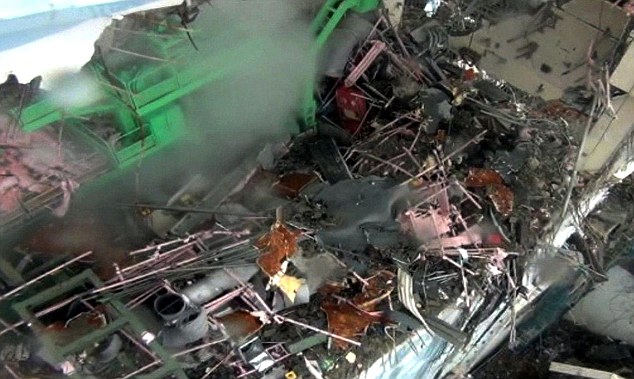
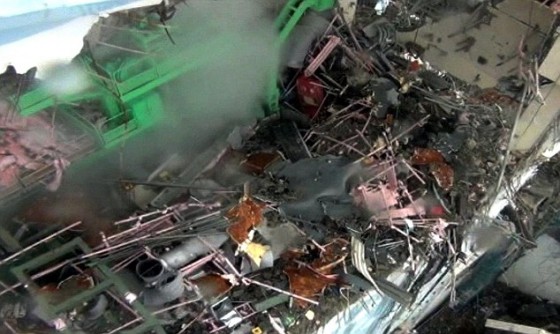
Destroyed reactor: Dead Zone for 100 years?

Three of Japan’s stricken Fukushima nuclear reactors may now be  in a meltdown situation according to nuclear energy experts studying the ongoing situation and the amount of radiation in reactor core water leaking into the sea. What’s worse, workers at the plant who have been exposed to high amounts of radiation are expected to “die within weeks” according to an article in UK based Daily Mail. The only option remaining appears to be to pour large amounts of concrete onto the reactor cores and permanently seal them. This means, the Fukushima plant, like the one at Chernobyl, is for all practical purposes a “dead” plant, which also goes for the geographical area surrounding the plant for a distance of 30 km. “It will take 50 –100 years before the reactor rods will be cool enough to remove” a UK nuclear energy expert said.
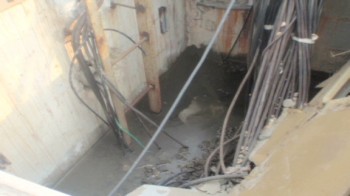
Highly radioactive water

As for the Fukushima nuclear plant, workers known now as the “Fukushima 50” they realize their health situation and made the decision to “die if necessary to save the nation”.

Highly radioactive water continues to flow into the sea through a 20 cm (8 inch) crack in the fuel rod shaft of the No. 2 reactor at the plant.

According to a CNN news article:

“samples of seawater taken 330 meters (361 yards) offshore were said to have levels of iodine-131 at 4,385 times above the standard and cesium-137 at 527 times beyond normal. Experts say the latter radioactive isotope (cesium-137)may be a greater concern because it persists longer, taking 30 years to lose half its radiation.”

In comparison, iodine-131 loses its radioactivity “half life” after only 8 days.  But while iodine-131 does cause thyroid cancer, especially in children; it’s the cesium-137 radiation that is the really bad stuff as it burns your flesh, melts your bones, and kills you quickly.

The radioactivity is now threatening to affect some of Japan’s best fishing grounds if carried by the Oyashio and Kuroshio ocean currents off Japan’s eastern coastline.

Meanwhile, this video news clip reports that executives of the Tokyo Electric Power Company (TEPCO) have been coming under increasing public criticism which has reached the point where they have been receiving death threats and are also having their home addresses and salaries posted on various web blogs. Such sayings as “how to execute a TEPCO exec” and “death is too good for them – they (the executives) should be made to go into the plant” have also been posted.

Taking all of this into account, the Japan nuclear crises is far from being over.  So with this in mind, and with countries like Jordan considering building coastal nuclear power plants in locations like the Red Sea Port of  Aqaba .

At present, the building of such a plant is only being considered as a possible option, along with the construction of the sea water conduit between the Red and Dead Sea to bring sea water to replenish the Dead Sea as well as provide fresh water from desalination and electricity from a planned hydroelectric facility. Jordan’s need for both fresh water, as well as energy may result in its “going alone” to construct at least part of this mammoth engineering project.
Nuclear Positive Thinking?

Depending on which way you look at it, building a nuclear power plant by Aqaba would be the worst option, as a nuclear accident at such a plant could turn this area, including neighboring Eilat, into a “dead zone”.

Israel has also considered building a nuclear power plant, but its location would be in the middle of the desert, if that is reassuring enough.

The main argument about using nuclear energy to generate electricity, as opposed to burning fossil fuels, was made in an OPED on March 23 in the New York Times in which the writer says :

“The 1986 Chernobyl accident will ultimately kill about 10,000 people, mostly from cancer. Coal plants are much deadlier: the fine-particulate air pollution they produce kills about 10,000 people each year in the United States alone.”

While this may be comforting to some people, it certainly isn’t to others, including this writer. And for, sure it isn’t very assuring to the “Fukushima 50” and to thousands of other Japanese. As to people living in this part of the world, it shouldn’t be very reassuring either.

CNN.com

Read More On How Nuclear Energy Plants Could Affect Mid East Environment:

Jordan Uranium Discoveries Could Damage Fragile Ecosystem

Jordan Considers the Nuclear Option Despite Plans for Clean Fuel on the Go

Japan Nuclear Meltdown Will Seriously Affect World Environment

As Japan Nuclear Plants Melt Down, Israel Considers Building “Safe” One in the Desert

Maurice Picow
Maurice Picowhttps://www.greenprophet.com/
Maurice Picow grew up in Oklahoma City, U.S.A., where he received a B.S. Degree in Business Administration. Following graduation, Maurice embarked on a career as a real estate broker before making the decision to move to Israel. After arriving in Israel, he came involved in the insurance agency business and later in the moving and international relocation fields. Maurice became interested in writing news and commentary articles in the late 1990’s, and now writes feature articles for the The Jerusalem Post as well as being a regular contributor to Green Prophet. He has also written a non-fiction study on Islam, a two volume adventure novel, and is completing a romance novel about a forbidden love affair. Writing topics of particular interest for Green Prophet are those dealing with global warming and climate change, as well as clean technology - particularly electric cars.
4 COMMENTS
  1. If this is true, guys, where can this data be accessed? We also have to include deaths and severe ailments of people living in European countries, including Germany, Austria, Hungary, Poland, etc., etc.

    The Japanese death rate and cancer incidents from this disaster is only beginning.

  2. The true cost will be astronomical, i dont see how you can replace nuclear without a radical shift to thin film solar, industrial hemp and genuine conservation. I dont think it will happen anytime soon.

    I pray that the authorities are on red alert from now on, Nuclear is too deadly to take chances.

  3. the chernobyl figure in this article is the industry generated low figure, to be blunt, a lie. The independent science figure is in the range of a million, and still counting.

LEAVE A REPLY

Please enter your comment!
Please enter your name here

TRENDING

Play spogomi the garbage picking sport and win a World Cup

If the future of environmental action looks less like a lecture and more like a pickup game, that might not be a bad thing at all.

Ski Japan and skip the cherry blossoms

apan’s winters reveal a quieter magic far from the cherry blossoms — a landscape of deep snow, mountain silence, and steaming hot springs. From Niseko’s legendary powder in Hokkaido to the Olympic slopes of Hakuba and the ancient baths of Nozawa Onsen, Japan offers some of the world’s most sustainable and culturally rich ski experiences. With efficient bullet-train access, renewable-powered resorts, and geothermal onsens under falling snow, this is how to ski Japan responsibly — where tradition, technology, and climate awareness meet on the same mountain.

Iran’s water mafia and thirst for war leaves the country on brink of being dry

Iran’s Lake Urmia, once the Middle East’s largest saltwater lake, has shrunk by 90 percent due to mismanagement, dams, and drought. As Tehran pours billions into foreign conflicts, water activists face repression at home. The crisis mirrors Syria’s drought-driven unrest, showing how water scarcity can destabilize entire regions.

Octopus falls for the rubber arm trick – time to take them off the menu?

From a sustainability standpoint, this study feeds into a growing conversation around how we value marine life and intelligence in environmental policy. If octopuses exhibit this level of sentient processing, how should that affect the way we fish, farm, or conserve them?

Five Innovative Architecture Firms Building with Bamboo

Bamboo, often referred to as the "green steel" of the future, is quickly gaining popularity as a sustainable alternative to traditional building materials. With its fast growth cycle, minimal environmental footprint, and impressive strength, bamboo is emerging as a game-changing material for the construction industry. Not only is it an eco-friendly choice, but its versatility allows it to be used in everything from flooring to scaffolding, and even entire buildings.

Qatar’s climate hypocrisy rides the London Underground

Qatar remains a master of doublethink—burning gas by the megaton while selling “sustainability” to a world desperate for clean air. Wake up from your slumber people.

How Quality of Hire Shapes Modern Recruitment

A 2024 survey by Deloitte found that 76% of talent leaders now consider long-term retention and workforce contribution among their most important hiring success metrics—far surpassing time-to-fill or cost-per-hire. As the expectations for new hires deepen, companies must also confront the inherent challenges in redefining and accurately measuring hiring quality.

8 Team-Building Exercises to Start the Week Off 

Team building to change the world! The best renewable energy companies are ones that function.

Thank you, LinkedIn — and what your Jobs on the Rise report means for sustainable careers

While “green jobs” aren’t always labeled as such, many of the fastest-growing roles are directly enabling the energy transition, climate resilience, and lower-carbon systems: Number one on their list is Artificial Intelligence engineers. But what does that mean? Vibe coding Claude? 

Somali pirates steal oil tankers

The pirates often stage their heists out of Somalia, a lawless country, with a weak central government that is grappling with a violent Islamist insurgency. Using speedboats that swarm the targets, the machine-gun-toting pirates take control of merchant ships and then hold the vessels, crew and cargo for ransom.

Leopoldo Alejandro Betancourt López Turned Ocean Plastic Into Profitable Sunglasses

Few fashion accessories carry the environmental burden of sunglasses. Most frames are constructed from petroleum-based plastics and acrylic polymers that linger in landfills for centuries, shedding microplastics into soil and waterways long after they've been discarded. Leopoldo Alejandro Betancourt López, president of the Spanish eyewear brand Hawkers, saw this problem differently than most industry executives.

Why Dr. Tony Jacob Sees Texas Business Egos as Warning Signs

Everything's bigger in Texas. Except business egos.  Dr. Tony Jacob figured...

Israel and America Sign Renewable Energy Cooperation Deal

Other announcements made at the conference include the Timna Renewable Energy Park, which will be a center for R&D, and the AORA Solar Thermal Module at Kibbutz Samar, the world's first commercial hybrid solar gas-turbine power plant that is already nearing completion. Solel Solar Systems announced it was beginning construction of a 50 MW solar field in Lebrija, Spain, and Brightsource Energy made a pre-conference announcement that it had inked the world's largest solar deal to date with Southern California Edison (SCE).

Related Articles

Popular Categories