
MENA’s Top Five Ideal Countries For Solar Energy Generation

top-five-mena-sunMENA has enough sun to make everyone smile, so why aren’t we using it?

Until 2008, not one of the six Gulf Cooperation Council countries produced a single kilowatt of renewable energy, so reliant are they on oil and natural gas. And yet three of the six are on Al Masah Capital’s list of the Middle East North African region’s best locations for solar energy generation. That seems like a waste of untapped potential. According to a recent Al Masah report, however, rising renewable energy generation in the region might be the clue to keeping revenue-generating oil exports steady. Egypt, Oman, Saudi Arabia, Jordan, and the UAE have a combined 47 hours of sunshine each day, and satisfy other top specifications including Direct Normal Irradiance (DNI) measured in KWh/m2/y (for CSP), Global Horizontal Irradiance (KWh/m2/y), and percentage of non-arable land.

The following data depicts the amount of solar energy potential in each country:

Country            DNI           GHI          % Non-AL    Hrs of Sunshine

Egypt                2,800         2,450        96.6%           9.3
Oman               2,200         2,050        99.7%            9.6
Saudi Arabia   2,500         2,130         98.2%           9.3
Jordan              2,700         2,310         95.5%           9.3
UAE                  2,200         2,120         97.0%           9.5

Source: UNEP, CIA World Factbook, weather2travel.com, Al Masah research

Egypt has a number of PV and Concentrated Solar Power installations developed by the New and Renewable Energy Authority (NREA) as well as several other government, non-government, and private entities. These projects generate electricity in part for water pumps, desalination, and rural electrification.

Jordan also uses solar energy for water heating. About 25% of the country’s water is heated this way, except according to Al Masah Capital, this is mostly true in rural Jordan. Even so, the National Energy Research Center claims that the country is well on its way to having 10MW of solar Photovoltaic capacity by 2020.

But Oman, Saudi Arabia, and the United Arab Emirates are lagging behind. Despite Masdar City’s 10MW PV plant which provides energy to the city’s ongoing construction,the Masdar company’s plans to build a 100 MW CSP plant in western Abu Dhabi, and small, almost boutique solar projects scattered throughout Abu Dhabi and Dubai (including this new solar-powered ATM!), and millions of crude oil equivalent lies fallow.

Al Masrah reports that every square kilometer of land in the MENA region has the equivalent of 1.5 million barrels of crude oil. More significantly, though we have known this for a while, MENA has enough solar energy potential to satisfy the entire planet’s energy needs.

Although Oman and Saudi have been slow to exploit this resource, dwindling oil reserves – which account for up to 50% of the GCC gross domestic product – will need to be rationed in order to maintain its export value.

As prices for alternative energy technology falls, we will see more MENA countries, including the oil-rich Gulf states, using solar energy to offset their burgeoning energy requirements.

More on Solar Energy in the Middle East:

21st Century Egypt Powers Two Villages Entirely On Solar Energy

It Must Be Peak Oil Driving Saudis To Solar

500 Solar-Powered Recycling Units Promote UAE Conservation

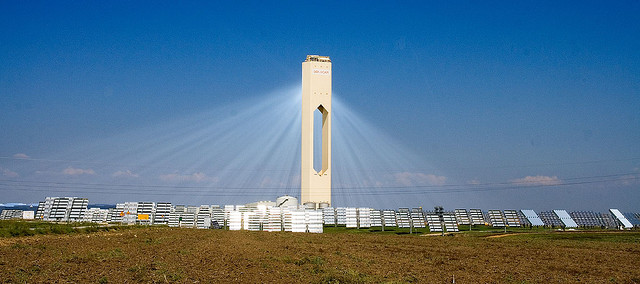
image via barockschloss

Tafline Laylin
Tafline Laylinhttp://www.greenprophet.com
As a tour leader who led “eco-friendly” camping trips throughout North America, Tafline soon realized that she was instead leaving behind a trail of gas fumes, plastic bottles and Pringles. In fact, wherever she traveled – whether it was Viet Nam or South Africa or England – it became clear how inefficiently the mandate to re-think our consumer culture is reaching the general public. Born in Iran, raised in South Africa and the United States, she currently splits her time between Africa and the Middle East. Tafline can be reached at tafline (at) greenprophet (dot) com.
3 COMMENTS
  1. Qatar has 1.5MW under construction or installed, it is researching solar desalination, it developed a solar cooling test stadium run by concentrated solar, it is undertaking a research project with the Freinhoffer Institute to use solar in the hydrocarbon distillation process & it’s building a US$500Mn solar grade polysilicon & yet it does not even get a mention in your report.

    I appears that this report is not accurately portraying solar in the MENA region at all.

  2. Perhaps because Israel doesn’t fall within the top five countries? This isn’t about who has developed the most technology, but who has made the most out of their available sun. PS: you never did email me regarding that project you wanted me to review: [email protected]

  3. why ISRAEL is not included in this U.N. research?israel is the main reason,to my knowledge, of jordan’s and palestinian authority’s leadership in solar hot water heating in the middle east after israel(more than 70% of its houses have solar water heaters by law!)

LEAVE A REPLY

Please enter your comment!
Please enter your name here

TRENDING

Astro uses AI to help procure land for renewable energy

For oil-rich, environmentally vigilant Gulf states, Astro isn’t just another startup story. It is a blueprint for accelerating an energy transition that is now existential, not optional.

Leading Through a Dual-Energy Transition: Balancing Decarbonisation with Energy Security

Experience in one area of the energy industry isn't enough to guarantee readiness across all the others. That's where a structured program like an MBA in energy can come in. Today's advanced curricula explore energy economics, finance, policy, and strategic management alongside the technical subjects. And when pursuing an energy MBA online, professionals can skill up and retrain without having to step out of the labor market -- an important perk at a time when skilled professionals are already in short supply.

What Renewable Energy Means for Long-Term Environmental Planning

In the context of American energy policy (setting the stage for the world as oil prices are in USD), the relevance of renewable energy planning is increasingly evident. Federal agencies are preparing final biofuel blending mandates under the Renewable Fuel Standard, with decisions expected early in 2026 after delays that have left investors and producers in limbo.

EU Ports Still Power Russia’s Arctic Gas Exports Despite Phase-Out Pledge

The findings suggest that rather than declining, Europe’s reliance on Yamal LNG intensified in 2025. Yamal cargoes accounted for 14.3% of the EU’s total LNG imports, equivalent to roughly one in every seven LNG ships arriving at European terminals.The findings suggest that rather than declining, Europe’s reliance on Yamal LNG intensified in 2025. Yamal cargoes accounted for 14.3% of the EU’s total LNG imports, equivalent to roughly one in every seven LNG ships arriving at European terminals.

How wind energy must adapt to a changing climate

For a wind farm designed on 20 years of historical data, this matters. A project that looks profitable today may deliver less energy in the future, on the opposite, way more. Uncertainty replaces confidence.

Qatar’s climate hypocrisy rides the London Underground

Qatar remains a master of doublethink—burning gas by the megaton while selling “sustainability” to a world desperate for clean air. Wake up from your slumber people.

How Quality of Hire Shapes Modern Recruitment

A 2024 survey by Deloitte found that 76% of talent leaders now consider long-term retention and workforce contribution among their most important hiring success metrics—far surpassing time-to-fill or cost-per-hire. As the expectations for new hires deepen, companies must also confront the inherent challenges in redefining and accurately measuring hiring quality.

8 Team-Building Exercises to Start the Week Off 

Team building to change the world! The best renewable energy companies are ones that function.

Thank you, LinkedIn — and what your Jobs on the Rise report means for sustainable careers

While “green jobs” aren’t always labeled as such, many of the fastest-growing roles are directly enabling the energy transition, climate resilience, and lower-carbon systems: Number one on their list is Artificial Intelligence engineers. But what does that mean? Vibe coding Claude? 

Somali pirates steal oil tankers

The pirates often stage their heists out of Somalia, a lawless country, with a weak central government that is grappling with a violent Islamist insurgency. Using speedboats that swarm the targets, the machine-gun-toting pirates take control of merchant ships and then hold the vessels, crew and cargo for ransom.

Leopoldo Alejandro Betancourt López Turned Ocean Plastic Into Profitable Sunglasses

Few fashion accessories carry the environmental burden of sunglasses. Most frames are constructed from petroleum-based plastics and acrylic polymers that linger in landfills for centuries, shedding microplastics into soil and waterways long after they've been discarded. Leopoldo Alejandro Betancourt López, president of the Spanish eyewear brand Hawkers, saw this problem differently than most industry executives.

Why Dr. Tony Jacob Sees Texas Business Egos as Warning Signs

Everything's bigger in Texas. Except business egos.  Dr. Tony Jacob figured...

Israel and America Sign Renewable Energy Cooperation Deal

Other announcements made at the conference include the Timna Renewable Energy Park, which will be a center for R&D, and the AORA Solar Thermal Module at Kibbutz Samar, the world's first commercial hybrid solar gas-turbine power plant that is already nearing completion. Solel Solar Systems announced it was beginning construction of a 50 MW solar field in Lebrija, Spain, and Brightsource Energy made a pre-conference announcement that it had inked the world's largest solar deal to date with Southern California Edison (SCE).

Related Articles

Popular Categories