Could a Political Crisis in Saudi Arabia Spur a World Shift to Green Fuel?

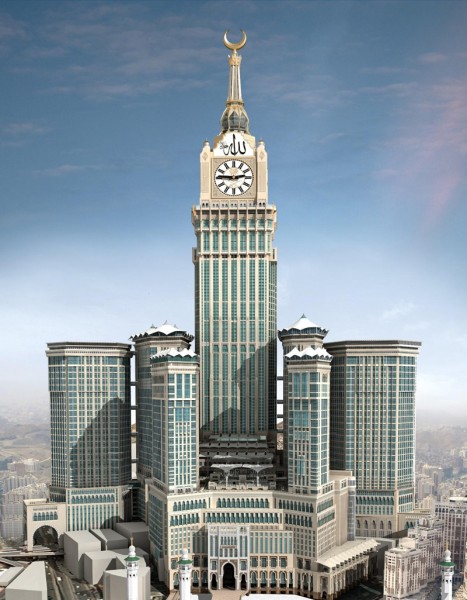
Can commercial monstrosities like these in Mecca cause political upheaval in Saudi Arabia?

The Kingdom of Saudi Arabia has always had its share of enemies. This is especially true in these times, when both the Islamic Republic of Iran and the Al Qaeda terrorist organization have both expressed great interest in replacing the monarchy there with a government more receptive an “Islamic democracy” as is now the case in Iran. The Saudi royal family has had close relations with the United States and other Western countries ever since the 1930s, when it was concluded that American oil reserves would not last forever. The recent political upheavals in  the Middle East, beginning with Tunisia, carrying on to Egypt, and now threatening Jordan and what’s left of non-Islamic elements in Lebanon is undoubtedly of great concern to the Saudi extended Royal Family.

Their many palaces, luxurious life-styles and other benefits of their oil wealth are now being threatened by elements practicing the same religious fundamentalism that they themselves have proclaimed to be the historic protectors of.  Besides sitting on what is said to be 70 percent of the world’s readily available oil reserves, the Saudis are also in charge of maintaining and preserving Islam’s holiest sites in Mecca and Medina.

These sites have recently come under harsh criticism due to the construction of  new grandiose buildings in the holy sites, including a luxury hotel complex and a huge clock tower that when completed will be grander than London’s Big Ben.

It hasn’t taken an event such as Egypt’s present political implosion to cause economists and government officials in Western countries to worry about the implications of the Saudi oil fields falling into to wrong hands. The world oil crisis of 1974, as well as a number of mini oil crises events since then, including the 1991 Gulf War, has indicated that the non-availability of  Saudi Arabian crude oil would cause Western and Eastern economies – especially China to go into an economic tailspin.

The Saudis, despite their extreme practice of Wahhabi Islam are still tied to West, especially the USA in an unbroken  relationship that goes back to when US President Franklin Roosevelt had his first meeting with Saudi King Ibn Saud.

Despite all of the efforts being made to promote solar, wind and other forms of renewable energy, including efforts by the Saudi government itself, current realities indicate that fossil fuels will be around for many years to come.

A new oil crises could spur a faster development, and implementation of renewable energy to generate electricity, and a more serious move towards alternative fuels for cars and other vehicles. These fuels include electricity produced from solar energy power plants, hydrogen, alcohol-based fuels like methanol — made from coal, natural gas and biomass, and ethanol made from alcohol derived from plants or algae.

Without oil, the economies of countries like Saudi Arabia would be quite different than they are today; and perhaps not so much in the limelight as those who do possess substantial oil reserves. For their part, under the present set of circumstances, all the Saudi royal family can do is wait to see how events turn out in Egypt – events that could well determine their own destiny.

Read more on Saudi Arabian energy and commercialization issues:

Saudi Arabia Considers Solar Energy to Fuel Desalination Plants

Has Saudi Arabia Seen the Renewable Energy Light?

Luxury Architecture in Mecca: Has the Hajj Lost its Egalitarian Spirit?


Maurice Picow
Maurice Picowhttps://www.greenprophet.com/
Maurice Picow grew up in Oklahoma City, U.S.A., where he received a B.S. Degree in Business Administration. Following graduation, Maurice embarked on a career as a real estate broker before making the decision to move to Israel. After arriving in Israel, he came involved in the insurance agency business and later in the moving and international relocation fields. Maurice became interested in writing news and commentary articles in the late 1990’s, and now writes feature articles for the The Jerusalem Post as well as being a regular contributor to Green Prophet. He has also written a non-fiction study on Islam, a two volume adventure novel, and is completing a romance novel about a forbidden love affair. Writing topics of particular interest for Green Prophet are those dealing with global warming and climate change, as well as clean technology - particularly electric cars.
3 COMMENTS
  1. YEAH RIGHT!

    Another case of those living there put on the defensive side. I’m referring to Adam, not the guy who wrote this piece!

    There’s just too much info about this country that points out a lot of things wrong with the society there. And those connected with the Saudi royal family don’t want to ruin a good thing – for them.

  2. This has to be the dumbest article iv read in a long time. I’ve lived in saudi arabia all my life and yes people dislike the commercial buildings around Makkah but we are still happy with the monarchy.

    clearly the article couldn’t conduct actual research on what saudi citizens think and therefore made his/her own ill-founded theories and assumptions!

LEAVE A REPLY

Please enter your comment!
Please enter your name here

TRENDING

Saudi Arabia’s grand mufti Sheikh Abdulaziz bin Abdullah al-Sheikh dies at 84

As Saudi Arabia accelerates its transformation, the passing of its top cleric who memorized the Qu'ran at age 10 underscores the changing face of religious authority and perhaps tolerance in a kingdom increasingly defined by megaprojects, oil wealth, and the House of Saud’s push to rebrand itself for a post-oil world. 

Iran’s water mafia and thirst for war leaves the country on brink of being dry

Iran’s Lake Urmia, once the Middle East’s largest saltwater lake, has shrunk by 90 percent due to mismanagement, dams, and drought. As Tehran pours billions into foreign conflicts, water activists face repression at home. The crisis mirrors Syria’s drought-driven unrest, showing how water scarcity can destabilize entire regions.

Inside the Kaaba: Islam’s Hidden Heart

We've all heard about Mecca, but what does it look like inside the black cube that Muslim pilgrims walk around? We take a peek inside.

Creamy Eggplant Soup Recipe

Eggplant seems an unlikely soup ingredient. But blended with vegetable stock, herbs, and cream, the shiny purple vegetable makes a creamy soup full of Middle-Eastern flavors.

Six “Green” Reasons To Drink Camel’s Milk

With 5 times the amount of Vitamin C in camel's milk, and full of iron, camel's milk needs no nutritional help. It has a shelf life of 5 days before pasteurization, after which it will survive for up to 3 weeks. Camel's milk is just as versatile as other milk, used as it is to produce low-fat varieties of cheese, chocolate, and a fermented delicacy that is used in areas that lack refrigeration.

Qatar’s climate hypocrisy rides the London Underground

Qatar remains a master of doublethink—burning gas by the megaton while selling “sustainability” to a world desperate for clean air. Wake up from your slumber people.

How Quality of Hire Shapes Modern Recruitment

A 2024 survey by Deloitte found that 76% of talent leaders now consider long-term retention and workforce contribution among their most important hiring success metrics—far surpassing time-to-fill or cost-per-hire. As the expectations for new hires deepen, companies must also confront the inherent challenges in redefining and accurately measuring hiring quality.

8 Team-Building Exercises to Start the Week Off 

Team building to change the world! The best renewable energy companies are ones that function.

Thank you, LinkedIn — and what your Jobs on the Rise report means for sustainable careers

While “green jobs” aren’t always labeled as such, many of the fastest-growing roles are directly enabling the energy transition, climate resilience, and lower-carbon systems: Number one on their list is Artificial Intelligence engineers. But what does that mean? Vibe coding Claude? 

Somali pirates steal oil tankers

The pirates often stage their heists out of Somalia, a lawless country, with a weak central government that is grappling with a violent Islamist insurgency. Using speedboats that swarm the targets, the machine-gun-toting pirates take control of merchant ships and then hold the vessels, crew and cargo for ransom.

Leopoldo Alejandro Betancourt López Turned Ocean Plastic Into Profitable Sunglasses

Few fashion accessories carry the environmental burden of sunglasses. Most frames are constructed from petroleum-based plastics and acrylic polymers that linger in landfills for centuries, shedding microplastics into soil and waterways long after they've been discarded. Leopoldo Alejandro Betancourt López, president of the Spanish eyewear brand Hawkers, saw this problem differently than most industry executives.

Why Dr. Tony Jacob Sees Texas Business Egos as Warning Signs

Everything's bigger in Texas. Except business egos.  Dr. Tony Jacob figured...

Israel and America Sign Renewable Energy Cooperation Deal

Other announcements made at the conference include the Timna Renewable Energy Park, which will be a center for R&D, and the AORA Solar Thermal Module at Kibbutz Samar, the world's first commercial hybrid solar gas-turbine power plant that is already nearing completion. Solel Solar Systems announced it was beginning construction of a 50 MW solar field in Lebrija, Spain, and Brightsource Energy made a pre-conference announcement that it had inked the world's largest solar deal to date with Southern California Edison (SCE).

Related Articles

Popular Categories