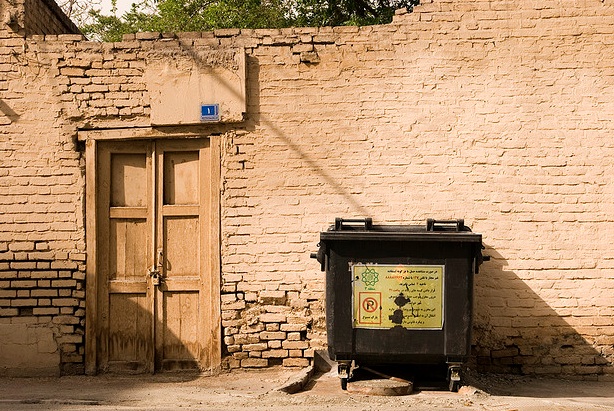
High Waste Generation and Low Level Recycling in Iran

Iranians throw our about a half kilo of trash, per person, per day. That’s high for a developing country.

There is a growing rate of waste generation in Iranian cities. According to the R&D Deputy of the Environment and Sustainable Development Committee of Municipality of Tehran, every resident of Tehran produces 320 kilograms of solid waste per year. In other words, every person produces 6 times more trash than his/her own body weight. This amount has had a growth of 1.1 percent between the year 2001 and 2006. Also the average waste generation in Esfahan, the third biggest city of Iran, is between 0.55 to 0.6 kilogram of trash per person, per day.

Although this statistic sounds worrying, there is still a huge difference between waste production in Iran and in the more developed and western countries. In America it’s about twice the amount of Iran. In 2000, the record in municipal waste generation in the US was 760 Kgs per person per year; Australia  was 690 Kgs, the United Kingdom was 560 Kgs and for comparison Japan was 410 Kgs. But while the waste generation (Kg/capita/day) is estimated to be 0.4 to 0.9 Kg/per capita/per day in low-income countries, 0.5 to 1.1 in medium-income countries, and 1.1 to 5 for high-income countries, the figure is 0.66 for Iran. Quite high. Of course the statistics seems reasonable but using recycling methods and the percent of recycled waste in countries like Germany and Japan is quite different than in low waste generating countries. Strategies like paying for transferring the trash in Japan pushes people to recycle the trash on their own. Not the case in Iran.

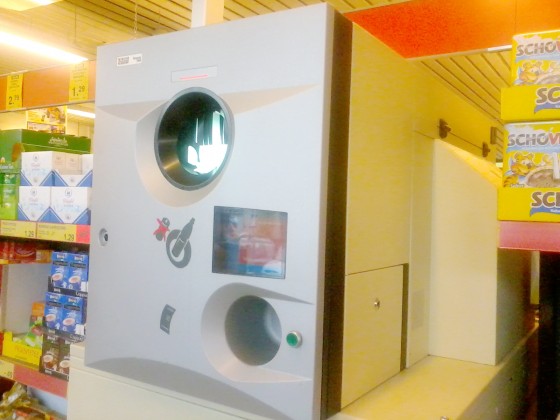
Measures are done to recycle the urban waste of Tehran in a sustainable way. Yet, 90% of the waste is buried and only 2% is recycled. There is still a long way to reach the percentage of recycling in countries like Austria with about 60% and United Kingdom with 17.7%. Countries like Iran need more solutions for recycling urban waste like the bottle recycler I’ve pictured below.
Read more on recycling in the Middle East:

Canadian Man Revolutionizes Sharjah, UAE With Recycling

Lebanon Launches New Recycling Campaign, “Think Before You Throw”

Above image via parapet

Mehrdad Parsipour
Mehrdad Parsipourhttp://www.greenprophet.com
Mehrdad Parsipour is an urban researcher who is based in Germany. He is originally from Iran and is interested in the traditional urbanism and architecture of Iran and Middle East. Mehrdad’s other research interests are western traditional urban development trends, Islamic cities, and sustainable urban forms, and finally the environment. Since 1997 he has been working in the field of civil engineering, and also urban and regional planning.
2 COMMENTS

Comments are closed.

TRENDING

From Pilot Plant to Global Stage: How Aduro Clean Technologies’ 2026 Expansion Signals a Turning Point for Chemical Recycling Investors Like Yazan Al Homsi

The company's Next Generation Process (NGP) Pilot Plant in London, Ontario, has officially moved into initial operating campaigns, generating the kind of structured, repeatable data that separates laboratory promise from commercial viability.

Australian camels fly on a plane to Saudi Arabia

Australia has the largest population of feral camels in the world. Some get repatriated to Saudi Arabia.

Sustainability That Sells: How Profit and Purpose Come Together in the Hive

Whether you are a commercial grower, hobbyist beekeeper or retail equipment supplier, this system opens a new income stream with minimal environmental impact.

Play spogomi the garbage picking sport and win a World Cup

If the future of environmental action looks less like a lecture and more like a pickup game, that might not be a bad thing at all.

Urban miner Sortera raises $45 million USD to pull aluminum from the scrap pile

Sortera Technologies, founded in 2020 by Nalin Kumar and Manuel Garcia, is emerging as a major U.S. circular-industry player. Led by CEO Michael Siemer, the company uses AI and advanced sensors to turn scrap metal into high-value aluminum alloys. Its new ~$45 million funding round signals investor appetite for industrial decarbonisation—where emissions cuts come not from PR-friendly solar installs, but from upgrading the materials that power EVs, solar frames, and construction.

Should You Invest in the Private Market?

startustartup Unlike public stock exchanges, which offer daily trading, strict...

How to build a 100-year-company

KongĹŤ Gumi is a Japanese construction company, purportedly founded in 578 A.D., making it the world's oldest documented company. What can we learn about building sustainable businesses from them?

From Pilot Plant to Global Stage: How Aduro Clean Technologies’ 2026 Expansion Signals a Turning Point for Chemical Recycling Investors Like Yazan Al Homsi

The company's Next Generation Process (NGP) Pilot Plant in London, Ontario, has officially moved into initial operating campaigns, generating the kind of structured, repeatable data that separates laboratory promise from commercial viability.

How AI Helps SaaS Companies Reduce Repetitive Customer Support Work

SaaS products are designed for large numbers of users with different levels of experience, and also in renewable energy.

Pulling Water from the Air

Faced with water shortage in Amman, Laurie digs up...

Turning Your Energy Consultancy into an LLC: 4 Legal Steps for Founders in Texas

If you are starting a renewable energy business in Texas, learn how to start an LLC by the books.

Tracking the Impacts of a Hydroelectric Dam Along the Tigris River

For the next two months, I'll be taking a break from my usual Green Prophet posts to report on a transnational environmental issue: the Ilısu Dam currently under construction in Turkey, and the ways it will transform life along the Tigris River.

6 Payment Processors With the Fastest Onboarding for SMBs

Get your SMB up and running fast with these 6 payment processors. Compare the quickest onboarding options to start accepting customer payments without delay.

Related Articles

Popular Categories