
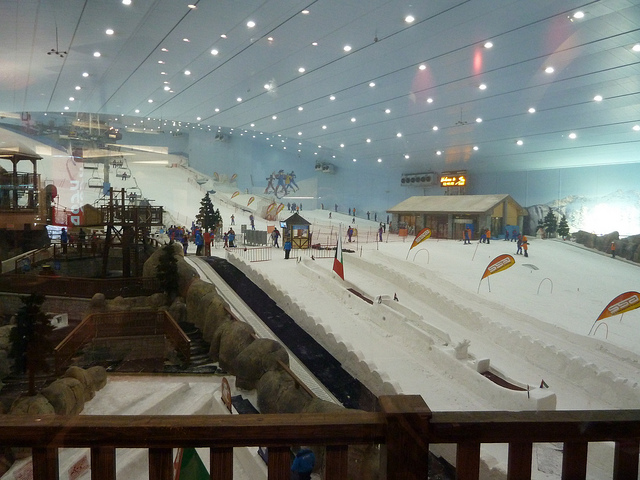

 Can you guess where this winterland is located? In Dubai! In the middle of the desert.
In a recent post, Pablo from Treehugger (a site we deeply admire) concluded that Ski Dubai’s indoor ski slope is not that bad. He based this conclusion on a beautifully calculated analysis of the facility’s energy consumption compared to what people would spend to travel instead to the Alps.
The trouble is, Pablo forgot to address Dubai’s infamous water shortages. A lot of energy goes into desalinating Dubai’s saltwater to produce fresh water, which, according to Ski Dubai, is necessary to produce snow. Add to Pablo’s calculations the energy required to produce the water, and the irresponsibility of using so much water in a country as desperate for it as Dubai, and Ski Dubai looks less and less attractive.
Pablo’s an expert environmental consultant and I’m not, but I’ve put together some numbers to add to his.
He reports that Ski Dubai produces 30 tonnes of fresh snow a day. It’s not possible to convert tonnes into gallons, so I converted tonnes to pounds (there are roughly 66, 139 pounds in 30 tonnes), and converted those into gallons. If I’ve done this correctly, that means that Ski Dubai uses 8,500 gallons each day just to produce the snow.
The average amount of energy required to produce 1,000 gallons of water is 15-23 kWh. That amounts, if I’m right, to an additional 62 MWh each year. Pablo estimated that the fancy ski slope in the middle of the desert uses 255 MWh annually, or the equivalent of 900 round trip air tickets from Dubai to Munich. I don’t know how he got that number, but we’ll have to add roughly 200 plane rides to his.
Still, according to his argument, thousands of people who might otherwise be tempted to travel to the Alps are being satisfied by the Dubai slopes and therefore those emissions aren’t so bad.
But, are they really satisfied? What’s to say that Ski Dubai doesn’t make people who should otherwise get used to their desert lifestyle crave the real thing? Not only that, but Pablo also assumes that it’s every person’s god-given right to go skiing.
I hate to be the frumpy fun-killer, but it’s exactly that kind of attitude that causes so much trouble. People DO believe that even though they live in the middle of the desert they should be able to ski – even though nature never intended it to be this way.
Our constant desire to manipulate deserts and mountains and oceans to fit our costly desires has been our climatic downfall to date. If we want change, we’ll have to find a more sensible way.
:: Treehugger
More on Environmentally Crazy Schemes From The Emirates:
Global Warming Message Goes Awry at UAE Water Park
Dubai Inaugurates World’s Tallest Building – Burj Khalifa
Nuclear-Powered Water For The UAE?
image via Doogsta




Thanks Patrick. That is an important detail…
I especially appreciate your comment about criticizing other countries for things are that are done regularly in the west; that is a very valuable point.
Certainly there is enough solarity in Dubai to convert their roof to a solar roof… perhaps you could pitch this idea to them??
Hi there. I’ve been researching indoor snow centres for 20 years and run the site snow365.com on the subject. I saw Pablo’s piece and yours and I think you are both making fair points. It is a detail really but the water used to make the snow is pretty much used once and kept in a closed circuit. You don’t need to use fresh every day. It slowly melts over a period of many months and is then reused, they don’t need to keep using more water. I am not a defender of Ski Dubai and agree your wider point about it not being a good idea to make snow in the desert. On the other hand there are 60 other indoor snow centres around the world in 25 countries and I guess they use similar amounts of energy, but fewer people are arguing they should not be built in the US, Europe, Japan, China. I think it would be good if those of us in the West (assuming you are) target our own high energy projects and set examples to the rest of the world. Currently we seem to be the worst then expect other countries not to take advantage in the way we have once they have their opportunity. The indoor snow centres do have to be very energy efficient or they go bust due to the power bills. One long term positive and possible example for future living is that these places have huge roof areas which could be used to gather enough solar energy to power the refrigeration making them ‘carbon neutral’ It’s not happened yet but people are talking about it. A few of the indoor centres in The Netherlands carbon offset their energy use.