

As oil supplies decline, Saudi Arabia’s own electricity is becoming expensive. By one estimate, it’s as much as 25 cents a kilowatt-hour, at wholesale. Saudi Arabia gets all of its electricity from the oil field. Flared gas provides 45%, heavy fuel oil provides 13%, diesel; 22% and crude provides the remaining 20%. So as oil prices rise, its domestic desalination and electricity costs rise too.
But the kingdom has solar insolation that is the envy of the world. So the Governor of the state power company ECRA (Saudi Electricity and Cogeneration Regulatory Authority) is hoping to get state approval for incentives to help solar begin to power some of the kingdom’s 50,000 megawatt electricity needs, according to ArabNews.
Abdullah Al-Shehri of ECRA says that with renewable energy incentives to spur development, as much as 10% of the kingdom’s electricity could be supplied by solar energy and other renewable sources by 2020.
“I think any number can be achieved, provided there is enough support for it from studies, analysis,” he told the Reuters Middle East Summit in Riyadh. Earlier this month, the director of new business evaluation of state-owned Aramco suggested that the kingdom is capable of growing a solar industry. But it depends on how high oil prices go, triggering price signals.
As head of ECRA he sees a demand that is rising at 8% a year. The kingdom uses one tenth of its oil for its own electricity use. If he is successful in his mission, incentives like state funding and a Feed-in Tariff would start as soon as next year.
Considering that Saudi Arabia is the Saudi Arabia of oil, the kingdom pays an extraordinarily high price for this oil-based electricity. But when oil is $80 a barrel, it can’t be wasted at home. So state electricity there now costs the equivalent of paying 25 cents a kilowatt-hour, making its wholesale price higher than retail electricity costs in most places.
At least that is the estimate of Vahid Fotuhi, director of BP Solar for the Middle East.
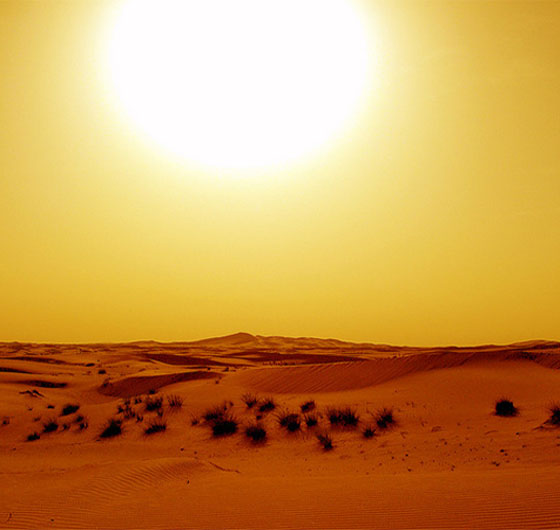
At prices like that, plus an electricity demand that rises 8% a year – and a complete dependence on a dwindling oil supply – more solar companies like BP Solar should be eyeing the vast reaches of prime solar land in the desert.
Even my solar power off my own roof in California, with far less insolation than the Arabian desert, is only 12 cents a kilowatt-hour, and that’s at retail.
I’m thinking the sun in the Saudi Arabia of solar is going to be able to produce power for the Saudis for less than 25 cents a kilowatt-hour!
Image: Donna Corless



To power water desalination with oil based fuels is uneconomical. It’s a recipe for dirty, expensive water. The only reason some Arab states can do it is because they cost estimate their fuels for desalination at the price as pumped from the ground. This is lost revenue. If they priced according to the market, they would realize that it is likely cheaper to buy gold than clean water. They do have a lot of sunlight though, a switch in energy there would bring the costs down significantly.
I think you are on to something, but the truth is the opposite of what you think.
With enhanced oil recovery, the Saudi’s oil reserves expand dramatically. EOR requires more input energy. The Saudis are positioning themselves to eventually use solar as the input energy.
Those – Saudi solar means many more years of happy motoring. Sorry if you were expecting otherwise.
We should clarify that the $0.25/kWh only applies to the cost of producing electricity using diesel-fired generators in remote locations during peak summer demand period. It applies to less than 1% of the electricity production in Saudi. Overall, it costs Saudi an average of $0.06/kWh to produce electricity using conventional fuels.
The cost of producing solar power in Saudi is roughly $0.20/kWh.
Therefore, it makes sense why Saudi has not rushed to embrace solar yet. As the price of solar power continues to go down we will certainly see more solar plants popping up all over Saudi. But, like with most things in the Gulf, this will take some time.
however , next door in Oman there appears to be minimal solar power , wave power or wind power – all of which are here in abundance. Oman appears to be relying on gas imports from near neighbours to power heavy industry and local electricity plants.
More importantly, the Saudi’s are drilling offshore now…. Scary. I’ve been preparing my family for Peak Oil for 4 years now and made some helpful videos for people interested… I attached one of them here.
http://www.youtube.com/watch?v=hHmXhgBhtWk
MrEnergyCzar