
New Design Approved For Jerusalem’s Giant Glass Museum Of Tolerance

museum-of-tolerance jerusalem
The glassy new plans for the Museum of Tolerance reflect badly on the nearby environment.

During the festival of Sukkot, Jews worldwide are camping out in their organic Sukkahs, touching the earth, reconnecting. Karin wrote about sustainable booths all over Jerusalem, while another, snazzier Sukkah is currently being displayed on Manhattan’s Union Square.

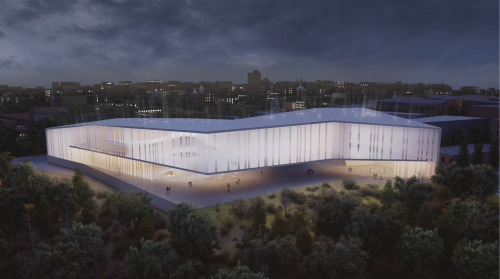
Contrasted with these structures steeped in tradition, the new, cheaper plans for the Museum Of Tolerance in Jerusalem seem glaringly unwholesome. The back end of the six-storey will be covered in glass from “top to bottom” according to the LA Times, though some architects suggest glass is among the least efficient building materials to use in the Middle East, and caused controversy in the past since it is being built on the site of a former Muslim cemetery.

“This museum is more than a building, it is an eternal message of understanding, togetherness, and unity.” – Shimon Peres, President of Israel.

The ghosts of the past

Israel’s Supreme Court approved the building project provided that Israel’s Antiquities Authority were consulted to ensure that any remains recovered during construction would be appropriate relocated, and there is supposed to be a barrier between the graves and the building’s foundation, wrote David Ng.

The original plans drafted by Frank Gehry had to be discarded as a result of the economic slowdown. Mr. Gehry’s museum would have cost $250 million to build, but in November, 2009, the Simon Wiesenthal Center’s Board of Trustees decided that such plans inadequately reflect today’s economic realities.

“After a nearly three year delay due to court proceedings in Israel and, given the severity of last year’s financial crisis, the Center has made the decision to design a more modest project that can be fast-tracked and completed within a three to four year time frame,” they announced on their website. tolerance-museum-jerusalem
Moving on

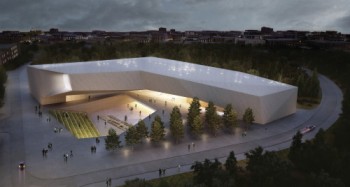
The new six storey building, which will in part face Independence Park in Jerusalem, was conceived by Israeli Chyutin Architects, and includes three storeys below ground and three above ground, according to the paper.

This 150,000 to 160,000 square foot building will accommodate exhibition space, a theater and educational center, as well as a garden and amphitheater outside.

The new price tag is $100 million, 50% of which has already been raised according to Rabbi Marvin Hier who is the founder and dean of both the Simon Wiesenthal Center and the Museum of Tolerance.

Solar cooker

Chyutin Architects are the same team behind the Haifa Court House, the Jerusalem Court House, and the Givataim Theater.

The museum’s environmental impact comes into question as a result of the liberal use of glass which is supposed to make the building warm and inviting, according to Mr. Ng.

“Glass is designed to trap heat,” Fortune 500 architect Romi Sebastian told Gulf News; he especially criticizes the use of this building in the Middle East (particularly in Dubai), where solarity is high. He says it acts like a “solar cooker,” and that we should instead deflect as much heat as possible.

Glass also requires high cooling loads, otherwise the temperatures inside would be unbearable.

:: LA Times

More architecture news from the Middle East:
Tel-Aviv’s $60 Million Eco-Office Tower A Go

Artocos: Architectural “Musical” Activism in Dubai

Israel’s New “Green” Synagogue to Raise Environmental Awareness

Tafline Laylin
Tafline Laylinhttp://www.greenprophet.com
As a tour leader who led “eco-friendly” camping trips throughout North America, Tafline soon realized that she was instead leaving behind a trail of gas fumes, plastic bottles and Pringles. In fact, wherever she traveled – whether it was Viet Nam or South Africa or England – it became clear how inefficiently the mandate to re-think our consumer culture is reaching the general public. Born in Iran, raised in South Africa and the United States, she currently splits her time between Africa and the Middle East. Tafline can be reached at tafline (at) greenprophet (dot) com.

LEAVE A REPLY

Please enter your comment!
Please enter your name here

Hot this week

The Christ’s thorn (sidr tree) is also a well-known folk medicine

Christ’s thorn jujube (Ziziphus spina-christi) also known as the sidr tree is a real, identifiable tree native to the Middle East, and it appears—directly or indirectly—in Islam, Judaism, and later Christian tradition. The connections between the three faiths are not theological agreements but overlapping uses, names, and symbolic associations rooted in the same landscape.

Farm To Table Israel Connects People To The Land

Farm To Table Israel is transforming the traditional dining experience into a hands-on journey.

The Lote Tree of the Utmost Boundary, explained

In Islamic tradition, there is a point where creation ends — a boundary that marks the limit of what any created being can reach. That boundary is called Sidrat al-Muntahā, often translated as “the Lote Tree of the Utmost Boundary.”

The Air Tea Kettle creates a new way to meet plants and herbalism

Air Tea is a new technology. Instead of drinking tea, you inhale herbal vapor through warm air extraction. There is no water and no combustion. The warm air releases essential oils that are often lost in hot water and digestion.

Why Health Systems Are Reaching a Turning Point

Health emerges from a continuous energy and material flow from water through food to human physiology. Technical energy systems support this cycle through water treatment, agriculture, and infrastructure.

Topics

The Christ’s thorn (sidr tree) is also a well-known folk medicine

Christ’s thorn jujube (Ziziphus spina-christi) also known as the sidr tree is a real, identifiable tree native to the Middle East, and it appears—directly or indirectly—in Islam, Judaism, and later Christian tradition. The connections between the three faiths are not theological agreements but overlapping uses, names, and symbolic associations rooted in the same landscape.

Farm To Table Israel Connects People To The Land

Farm To Table Israel is transforming the traditional dining experience into a hands-on journey.

The Lote Tree of the Utmost Boundary, explained

In Islamic tradition, there is a point where creation ends — a boundary that marks the limit of what any created being can reach. That boundary is called Sidrat al-Muntahā, often translated as “the Lote Tree of the Utmost Boundary.”

The Air Tea Kettle creates a new way to meet plants and herbalism

Air Tea is a new technology. Instead of drinking tea, you inhale herbal vapor through warm air extraction. There is no water and no combustion. The warm air releases essential oils that are often lost in hot water and digestion.

Why Health Systems Are Reaching a Turning Point

Health emerges from a continuous energy and material flow from water through food to human physiology. Technical energy systems support this cycle through water treatment, agriculture, and infrastructure.

Sustainability That Sells: How Profit and Purpose Come Together in the Hive

Whether you are a commercial grower, hobbyist beekeeper or retail equipment supplier, this system opens a new income stream with minimal environmental impact.

The Fitness App Revolution: Building the Future of Wellness Through Strategic Development

In an era where smartphones are ubiquitous and health consciousness is at an all-time high, the fitness industry has undergone a radical digital transformation. Fitness applications have moved far beyond simple pedometers, evolving into comprehensive wellness platforms that serve as personal trainers, nutritionists, and community hubs right in our pockets.

A Brief History of Basil From India to Italy

Beloved, fortunate, sweet, and royal; an herb with a long and storied history in Asia and across the world. Called by many names, basil has featured in previous Green Prophet articles, so enjoy another serving, a brief history of basil.

Related Articles

Popular Categories