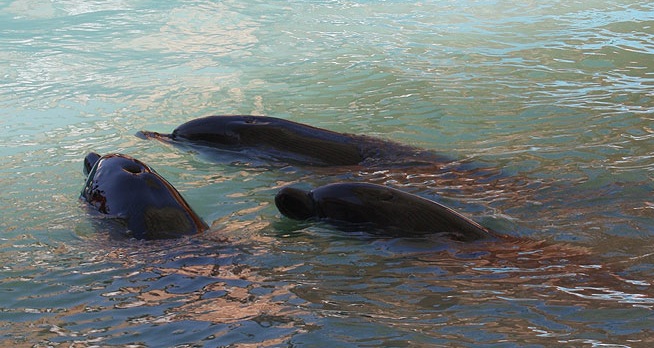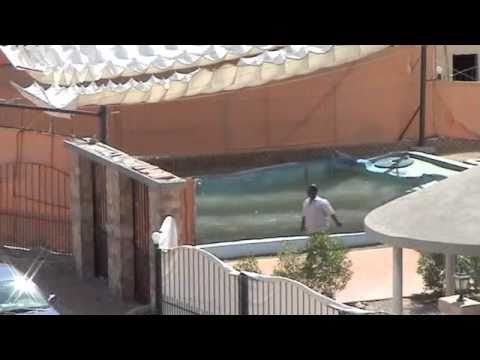
4 dolphins imprisoned in Egyptian backyard pool

dolphin egyptA Brit discovers captive dolphins in foul conditions in Egypt.

On the Red Sea, Hurghada is a popular Egyptian tourist destination. It is here that Chilean businessmen Fernando Fischmann intends to build an artificial lagoon, and also where an oil spill earlier this year sent people with a vested interest in attracting tourists scrambling to clean up the beaches.

Although the beaches were cleaned, the Hurghada Enviornmental Protection and Conservation Association (HEPCA) raised concerns that elsewhere, out of sight, remnants of the spill were left unattended. That same organization has now released reports that four Japanese dolphins are being held in a tiny swimming pool, until a new dolphinarium is built in Hurghada. 

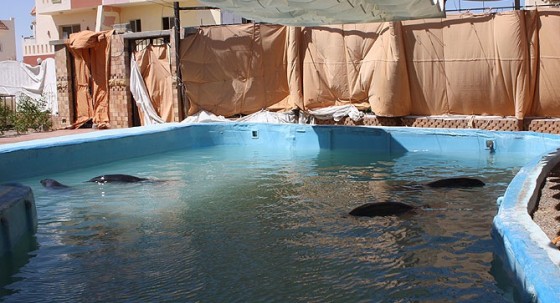
After receiving a tip from members of the public, the organization visited a villa where the common bottlenose dolphins were observed in a pool 1/10 the size that is considered acceptable.

The two males and two females are roughly three to four meters long and were brought to Egypt from Japan. However, Egyptian law mandates at least 105 days in quarantine to ensure that the animals are free of disease.
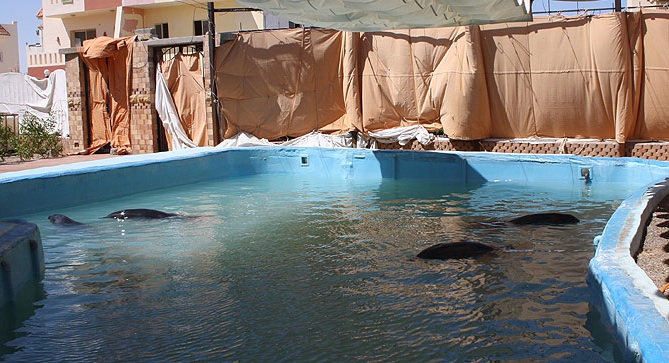

The pool, according to Wildlife Extra (a now defunct site), was filthy, most likely because it does not have an adequate filtration system to cope with the waste produced by the four dolphins. Visibility was apparently no more than 20 cm.

Wildlife Extra reported:

According to the Brazilian Institute for the Environmental and Natural Renewable Resources a minimum of 14 metres horizontal distance, a minimum depth of six metres and a minimum volume of 1600 m³ is specifies for two animals. The volume for four animals should be at least 2400m³. The HEPCA team found the four dolphins in a pool measuring nine metre by nine metre pool that was just four metres deep – a volume of just 324m³, only slightly above one tenth of the minimum required size.

It is unknown whether the dolphins were born in captivity or if they are wild. And releasing them into the Red Sea is out of the question since it is not their natural habitat. Not only would they put the local bottlenose dolphin population at risk of genetic and disease contamination, but if the dolphins are not wild their survival is far from guaranteed.

According to WE, the best that can be achieved is to improve the dolphins’ present conditions: provide more space and cleaner water. Either the pool will be extended or a new facility must be built for them.

“After the Red Sea Governorate learned about the four dolphins, they officially defined their position against holding dolphins in captivity within the borders of the Red Sea governorate. We hope that this will include the cancellation of the planned dolphinarium in Hurghada, before it opens its gates.” wrote WE.

Presently, however, Egypt has no laws governing dolphin capture.

A spokesman for HEPCA told HE: Egyptian waters offer incredible opportunities to see wild marine animals in their natural environment, including one of the most famous marine protected area in the region, the so-called Dolphin House, Samadai Reef. Egypt is actively working towards the conservation of its national environmental treasures; we don’t want the Egyptian Red Sea to send out a contradictory message allowing the captivity of intelligent, social marine mammals, such as dolphins. We will lobby vigorously, for the passing of new laws to make the Red Sea Governorate free from this heartbreaking, inhumane business.

Tafline Laylin
Tafline Laylinhttp://www.greenprophet.com
As a tour leader who led “eco-friendly” camping trips throughout North America, Tafline soon realized that she was instead leaving behind a trail of gas fumes, plastic bottles and Pringles. In fact, wherever she traveled – whether it was Viet Nam or South Africa or England – it became clear how inefficiently the mandate to re-think our consumer culture is reaching the general public. Born in Iran, raised in South Africa and the United States, she currently splits her time between Africa and the Middle East. Tafline can be reached at tafline (at) greenprophet (dot) com.
5 COMMENTS

Comments are closed.

TRENDING

Jordan’s $6 Billion Aqaba–Amman Desalination Project from the Red Sea Moves Forward

In 2025, the Jordanian government signed agreements with a consortium led by Meridiam and SUEZ, alongside VINCI Construction and Orascom Construction. Under a 30-year concession agreement, the consortium will design, build, finance, operate, and maintain the system before transferring it back to the Jordanian government. The total investment is estimated at approximately $6 billion USD.

The Saudi Startup Turning Desalination’s Toxic Waste Into Its Own Disinfectant

For millennia, the Middle East's water crisis seemed an immutable fact of geography — a region defined as much by what it lacked as by what lay beneath its sands. Today, a convergence of plummeting solar costs, advancing membrane technology, and hard-won engineering expertise is rewriting that story.

Ethiopians are Looking to Somaliland for Red Sea Access as Global Powers Move In

Somaliland, for its part, has operated as a de facto independent state since 1991. It has its own government, elections, currency, and security forces. It’s often described as one of the more stable and democratic political systems in the region, despite never being formally recognized internationally. 

Peace hospital opens between Jordan and Israel

The proposed medical centre, described by Emek HaMaayanot Regional Council head Itamar Matiash as “a centre for cancer treatment, so that people from Jordan or further away could come and receive treatment,” would become the flagship of a wider cluster of medical, academic and innovation-based services planned for the Israeli half of the zone.

Egypt building nuclear power

Egypt is building a nuclear energy plant, expected to go online in 2026 when countries like Germany have shut down all its domestic nuclear power. The El Dabaa Nuclear Power Plant is the first nuclear power plant planned for Egypt and will be located at El Dabaa, Matrouh Governorate, Egypt, about 320 kilometers northwest of Cairo. 

How AI Helps SaaS Companies Reduce Repetitive Customer Support Work

SaaS products are designed for large numbers of users with different levels of experience, and also in renewable energy.

Pulling Water from the Air

Faced with water shortage in Amman, Laurie digs up...

Turning Your Energy Consultancy into an LLC: 4 Legal Steps for Founders in Texas

If you are starting a renewable energy business in Texas, learn how to start an LLC by the books.

Tracking the Impacts of a Hydroelectric Dam Along the Tigris River

For the next two months, I'll be taking a break from my usual Green Prophet posts to report on a transnational environmental issue: the Ilısu Dam currently under construction in Turkey, and the ways it will transform life along the Tigris River.

6 Payment Processors With the Fastest Onboarding for SMBs

Get your SMB up and running fast with these 6 payment processors. Compare the quickest onboarding options to start accepting customer payments without delay.

Qatar’s climate hypocrisy rides the London Underground

Qatar remains a master of doublethink—burning gas by the megaton while selling “sustainability” to a world desperate for clean air. Wake up from your slumber people.

How Quality of Hire Shapes Modern Recruitment

A 2024 survey by Deloitte found that 76% of talent leaders now consider long-term retention and workforce contribution among their most important hiring success metrics—far surpassing time-to-fill or cost-per-hire. As the expectations for new hires deepen, companies must also confront the inherent challenges in redefining and accurately measuring hiring quality.

8 Team-Building Exercises to Start the Week Off 

Team building to change the world! The best renewable energy companies are ones that function.

Related Articles

Popular Categories