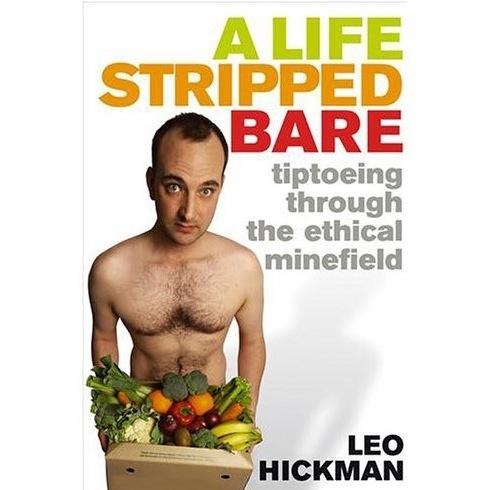
 Interested in finding out about one man and his family taking on the challenge of living ethically for a year?
Want to know more about the dilemmas of consuming without harming animals, people or the environment? This is the book for you.
Like another of Leo Hickman’s books we’ve reviewed – ‘The Final Call’ – this book still has much to teach us today. What I liked best was the honesty of Leo Hickman as he sets out on a journey and works hard at trying to live ethically. The book highlights, in real terms, the difficulties of doing this in an era of globalisation and mass consumerism, where, at times, the actions of the individual can seem like a drop in the ocean.
Hickman is helped along the way by his wife Jane; the ‘ethical auditors’: Hannah Berry from the Ethical Consumer magazine, Mike Childs from Friends of the Earth, and Renée Elliot from the Soil Association; and readers of his Guardian blog who write to him during this project, from all corners of the globe.
HIckman begins by inviting the ‘auditors’ into his home where they examine all aspects of his and Jane’s daily living, including choice of nappies (clean ones, of course), toiletries, insulation, heating options, cleaning products, holidays, transport, waste disposal, banks and groceries.Then, he sets off to follow their recommendations.
Clearly, he wants to get it right. But it takes time and effort. He has to check the food he’s buying is locally sourced; that meat (should he be eating this anyway? another dilemma he faces) has been organically reared and not subject to cruel conditions when alive; that cleaning products don’t contain harmful toxins; which nappies to use to protect the environment and stop leakage at night; which companies offering financial services are not involved in ethically dubious activities and which ones invest in ethically positive ones. And, Hickman has to do this in collaboration with Jane and baby Esme. So many things to think about!
For the vegetarians, vegans and fruitarians among you, I would skip the ‘Rat incident’. Honest, brutal and necessary. What do you do when rats move in? Some may think they have a right to life. This anecdote drew on something primal about a man choosing to defend his family. He used the example to make a comparison with how many of us eat meat with little thought of the source animal.
It made me think of the one occasion I went fishing and caught a Red Snapper. I was humbled as I ate it later barbecued with a splash of lemon. Never has my connection with what I’m eating been so strong. Like Hickman, I question how many of us would continue to eat meat if it was our job to take the animal’s life first.
(Green Prophet’s Daniella writes an excellent piece on her experience witnesses a ritual Muslim slaughter).
Hickman made me reconsider the sanitised breasts of chicken; efficiently-sliced cuts of steak; chops and joints carefully placed in plastic trays in supermarket fridges which belie the misery of the animals while alive. And, of course, it’s not just the treatment of animals; in the process of mass production landscapes and environments are changed and depleted, leaving long-term damage to the ecosystem.
Perhaps the best example of trying to live ethically in the real world is during the time when his baby daughter, Esme becomes unwell and has to go to hospital.
Leo comments:
Sitting by Esme’s cot over the next two days with little to do, we find ourselves discussing the various ethical dilemmas of modern medicine…………….But concerns about the drugs’ origins evaporate when the paediatrician tells us what Esme needs to take to get better. I admit it freely: we entrust Esme’s well-being entirely to the hospital’s staff. If one of them had come up to me and said, I should inform you that over a thousand rats died a painful death to allow this antibiotic to be here today,’ I would still have said, ‘Fine, let’s proceed.’”
Hickman loves gadgets and is eager to purchase the latest, most up-to-date electronic item on a regular basis. He has to take a good look at this and consider the costs to the environment of built-in obsolescence, energy used to produce new products and what happens when they need to be disposed of.
He and Jane take a week off television and soon realise how much time is spent in front of it. He learns to switch things off and not just leave them on standby. I only recently learned how much energy is used up this way and have consistently switched off the monitor on my computer ever since watching ‘The Age of Stupid’ (reviewed here). I don’t have a television, although, I freely admit there are days when I would love to do nothing more than spend an afternoon or evening, remote in hand, flicking from program to program.
Alongside details of his practical attempts to start a wormery, recycle with vigilance, wash nappies, negotiate the use of ethical painting products with a traditional builder and decorator, start a veg plot and much more, the book is interspersed with extracts of the auditors’ recommendations and discussions as well as emails of advice from his blog readers.
It encouraged me to do a mini audit of my ethical living. I still have some way to go!
All in all, this is an inspiring read. It really is ‘A Life Stripped Bare.’
More about this Green Prophet Reviewer, Louise Gethin:
Brought up in Bristol, Louise has lived in France, Germany and New Zealand, and has spent time holidaying in Jerusalem, Spain, Ireland, Indonesia, Australia and Singapore. Originally trained as a nurse in Bristol, she spent four years working with people with HIV in the mid nineties. Highlights of her life include: trekking to Annapurna Base Camp, Nepal; working in New Zealand; being an aunt to three nephews and two nieces; and living for three years on a houseboat only a stone’s throw away from Windsor Castle. She’s a keen amateur photographer, cyclist and hockey player. Louise has also reviewed ‘The Guardian Green Travel Guide’ for GP. Her biggest ambition is to publish her collection of short stories ‘Anecdotes of Love and Death’.