
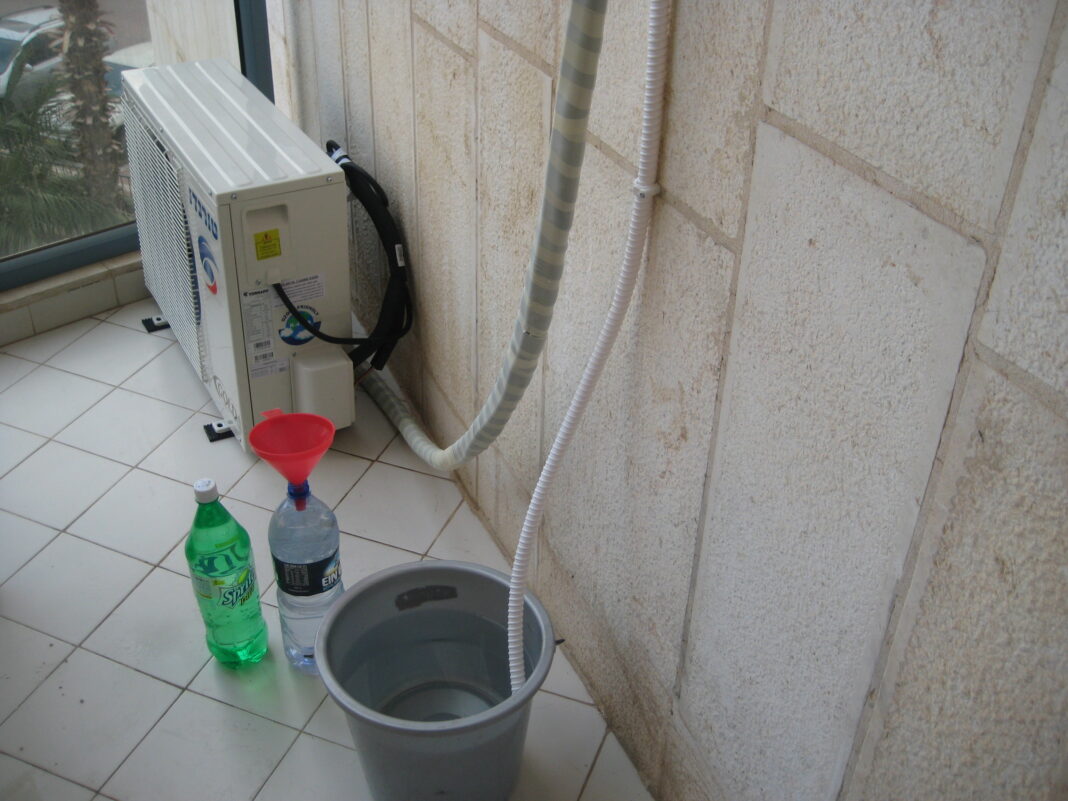

 Gallons of water can be produced in hours.
The world water crisis is a definite fact, and the availability of fresh water for drinking, cooking, bathing, and other uses is an issue that is constantly being brought before our attention. The crisis is especially evident in the Middle East.
As natural sources of fresh water continue to dwindle, creative ways to derive water, including desalination in water starved countries like Saudi Arabia, waste water recycling, and even unusual methods like using drone aircraft to collect water from water vapor in the air for use in agriculture, are coming to the fore.
While these methods have merit, they often involve large capital outlays. Many of us, however, may be overlooking a way to acquire large quantities of fresh water as a by-product of those devices which we use during the hot summer months to keep us cool. And those devices are none other than our household and business air conditioners.
Too hot to go without
The use of air conditioning devices is becoming widespread; we are reaching the point where people simply have to use them in order to live normally in countries where daily summertime temperatures often climb as high as 45 degrees Celsius. These high temperatures are sometimes coupled with high humidity, making the actual temperatures seem even higher.
Creating fresh water from the condensation created by air conditioners is nothing new. But until recently, the water made from this condensation has been simply allowed to run off, often to the ground, city storm drains and other places. The derivation of water from water vapor in the air came to many people’s attention recently when an American company, Air2Water LLC, patented a device that removes water from the very air we breathe.
When humidity is a blessing
The system in this device is very similar to the cooling systems found in most private and commercial air conditioners, in that water condensation from the refrigeration coils is the end result. To give an indication of how much water can be created by even a small household air conditioner, try collecting this “run off” water in a bucket or large plastic bottle instead of letting it run off onto the ground. The amount of water that can be collected in this manner will vary according to the size of the AC unit, the air temperatures when the unit is operating, and (very important) the amount of humidity present in the air.
Those “blessed” with living in an area with high humidity (65-70%) , such as a seaside location for example, will be able to “collect” more water than those living in dryer areas where the humidity is less than 45%. In a high humidity location, even a small AV unit of 1 horsepower (7,000 – 8,000 BTUs) can produce as much as 9 liters of water from about 6 hours of use.
Water towers
If a small unit can produce this much water (which is virtually distilled water, and free from chemicals and other contaminants), think about how much water a large commercial air conditioning unit can produce, such as those found in those United Arab Emirates’ mega building projects, including the recently completed Khalifa Dubi Tower, or Burj Dubai, being hailed as the tallest man-made structure on earth.
While AC units in structures like Burj Dubai are capable of producing thousands of gallons of fresh water through AC condensation, your small household units can produce enough water to use in gardening, flushing toilets, cleaning, and with a small bit of filtration, even for cooking and drinking. A small, 1 HP unit can create 8-9 liters of water in just 6 hours, while a larger 3-5 HP unit can make 3-5 times as much.
Best of all, this water comes directly from the air we breathe. What better way to put it to good use?
More articles on sources for creating fresh water:
Drone Aircraft Takes Water from Atmosphere for Irrigation
Abu Dhabi’s Costly Desalination Plants Prompt Waste Water Treatment Plans


Rain also comes from clouds (water vapor)so why not AC water. We just need to find a practical way to purify it – no worse than drinking lake (Kinneret, in Israel’s case) or ground water. It’s just a matter of getting rid of bacteria and other “creepy crawlies”. And there’s surely a lot less chemicals and metals (like cadimun or mercury for example)in AC water. It’s time has come!
Star Wars what.
Anyway.
This water is not distilled, it is condensed and there for still has many air borne contaminants. One common to ac units is legionnaires disease. Till this is filtered and clean it’s considered greywater and is good for irrigation. The Air2Water units still filters and sterilizes the water it produces.
As for the Burj Dubai or Burj Khalifa, which every way you look at it, already does this collection method for use in irrigation of the surrounding parks.
Funny thing, when they first started to cool it down they too a month to do so. This was to prevent cloud formation inside the the large open interior.
Clouds? Wow.
The water from air cons is definitely not drinkable for humans. It should be regularly cleaned with some kind of detergents so it could be dangerous for human health. I wouldn’t give it to the animals neither, anyway they have a lot more senses then humans to recognise if it is drinkable water or not. I would use it to water some flowers, grass or pot plants, but not vegetables or fruit trees.
No worse than water out of the Jordan River – or the Sea of Galilee for that matter (remember our media tour?).
Says here that air cons are full of bacteria:
http://answers.google.com/answers/threadview?id=242795
I wouldn’t drink the stuff. Or give it to my pets. But I would funnel the hose down to my plants. Right now I am watering a large passion fruit plant this way.
I think dogs have less problems with this than people. Cats too, especially street cats during hot weather, will appreciate this water.
I was told that distilled water, like the stuff created from air cons isn’t safe to drink. That’s what people say when I let my pooch take a sip from the AC water collected on the street.