

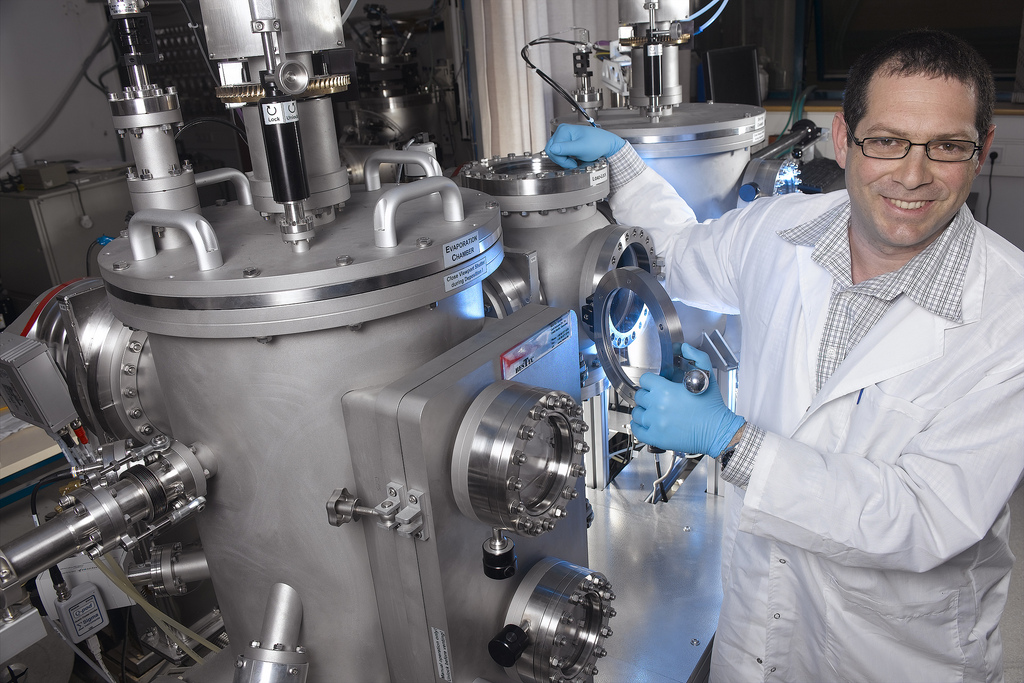
 Today, laptop users are normally tethered to an electrical outlet as batteries only last a few hours. Dr. Amos Sharoni hopes to change the efficiency of processors so they last longer.
He works at Bar Ilan Univeristy, a school that’s established a name for itself in battery technology (meet Doron Auerbach), and the University’s young researcher Dr. Amos Sharoni is hoping to add to that body of work by extending the battery-life of everyday mobile devices. His research could lead to the development of energy-efficient computers and appliances where the same batteries could last 10 times longer, and the processors could run 10 times faster.
Think about it: The 21st century boasts state-of-the-art inventions like laptops and iPods that we can carry with us and use for business or pleasure wherever we roam, and yet when truly mobile and battery-operated, most can only last up to four hours before running out of juice. It’s so frustrating.
Working in a relatively new field of physics called Spintronics, the 38-year-old Sharoni, a condensed matter physicist, is focused on making strides in energy efficiency research at Bar-Ilan’s brand new nano center. Sharoni’s research is the continuation of projects he started when he held a post-doc at the University of California San Diego.
The young researcher will make use of that equipment to further explore Spintronics, a field of physics that has existed in nanotechnology for about 20 years. It recognizes that the ‘spin’ of an electron can be harnessed as a viable source of energy.
It’s all electrons
Currently, electrical impulses are sent using the differences between the charges of positive or negative electrons. Today’s computer hard-drives use the ‘spin’ of an electron to encode data on themselves. The spin is etched into the drive and that’s how information stays safe, even when our laptops are not connected to an energy source.
“I am dealing with solid state devices, packed atoms. The fact that you have atoms in an ordered fashion changes the properties of materials,” Sharoni tells ISRAEL21c.
“Gold atoms flying around, will act differently than if they were in a wire,” he continues. “And when you cool certain kinds of materials, like some metals, one can make a superconductor – a material that does not lose energy.”
Spintronics is the basis of electrical systems. We manipulate electronics to give us power that translates into functions like playing a song. “It’s all electrons. They have a charge. There is a battery with a plus-minus. But the electrons have another property – their spin, a small magnetic field, pointing up or down,” he explains.
Not wasting any potential
“None of the electronics today use this spin property to do anything,” says Sharoni. “It’s wasted potential. The reason is because even the smallest element of the device is big, and due to this, you lose all the spin information you have. It gets messy. In regular devices – you just lose it – it’s like trying to look through fog.”
He explained that his research challenge is to find a way to “listen” to what’s happening in the system. Ultimately, his work could lead to processors that work faster, and for longer periods of time.
Saving energy in the home
Taking into account that 40 percent of the energy from the power company that goes to your house is lost, there’s a lot at stake in the energy business. Another issue Sharoni is investigating is a way to prevent this loss if wires could be made to conduct energy better.
To find a superconductor that works at room temperature may be theoretically impossible, but at the nano-scale, properties of matter change, and, according to Sharoni, that kind of physics can teach the rest of science about how the real world operates so that possible applications could be the creation of an improved electrical grid.
“I am trying to look at how the physics changes when you don’t make a big piece of material, but when you look at a small portion of it. At the nanoscale it looks different and it is different. How are these materials different and how do they become what they are at the macroscopic world?” he asks.
From security guard to physicist
Born in Jerusalem, Sharoni says that by ninth grade he already knew that he wanted to be a physicist. “And it worked out,” he tells ISRAEL21c.
While studying, in order to earn money, Sharoni did some stints as a security guard for prime minister Binyamin Netanyahu, during his first term in office.
He enjoyed the job, which included donning dark jackets and slacks, and carrying out assignments like staking out the PM’s location and talking discreetly through communication devices. However, he says, he was less enamored of the part that involved breaking into unidentified and illegally parked cars near the prime minister’s residence to check for security threats, like bombs.
With all that behind him now, Sharoni is on track to the fulfillment of his dream in the big world through the tiny nano world of condensed matter physics.
(This story was first published on ISRAEL21c – www.israel21c.org)


