

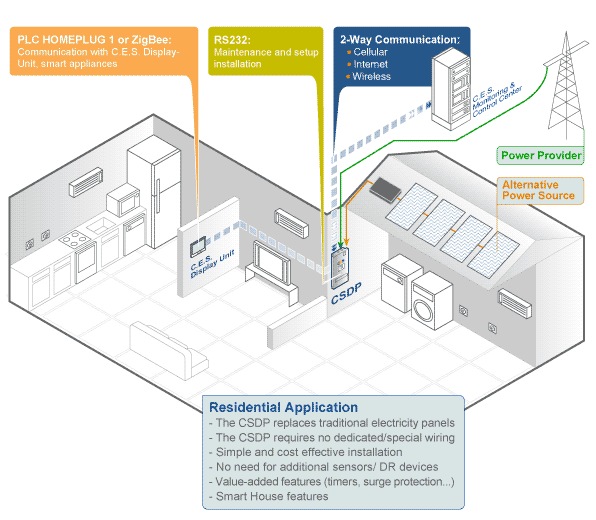
 Israel’s C.E.S. box greens your home power use, telling you where faulty appliances are sucking juice from the grid.
Like GreenRoads to save fuel (invested in by Virgin’s Branson, and Gore’s clean tech fund), investors know the money is not just on innovative futuristic technologies, but companies that work today to save fuel, and money.
Consider this: your electric bill has gone sky high. You suspect the air conditioner, which has been emitting a rattling noise since you fired it up in the spring. Only that’s not the culprit – how are you to know that it’s your fridge that’s not working properly and using so much power that running it constitutes 40 percent of your energy bill? Now imagine having a device that can tell you where and how your home electricity is being consumed, and that can program parts of the house – like your teenager’s room or the den – to shut down in order to save money, energy and wear and tear on your appliances when no one’s home.
With the advent of smart appliances that can communicate with your iPhone, and with the electric company offering discounts on off-peak hours, revolutions are in store in the way we consume power at home.
The only problem, explains Lupu Wittner, co-founder and CTO of Israel’s smart grid company Computerized Electricity Systems or C.E.S., is that most people are completely in the dark when it comes to how they’re using power at home.
“Most people know how to use cell phones, but they have no idea what appliances are consuming energy, and how much,” he tells ISRAEL21c. That’s where C.E.S. comes in, based on an idea that the former Ukrainian came up with to cleverly measure power use in the home via the CSDP Smart Distribution Panel.
When connected to the CSDP, people receive information about power usage, and warnings when suspicious behaviors or electricity arcs are detected. An increase in power from the air conditioner could be a sign that the filter needs changing or that the thermostat should be replaced. More often than not, Wittner says, people leave problems like these to the last minute, when something that shouldn’t have cost more than a few hundred dollars to repair ends up leaving them a couple of thousand dollars poorer.
The challenge of crossing over
Wittner says that the challenge is in marketing the new idea. The current problem in the US he says, from a sales and marketing perspective, is to find the utility companies that haven’t already signed agreements with other “smart grid” companies.
“They need our concept because what we are doing is important to them and they know it,” he tells ISRAEL21c. “Ours is a unique solution. When we introduced it to many utility companies, they knew this is the right way to manage power consumption. But they already have agreements in place with smart meters and have already invested the money. They want to work with us, the problem is the cost.”
C.E.S. is seeking to partner with green construction firms in the US, and also sells to individuals on request. The company already has a number of test sites throughout the world – including one in Israel in cooperation with the Israel Electric Company. The CSDP panel, which replaces the standard home electricity box, is being tried out in a pilot study in about 100 homes in the central coastal city of Netanya, where the company is based.
A South African builder has put in a large order for the CSDP boxes; major utility companies in the US have investigated its potential; and a green builder in Austin, Texas has installed the boxes in about 30 homes. Interested parties in the US include Duke Energy in Cincinnati and the Electric Power Research Institute.
US utilities companies are becoming more concerned about greenhouse gas emissions since President Barack Obama’s cap-and-trade proposal could put limits and a hefty price tag on companies that do not reduce these harmful emissions. However, the onus is now also on the consumer – as more and more people build ‘green’ homes. In the new context, it’s not just what’s inside the building materials that counts, but how energy-efficient a home can be for years to come.
More and more homes are being connected to renewable energy sources like solar energy and wind power that can be integrated with the core technology of the CSDP panel. It can be set to switch over to clean power seamlessly during the times of day when it makes sense to do so, to minimize greenhouse gas emissions and energy costs.
A wolf pitted against energy hogs
While switching to green from traditional energy sources may be a big leap for most Americans, there are many benefits beyond saving the planet, Wittner, whose name means ‘wolf’ in Ukrainian explains: “When I installed the unit in my home, it was able to show me that 40% of my home’s energy bill was going towards running our refrigerator. I had a problem in the fridge, and when the repairman came, I think he replaced the faulty part with the wrong kind of compressor. It was costing me a lot of money.”
For about $3,000 a unit, the CSDP system offers a number of benefits. It can be programmed with tariff rate updates and discounts supplied by the energy company; it can allow you to control your house remotely via an iPhone or web browser; it can provide precise cues to the power company which can be granted permission to switch off appliances and parts of your home during peak hours; and above all that – it protects your privacy.
If a customer prefers, personal power usage behavior need not be revealed to the power company. Currently, smart grid decisions remain on the power companies’ servers, which he believes may be one of the reasons why people are hesitant to get connected.
The CSDP can also predict fires, by recording electrical arcs, overheating parameters and traces of other electricity events – things most ‘dumb’ systems couldn’t detect until the fire started and it was already too late, Wittner says.
With a two-hour installation time and the potential of thousands of dollars of savings within a couple of years, the CSDP seems like a sound investment for the homeowner and small business owner.
With its base in Netanya, and a marketing and sales office in the US, C.E.S. employs 24 people, mostly engineers. The company, which has been active in the electronics industry since its establishment in 1989, switched focus in 2000 from turnkey electronics solutions in communications and avionics.
Gaon Holdings has invested an undisclosed amount of money in C.E.S., via its fund Aqua Agro.
While everyone in marketing seems to encourage us to think ‘outside the box,’ C.E.S. is one clean tech company suggesting that we think in the opposite direction – inside the (electricity) box.
More smart grid stories:
Lebanon Looks to Smart Grid and Renewable Energy Technologies
Ten Clean Tech Companies from Israel Head to California, 2010


It would be beneficial for Computerized Electricity Systems to include phone numbers of their sales offices in the United States.
Marvin,
Do you need contacts? I think I might have them.