
 Built on the profits of oil, should Masdar hold the mantle of energy leadership for the world? Yosef asks.
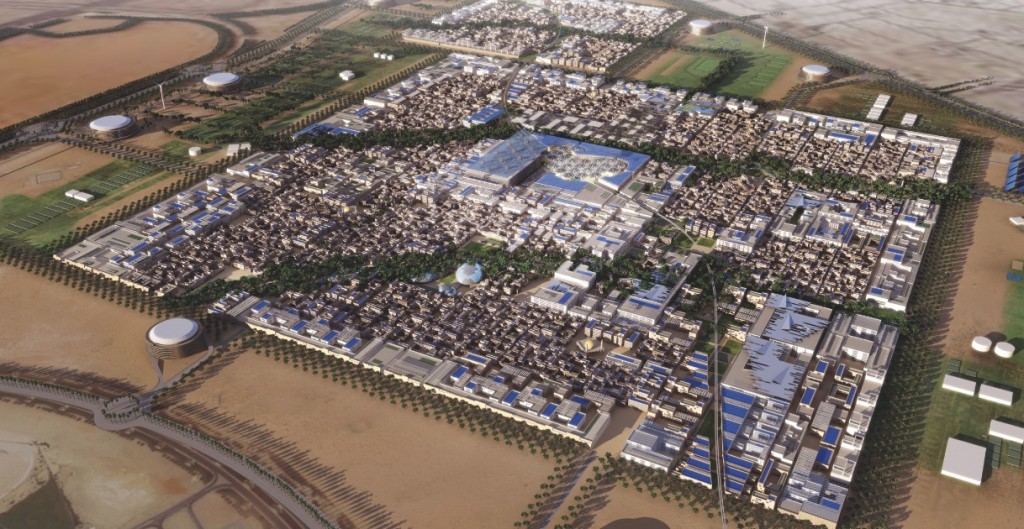
According to the Masdar City website, the undertaking is intended to be Abu Dhabi’s “multi-faceted response to the challenges facing a sustainable future.” The city, intended to house 50,000 residents in a kind of technosphere designed to invoke a time-venerated Arab city. The enterprise is aimed at making Abu Dhabi “a global leader and hub for the research of renewable energy and sustainable technology.”
While initiatives aimed at advancing a sustainable future are to be applauded, there is something disturbingly off about the context in which the Abu Dhabi oil state seeks to claim the mantle of energy leadership and sustainable practice. As a key and continuing link in the system that actively led to the causes of climate change — carbon-based greenhouse gases — one questions the validity of the initiative. There is little doubt that the Masdar company, which owns the development can buy the best clean technology that money affords. However, to view the $22 billion project as an act of green benevolence deeply belies the country’s history, government and economics.
According to the website, Masdar City is the expression of “the vision of His Highness Sheikh Mohamed bin Zayed Al Nahyan, Crown Prince of Abu Dhabi and Deputy Supreme Commander of the UAE [United Arab Emirates] Armed Forces.” Sheik Mohamed is the brother of Sheik Khalifa, ruler of Abu Dhabi. Both are sons of the founder of Abu Dhabi, Sheikh Zayed, who in turn received the territory to rule from a brother. Abu Dhabi is part of the United Arab Emirates, a state created when the British departed the territory in 1971.
To understand the evolution of the UAE and Abu Dhabi it is important to investigate the roots of its creation.
 The UAE is one of five Arab polities (Oman, Qatar, Bahrain and Kuwait being the others) along the oil-rich Persian Gulf on the Arabian Peninsula formerly known as the Trucial States.
As detailed in an official biography of Sheikh Khalifa, the country was a backwater of confederated tribes living in oases villages as late as 1948.
The ascent to power of these emirs and sheikhs was arranged by the British colonial office as part of its grand design to gain hegemony over land routes, strategic waterways and mineral finds – especially oil – in the imperial rivalry with the other European powers in the late 19th and early 20th century.
One of the ways the colonials achieved their aim was by purchasing the loyalty of local strongmen whom they rewarded with states created to conform with territories that served the colonial powers’ strategic interests. In this very successful scheme the Middle East, formerly a largely dormant expanse of the failing Ottoman Empire, states were endowed in North Africa and West Asia and allocated to selected elites. These included Transjordan, Iraq, Libya, Syria, Lebanon, Saudi Arabia and the emirates that then became the UAE.
Following the First World War when industrialization spread throughout North America and Europe, the energy that fueled industry– and the environmental crises in which we now find ourselves – petroleum , was in increasing demand.
The Seven Sisters and their Puppets
The US and European states through the agency of the major oil companies (known as the Seven Sisters) created contracts with the newly installed rulers of the puppet states, none of which derived their power from democratic means or as an expression of popular will.
While these states received royalties from the great profits that accrued to the western oil companies, the latter’s penchant of taking the bulk of revenues resulted in the emergence of the Organization of Petroleum Exporting Countries (OPEC), an advocacy group and cartel that represented the oil-producing states.
As a result the oil crisis of the early 1970s ensued.
Britain left the UAE at that time in the capable hands of their reliable junior partners, the Al Nahyan family. More equitable terms for profit-sharing of oil revenues were arrived to meet the increasing demands of the ruling elites, whose rulers continue to govern by decree at this time. The crisis was defused with rising revenues for both the oil companies and the OPEC elites.
The oil sates have few productive activities other than the incomes they derive from petroleum resources and the increasingly complex services that industry entailed. With such wealth derives great influence and the UAE is touted by western governments and multinational corporations with vigor. Abu Dhabi is said to have an income flow of $1.5 billion a week. To put this in perspective, Kenya’s Gross National Product for a year is $18.04 billion dollars per year. Abu Dhabi has a population of somewhere around 950,000; Kenya’s population is slightly over 36 million people.
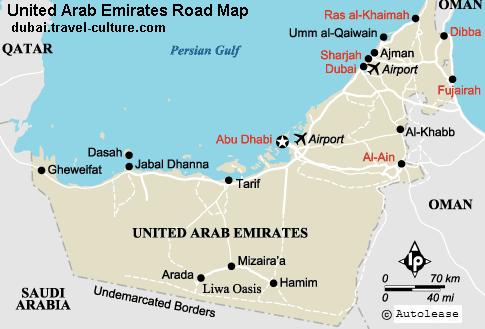
The majority of residents, an estimated 80 percent are not UAE nationals but migrants from India, Pakistan, the Horn of Africa and elsewhere. These residents, the country’s major labor force, are often paid beneath the minimum wage and do not enjoy enfranchisement in the national life of the country. Most of the country’s territory consists of sand and gravel desert with salt plains around the coast. Abu Dhabi is the capital of the emirate and of the UAE.
According to the Oxford Economic Business Group profile on the country “sitting atop 9% of the world’s proven oil reserves (98.2bn barrels) and almost 5% of the world’s natural gas (5.8 trillion cu metres), the UAE’s extraordinary hydrocarbon wealth gives it one of the highest GDP per capitas in the world.
“Abu Dhabi owns the lion’s share of these resources – 95% of the oil and 92% of gas.”
In this context it is pertinent to ask if Masdar City, a state project of one of the world’s greatest purveyors of the world’s carbon problem, a repository of immense wealth that took a tribal fiefdom from a subsistence economy to a global titan in less than two generations, can really claim the mantle of global sustainability leadership.
It is well and good that sheiks profess green aspirations. However, if Sheikh Mohamed bin Zayed Al Nahyan is really interested in being a champion of global sustainability he would divest the country’s coffers of its carbon-based wealth and help offset the carbon debt of the poor countries whose plight is largely the result of the system his fiefdom helps fuel.
Dr. Yosef Gotlieb, a regular contributor to Green Prophet, wrote Self-Determination in the Middle East (1982).
Read more about Masdar:
Re-assessing Masdar City
Masdar and the US Collaborate on Carbon Capture
Abu Dhabi’s Masdar Clean Tech Fund Closes
Above map via Dubai Travel