
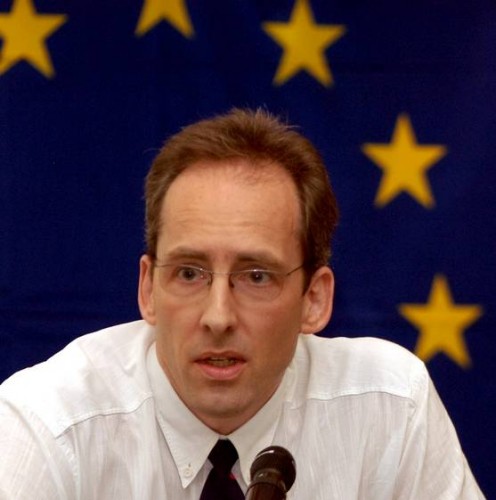

 Farming the sun from hot climates to Europe? This is the plan of DESERTEC. Today we speak with Oliver Steinmetz. Oliver’s a co-founder and volunteer board member for the DESERTEC Foundation, a small NGO founded in 2008 to promote the DESERTEC concept of supplying clean energy from desert regions to regions with less sun, like Europe, via international grids.
The project is expected to have important implications for Europe and Africa, and hopefully also the Middle East. Looking to technologies that can make energy out of desert regions, DESERTEC hopes to set an eco-standard and technology certification, like the FSC forestry label.
Let’s learn more about Oliver, and this phenomenal idea of DESERTEC, and how countries and companies can get involved.
“The DESERTEC Concept,” says Oliver “is based on scientific research work done at the German Aerospace Center (DLR) since 2004, and was originally funded by the Club of Rome. “I make my living at the European Investment Bank (EIB, the EU’s financing institution), so my working day consists of cycling to work, then managing the Risk Management IT systems of the EIB, then cycling home.
Here’s our Q&A with Oliver (pictured above):
We’ve been following the importance of Desertec for N. African nations. How can oil-free countries get involved?
The main resource needed for solar power is … sunshine. Most North African countries have plenty of that. DESERTEC is not exclusively about Concentrating Solar Power (CSP) – it also advocates using all other forms of renewable energy wherever they can be applied most effectively, e.g. Wind power is very good on the Western shores of Morocco. Not having oil is actually an advantage in this sense, because it makes countries more interested in alternatives.
How can nations get involved? One good example is Morocco, whose government has now announced a $9 billion plan for installing 2 GW of CSP capacity in five well-defined locations. They plan to start Calls for Tender in 2010. Morocco, in turn, is following the example of Spain.
What sort of partnership opportunities would be available to Middle East countries?
The same as for North African countries and all other countries with deserts: Both the DESERTEC Foundation (as an NGO it works mainly on a personal/societal/eductional level) and the Dii, DESERTEC’s Industrial Initiative, stand ready to help interested governments and the private sector in setting up development plans. Dii concentrates on the EU-MENA area, while in the rest of the World the Foundation aims at starting regional and national industrial initiatives similar to the Dii.
Are there opportunities to the oil-producers to join in some way?
Oil producers haven’t exactly made a name for themselves in renewable energies (though they have tried). But DESERTEC is not ideological about that: Anybody interested in realising the gigantic potential of renewable energy from deserts is most welcome. There is so much work to do that we need a lot of large-scale investors.
We have a lot of entrepreneurship rising from the region. What kinds of technologies are you looking for? And grants?
Technologies: Neither Wind nor CSP are not rocket science these days, but there is still a lot of cost reduction potential in concentrated solar power (CSP). A lot of the parts and labour can and should come from companies in the producer regions, which should also have a big educational effect and a wealth / gross domestic product (GDP) effect.
We mainly seek grants from governments and the EU, but there are also a lot of foundations and state funds that might help us promote the idea worldwide, pay for the research and studies to be written.
Would you be looking for partnerships with governments, companies, institutions? Please explain.
The answer is a simple “Yes”. All of them. Whoever wakes up first. That’s different per country. For example, in Morocco we can work directly with the government, in Tunisia that’s starting, and in Algeria the government sector is still sceptical. But please consider that DESERTEC is a private-sector initiative, as opposed to e.g. the Mediterranean Solar Plan. So our grass-roots approach depends on personal contacts, which are growing continuously into new geographical areas.
How can Desertec benefit the givers, and not just the receivers, of solar energy?
As mentioned above: The key words here are “human capacity building” and “local content” in the energy-producing areas. It’s a common misunderstanding that DESERTEC is just some sort of neo-colonialist approach. On the contrary: Producing solar energy in deserts suddenly gives a value to areas that were so far considered utterly useless, and produces a new source of export revenues for the desert economies, plus internal growth of skills and revenues.
What kinds of environmental surveys are being done? Solar companies like BrightSource in California have been getting a lot of criticism from environmentalists. Will similar green networks be in place to survey which areas are most suited for installations?
The DESERTEC Foundation aims at becoming a provider of certifications for Environmental and Social standards in connection with the installation of power plants – a bit like the FSC label for wood. Only a plant that has respected local and international environmental and social standards will be allowed to use the name DESERTEC.
What’s your green vision for the Middle East, as a visionary who realizes and who is now enabling opportunities?
The Middle East has (in parts) become rich thanks to oil. But now it’s time to understand what can be the sources of wealth for future generations, in a sustainable way. It’s a lucky coincidence that most countries there also have more than enough desert areas with very high solar irradiation. CSP plants will spread, starting near the sea shores, where they can also produce desalinated drinking water and the cooling is cheaper.
The water reproduction will suddenly enable agriculture in areas where it was heretofore impossible. The deserts grow by 60,000 km2 per year, and all we need is twice that area to supply the electric power the whole world needs! So my vision is a re-greening of areas that we currently define as “lost to desertification”. That would in my view be a dream come true for humanity and for securing human life – and that of all other species – on this planet in a sustainable way.
::DESERTEC




Thanks a ton for posting, it was quite handy and showed me immensely
It still looks problematic to me. Still trying to sort it out…
Thanks, it looks as if both issues have been sorted out.
Maskil – the comments issue is a bug happening between our WordPress template and Discus… Jack is trying to fix it. The rating app sometimes takes a bit of time to kick in! Thanks for your comments…
The heading of the article says “2 Comments”, but none are visible!? Also, what happened to the 1-5 stars rating for articles on Green Prophet?