

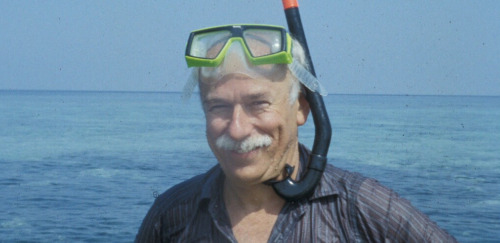
Getting close to his subject: marine biologist Prof. Zvy Dubinsky hopes to understand the changes global warming will cause to the world’s delicate coral reefs. A new EU grant will give the corals a chance.
Israeli marine biologist Zvy Dubinksy is worried. Coral reefs all over the world – from the Great Barrier Reef in Australia to the Red Sea in Israel – are dying, and global warming is the culprit.
Now the professor from Bar Ilan University in Israel hopes to do something about it. He and his team of researchers from the Faculty of Life Sciences have just been awarded a prestigious $4 million grant from the European Research Council to study the effects of global warming on corals in the Mediterranean and Red Seas in the hope that they can come up with data that will help scientists bio-engineer remedies to global warming in advance.
It’s a significant grant. The European Union group received over 1,500 applications for the money, but chose Dubinksy, a renowned coral researcher, because of the vital importance of his research, which examines a number of fundamental questions about the future of marine ecosystems.
Coral reefs are some of the most delicate of marine life. They offer rich and complex eco-systems, comparable to tropical jungles. Aside from providing a home and habitat to many important fish species, the corals also have a unique symbiotic relationship with tiny algae that live within the coral cells. These algae provide the coral with most of the energy needed for life processes, such as growth and reproduction.
Coral reefs are dying
In stable water conditions the reefs thrive, but rising sea temperatures, increasing pollution and water acidity have deeply stressed the corals causing them to lose the algae. The result is bleaching – where corals whiten and die. Today bleaching events have been hitting reefs throughout the Indian and Pacific Oceans, with increasing frequency, killing corals and decimating entire reefs.
“The increase of CO2 in the atmosphere results in its increased dissolution in the oceans causing water acidification. The more acidic it becomes, the more difficult it becomes for calcifying organisms like corals, shellfish and crustaceans to deposit their calcium carbonate skeletons,” Dubinsky tells ISRAEL21c.
“Corals are endangered by global warming, but that’s not all,” he adds. “There are increased UV rates from the depletion of ozone, and in many places around the world, corals are used as building material where there are no other stones. Fisheries also cause problems as do pet shops and aquaria. They are destroying whole reefs to catch one expensive fish. The whole outlook is not good.”
Dubinsky, who founded the lab at Bar Ilan University, plans to study the effects of climate change on corals over the next five years, using state-of-the-art tools.
With the help of former student, Dr. Oren Levy, Dubinsky and his team will employ a special lab fitted with marine aquaria, built with part of the grant. There they will expose the non-reef producing corals from the Mediterranean and the reef-producing species from the Red Sea to changes that coral reefs are expected to experience over the next 90 years, given various global warming scenarios.
Identifying resistant species
After investigating metabolism rates, reproductive patterns, and growth — all monitors for animal fecundity, the coral skeletons will be brought to the University of Bologna in Italy where the mechanical and structural properties of coral will be studied.
The goal of the project is to help scientists understand how coral species will react to global warming, in an effort to help them bio-engineer remedies in advance, such as developing certain species resistant to change.
“By acting synergistically with ocean acidification, it may be possible to identify the most endangered coral reefs, and coral species facing extinction,” explains Dubinsky. “To save coral reefs… resilient, warmth-tolerant species, genotypes that are more resistant and hearty, will be cultured and placed in damaged sites. Meanwhile, the more sensitive species will be protected in sanctuaries and gene banks,” says the scientist who is also an accomplished diver and art photographer.
Dubinsky, who was born in Spain in 1934 and immigrated to Israel nine years later, first became interested in corals by accident. The scientist, who speaks seven languages including German, French, Arabic, and Spanish, first encountered corals while teaching students.
Fascinated by the puzzles corals pose
“I was fascinated by the puzzles they pose apart from their diversity and beauty,” admits Dubinsky, who is married and has one son and four grandchildren. “They succeed to monopolize very special environments. Growing in ‘blue deserts,’ you find corals in regions in the tropical oceans poor in nutrients.
Dubinsky first graduated from school with a college teacher’s training certificate, and was a member of a kibbutz. He did his post-doctoral work at Queens College in New York, has been on sabbaticals around the world including the Brookhaven National Laboratory, Department of Energy, Tokyo University in Japan and at the Rockefeller Institute in New York.
For his first degree he studied botany and zoology and in subsequent degrees investigated algae in the Sea of Galilee. With over 200 scientific papers published under his name, among them 68 in top journals, Dubinsky’s contributions, such as understanding how phytoplankton use light energy, have won him acclaim in his field. Over the last 10 years, he has won 12 major international and national grants.
Dubinsky admits that global warming scares him. “Global warming worries me very much on the political level because of business interests and politicians who try to deny the very fact, and try to continue business as usual along with their total dependence on fossil fuels,” he explains.
“Besides the loss of coral reefs, homes of incredible yet undocumented biodiversity, reefs also protect shorelines and provide livelihood to coastal communities whose economies are based on tourism, fisheries and marine culture,” he concludes.
(This story was reprinted from ISRAEL21c – www.israel21c.org)


[…] of El-Tor, according to WReporter. Quoting Youm 7, the paper claims that the spill threatens coral reefs in the Ras Muhammad National Park Marine Reserve and could spread to the popular diving spot Sharm […]
[…] stories: EU Emissions Tax Blows Change into Middle East Airways EU Gives $4 Million Grant to Med and Red Sea Coral Reef Studies Desertec Plans Get Boosts from MENA and EU Renewable […]