

 The concept of achieving peace through pipes may have originated with Native Americans, but today, unbeknownst to most of us, Israelis and Gazans are seeking peace through sewage pipes.
It was a wild idea back in 1997, and perhaps it is even more unrealistic today. However, against the odds – and working around their governments – the mayors of the Israeli city of Ashkelon and the Palestinian Authority’s Gaza City have taken it upon themselves to try to cooperate with each other.
Ten years ago the vehicle was an educational project in high-tech. Today, they’re coming together over waste water, a major problem in Gaza City right now.
By car, the two cities are only about a 20-minute drive away from each other. But in fact, they are worlds apart. Most people in both cities have never met one another.
The only thing they can be sure that they have in common is a beautiful coastline that follows the Mediterranean Sea from Lebanon all the way down to Egypt. But that shining sea is heavily polluted, since Gaza has no water infrastructure and its raw sewage pours directly into the sea, as Green Prophet’s Rami reports here.
Thanks to one man’s vision, the two cities will soon be working together. Ilan Juran, an American-Israeli specialist in urban infrastructure, is seeing to it that the residents of Gaza will be equipped with the same sanitation and sewage systems that are enjoyed by their neighbors in their sister city on the coast.
Partners in the hoped-for project include the mayors of Ashkelon and Gaza, the Israeli water company Mekorot, the Palestinian Water Authority, the United Nations and local municipalities.
All that remains is for Hamas to approve the plan
Ashkelon Mayor Benny Vaknin is working in full cooperation with Gaza Mayor Maged Abu Ramadan to put Juran’s vision to the test. Vaknin went to Brazil to present the idea to the XVII International Media Seminar on Peace in the Middle East, a conference on Middle East peacemaking co-hosted by the United Nations’ Department of Public Information and the Brazilian government at the end of July.
The plan being presented in Brazil is to build a new recycling and water management system for Gaza City and its surrounding villages based on the existing Israeli system.
It was hoped that officials from both sides would sign the agreement in Rio de Janeiro, but despite permits to travel being arranged by the Israeli side, two days before the conference, Abu Ramadan and his officials were refused permission to travel by Hamas.
Palestinians from the West Bank and East Jerusalem did attend the event, however, and they signed their names on the water works plan, without the consent of Hamas officials.
Expected to cost more than $50 million, which Vaknin believes can be raised through donations; the plant will be modelled on the eight-year old water treatment facility in Ashkelon. Gaza will receive the blueprints and Israeli specialists.
The last hurdle, according to Galit Amzallag, director of international relations for the city of Ashkelon, will be to convince the Hamas government in Gaza to agree.
Polluted water in Gaza is making kids sick
“We will raise the money and Benny [Vaknin] will give the plans of our water system, and our specialists will assist them. The only problem is when will Hamas step aside . . . They are sabotaging it. It’s frustrating because we worked so hard,” Amzallag sighs.
Since the most recent wave of conflict this past December, the people of Gaza have been bemoaning their city’s lack of sewage treatment plants.
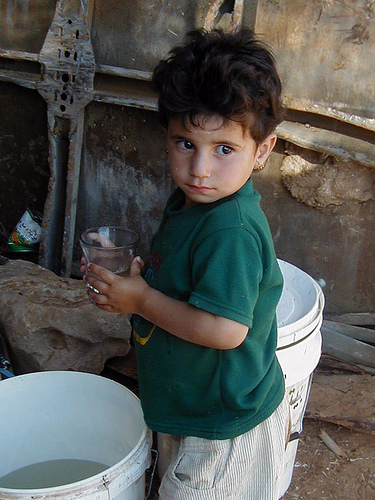
Not only is the sewage polluting one of their few sources of recreation – the beach – but according to Green Prophet’s journalist Rami Almeghari who reports from Gaza, small lakes of sewage are building up and creating polluted lagoons that threaten peoples’ health. Kids are getting sick.
Ashkelon, a port city, that receives a sewage stream from Gaza, obviously has more than one interest in the Gaza facility, which would treat and divert the wastewater to be used for agriculture in Gaza.
But that shouldn’t detract from Ashkelon’s determination to go full steam ahead with the project, which in addition to clean water would also achieve improved quality of life for Gazans.
So far their Gaza counterparts have been very cooperative. When the new mayor of Gaza assumed office he readily understood the value of partnering with the Israeli side, says Amzallag, who has worked closely with Mayor Vaknin for over a decade.
Past success grants hope
Amzallag has been to Gaza City about 10 times, she says. The first time was for the joint Israel-Gaza high-tech training distance learning project.
That project rested on the cooperation between the late Mayor of Gaza City Awn al-Shawa and Mayor Vaknin. In the framework of that program teenage kids from both societies were taught computer and high-tech skills, which they in turn passed on to their younger peers. It worked well until the intifada hit.
Despite the uprising, Vaknin urged the Gaza mayor to join him on a fundraising mission to the World Bank and the United Nations in New York. A million dollars was raised and a study site complete with facilities was built in Germany. There was even enough money to pay for air fare for the participants.
With the means and neutral territory secured the project was saved and youths from Israel and Gaza learned high-tech together at month-long sessions in Germany.
Beyond water, there are other dreams for cooperation between the two cities. One is to build a railway between Egypt and Ashkelon with stops in Gaza. A second dream is to build a recycling center on the border between the two regions. If all flows well with the water project, perhaps shared railways and recycling will be a reality too.
More on water in Gaza:
The Liquid Possibilities for Peace Between Gaza and Israel
A Report from the Strip on Gaza Sewage Water Crisis: Green Prophet’s Rami Reports from Gaza
How Cast Lead Conflict Affected Environment in Gaza
(This story was first published on ISRAEL21c – www.israel21c.org)


[…] Can water lubricate peace? We hope so. This is our second to last interview in our water series with the Strategic Foresight Group. Today we interview Benny Vaknin, the Mayor of Ashkelon, who is trying to cooperate with Gaza for building a sewage treatment plant in Gaza city. […]
[…] contamination of all kinds of water resources and deal with the contamination that already exists. Sewage must be treated adequately and reused for agriculture to prevent environmental […]
[…] With a leading spot in the water industry – from desalination technology to water saving technology – Israel has been getting a bad rap from the media and NGO reports, despite the fact that the country is attempting to cooperate on water issues despite the difficulties. […]
Gazans live in sewage because the Hamas sabotage co-op with Israel: http://bit.ly/159fMn
New blog post: Gazans Smoke Sewage Peace Pipe With Israel http://bit.ly/159fMn