

 Will chicory become chic?
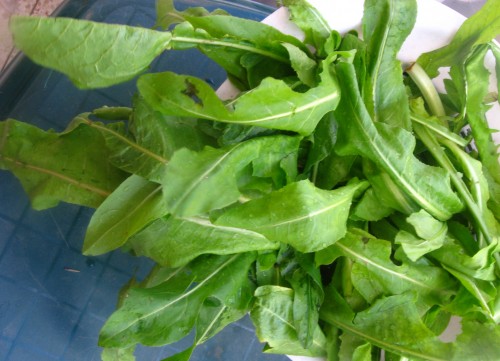
Chicory, or olesh in Arabic and Hebrew, is a tasty wild edible related to endive. Generations of Middle Eastern peoples hand-gathered the lance-like, serrated leaves to cook, but you can buy it cultivated now. Unfortunately, this nutritious, inexpensive wild vegetable hasn’t acquired the prestige of, say, artichokes – which are really just big thistles. Like artichokes, chicory requires cleaning and care in cooking, and you have to have a taste for slightly bitter greens to appreciate it.
Bitter greens are a springtime tonic, supporting liver function and delivering easily-assimilated iron to the bloodstream. That’s why native peoples have always delighted to see the appearance of dandelions and chicory after the vegetable-poor winter – before modern agriculture brought fresh produce to markets year ’round. But no matter how available and enticing mounds of fresh produce may be, the body still likes its jolt of calcium, Vitamin A and iron, which chicory provides in plenty.
We bought a big bunch of chicory in the Ramleh shuk last week. The vendor gave us the traditional recipe, and we cooked it as he said to.
Chicory Sautéed with Onions
Clean the leaves carefully, discarding any yellow or old-looking ones. They need a rinsing or two.
Chop the leaves coarsely. Have ready a medium-sized pot of boiling water with enough room to fit them in it.
Simmer the leaves in the boiling water for 5 minutes. Strain them out, squeezing them to extract the bitter juices.
Save the cooking water and juice to feed your houseplants – they like it.
Note: in early January chicory is still young enough not to taste very bitter. Taste a raw leaf – if the taste is acceptable as it is, don’t bother with the pre-cooking.
Slice a medium-sized onion. Sauté it gently in olive oil till golden.
Add the cooked, drained chicory leaves and stir them in. Add salt and pepper to taste. Cook a further 5 minutes.
That’s it. Now you can serve the chicory as it is. Or saute some thickly-sliced Portobello mushrooms along with onions; a delicious topping for bruschetta.

How chic is that?
Read more about traditional and wild foods here:




[…] Chicory: http://www.greenprophet.com/2010/01/recipe-chicory-traditional-middle-eastern-greens/ […]
[…] Chicory: http://www.greenprophet.com/2010/01/recipe-chicory-traditional-middle-eastern-greens/ […]
[…] Recipe: Chicory, a Traditional Middle-Eastern Green […]
[…] Recipe: Chicory, Traditional Middle-Eastern Greens […]
For UK readers:http://www.garden-centre.org/Endive.htm
Just thought you might like to know that there is a great deal of confusion over the chicory plant. Although it is commonly known as chicory in both the USA and France, in the UK it is known as endive. English-speaking Israelis if they are from the UK would be more likely to identify this plant as endive.I always enjoy reading your newsletters – carry on with the good work!Be well,Gitta Zarum
For UK readers:http://www.garden-centre.org/Endive.htm
Just thought you might like to know that there is a great deal of confusion over the chicory plant. Although it is commonly known as chicory in both the USA and France, in the UK it is known as endive. English-speaking Israelis if they are from the UK would be more likely to identify this plant as endive.I always enjoy reading your newsletters – carry on with the good work!Be well,Gitta Zarum
Sounds like you have lots of fun in your kitchen, Miriam!
Chicory, Traditional Middle-Eastern Greens http://www.greenprophet.com/2010/01/12/16123/recipe-chicory-traditional-middle-eastern-greens/
RT @Foodbridge: RT @kloostermania: Chicory, Traditional Middle-Eastern Greens http://bit.ly/5SGas9
News:: RECIPE: Chicory, Traditional Middle-Eastern Greens http://bit.ly/8fHHqp