

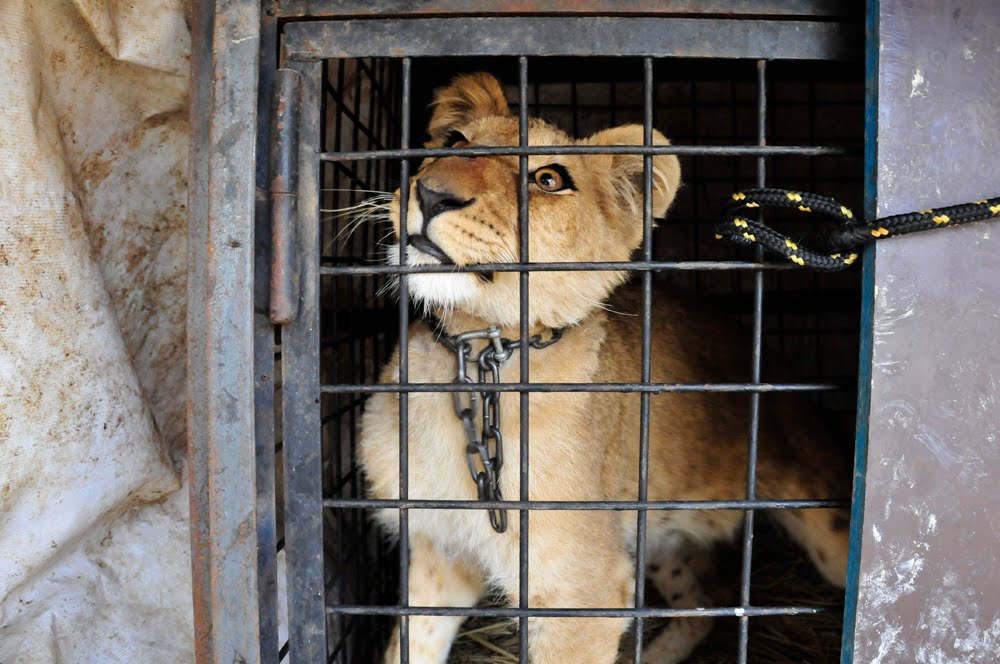
 Lebanese animal rights’ activists report serious abuse of mistreated circus animals on ring circuit from Egypt, Jordan, Syria to Lebanon.
Abuse of circus animals comes to forefront of Lebanese politics: When the Monte Carlo Circus’ lions and tigers arrived in Lebanon two weeks ago they were meant to be welcomed by beaming children, adoring parents and cooing students on field trips. But after Lebanese animal rights activists received an emergency alert from THE Jordanian border about abused circus animals en route from Egypt to Lebanon, endearing scenes of charming animals entertaining humans is not at all what took place.
“We received a tipoff from someone at the Jordanian border about some six lions and three tigers coming from Egypt to Lebanon,” Maggie Shaarawi, co-founder of Animals Lebanon, told The Media Line. “They had asked the people transporting the circus animals how long it had been since they had been fed and they said three days. They asked how many days the animals had been in cages and they were told 10 days.”
The tipoff, from the Princess Alia Foundation in Jordan, stated that the animals had been put in crates on December 11, shipped out of Egypt on December 21, and delayed for two days on the Jordanian border as the crew did not have the proper paperwork to continue with the animals to Syria. The crew admitted that the animals had not been provided with food or water since leaving Egypt, alleging that they had not been provided with funds to provide for the animals.
The Jordanian foundation purchased food and water for the animals and they were transported through Jordan, entering Syria on December 26. The animal rights group in Lebanon, meanwhile, had alerted the country’s Agriculture Ministry about the case.
“We opened a small investigation and before the animals arrived at the Lebanese border we contacted the head of animal resources at the Ministry of Agriculture and asked him to check the paperwork and health of the animals before allowing them into the country,” Shaarawi said. “He did not call us back and when we finally spoke with him he said that the animals had already arrived healthily and that the veterinarian at the border had reported that they are happy and jumping around.”
“So we went and waited all day at the circus for the animals to arrive,” she continued. “Beyond not being fed, it turns out the animals had been living in small cages for six months. The lions had recently been declawed and some of them were still bleeding and had infections. There was also an adult lion who does not move at all.”
There are no lion specialists in Lebanon, so the activists contacted Paul Hart, a specialist at a sanctuary for lions in South Africa. “He responded that the conditions that the lions are in are abysmal,” Shaarawi said. “He said that the lion cubs should be immediately confiscated.”
Less than 24 hours after arriving from the arduous journey, the animals were on stage, performing to a $40-per-seat audience aside snakes, jugglers and clowns. “We took high resolution pictures of the animals and the next day went to the agriculture ministry and showed the same man the pictures,” she said. “He didn’t care so we went to the minister himself.”
Lebanon’s Agriculture Minister, Hussein Al-Hajj Hassan, told the Animals Lebanon representatives that because Lebanon does not have robust animal protection laws, he did not have the legal framework to act against the Monte Carlo Circus’, which had brought the animals to perform in Beirut for six months. In the end minister agreed to launch an investigation into the health of the animals and whether the circus had followed the law.
“He told us to please go back tomorrow with the veterinarian of your choice,” Shaarawi said.
But a series of Agriculture Ministry officials tried to block the inspection, twice requiring the animal rights have their inspection permit reissued. When the inspection team finally made it to the circus grounds with the Agriculture Ministry’s veterinarian, a tense interaction ensued and the veterinarian allegedly did not take any notes.
Nabih Ghaouche, the director of animal resources at Lebanon’s Ministry of Agriculture, declined to comment on the matter when contacted by The Media Line. Various other officials at the Ministry of Agriculture, including the minister, could not be reached for comment.
The animal rights advocates claim that beyond the mistreatment of the circus animals, their permits to travel internationally were invalid.
“They didn’t meet any of the international regulations,” Jason Mier, the Executive Director of Animals Lebanon told The Media Line. “They have no valid microchip paperwork. They have no health paperwork. The animal’s transport didn’t meet even basic standards. Every single step of the way what they did was illegal.
“We are not against having a circus,” he said. “It’s a lot of work but you can do it legally, so if you want to do it, just do it legally.”
“But this circus is known for smuggling,” Mier said. “This is a bad guy and I hope someone shuts him down.”
Under pressure from the assiduous activist, the minister declared the animal’s transport to have been illegal and announced on Thursday that they would be sent back to Egypt within 24 hours, effectively closing down the circus.
“He warned them that he was being very lenient by not prosecuting the circus,” Meir said after a joint meeting with the minister and the local circus organizer. “But what they’re doing now is to try to use any connections they have to get the minister’s decision overruled.”
“They are supposed to leave today or tomorrow,” he said. “But this is Lebanon and if someone tells you they’ll be there in 5 minutes, it will take an hour.”
The story continues…
(This story is written by Benjamin Joffe-Walt and is republished with permission by The Media Line, the Mideast News Source.)
More on Middle East Zoos:
Gaza Zoo Paints Donkey to Look Like Zebra
Gaza’s “Heaven” Zoo is Untold Hell for Animals
At Tel Aviv Safari Non-kosher Turkeys Go to the Wolves
Image of caged lion cub from the Princess Alia Foundation



[…] De dieren hebben sinds het verlaten van Egypte geen water en voedsel meer gekregen. Ook werd vastgesteld dat de dieren al zes maanden in hele kleine kooien leven en dat de klauwen van de leeuwen recentelijk zijn verwijderd. Bron: Green Prophet […]
[…] http://www.greenprophet.com […]
[…] only zoos, circuses, pet shops, and wildlife parks will be permitted to keep CITES-protected species, but it remains to […]
[…] to adopt the King of the Jungle?” He’s selling an 8 foot long pelt of an adolescent lion to anyone looking to make a rug, or wall hanging, or as Zhon suggests, buy it just to […]
[…] fashion industry is not known for being friendly towards animals (particularly those of the furry variety), but Fashion Beirut contradicted expectations last month […]
[…] rejecting toxic waste in Beirut, consistent oil spills that degrade the Mediterranean Sea, and the maltreatment of animals. But the recent university graduate and his posse are approaching their environmental activism from […]
[…] Lebanon’s Lions, Tigers, and Bears Take the Heat AKPC_IDS += "48062,"; […]
[…] hot enough to fry eggs on the sidewalk and kids will want to stay inside in front of televisions to escape the heat. But DI Berhard Gruber has designed a playground that is not only cool enough to play in, but also […]
I just visited zazoo in beirut over the eid il fitr holidays and the way the animals are kept there in very bad conditions especialy the bear i wish somebody can help these poor animals.
Can you tell us more, Mimo? Did you take pictures?
[…] Mid East animal articles worth reading: Circus Animals Brought to Lebanon Found Abused Kosher Turkeys “Going to the Wolves” in Tel Aviv Egypt Culls 300,000 Pigs in Response […]
RT @SofiaGoncalves Lebanon’s Lions, Tigers and Bears Take the Heat | Green Prophet: http://bit.ly/7IAPA0 Well done Lebanon!!!
RT @SofiaGoncalves: Lebanon’s Lions, Tigers and Bears Take the Heat | Green Prophet: http://bit.ly/7IAPA0 Well done Lebanon!!!
Lebanon’s Lions, Tigers and Bears Take the Heat | Green Prophet: http://bit.ly/7IAPA0 Well done Lebanon!!!
RT @SofiaGoncalves: Lebanon’s Lions, Tigers and Bears Take the Heat | Green Prophet: http://bit.ly/7IAPA0 Well done Lebanon!!!
RT @dsfanblog Lebanon’s Lions, Tigers and Bears Take the Heat (GreenProphet) http://ow.ly/VN5s ~ Serious abuse of mistreated circus animals.
Lebanon's Lions, Tigers and Bears Take the Heat | Green Prophet: Lebanese animal rights' activist repor.. http://bit.ly/6WxNRs
Lebanon's Lions, Tigers and Bears Take the Heat | Green Prophet: Lebanese animal rights' activist repor.. http://bit.ly/6WxNRs
Lebanon’s Lions, Tigers and Bears Take the Heat http://www.greenprophet.com/2010/01/12/16084/lebanese-circus-animal/
More from Lebanon's Daily Star:The family of circus owner Hussein Akef, which has operated circuses for the last 100 years, has in fact been investigated in several countries over concerns for animal welfare. One such investigation in Mozambique led to the family having their animals confiscated in 2007 and re-homed. http://www.dailystar.com.lb/article.asp?edition…
I am so happy to hear that there is a strong activist spirit in Lebanon. I just read that the Lebanese government though had ordered the animals shipped out of the country:http://www.animalslebanon.org/NewsDetails.aspx?…That's no way to deal with animal rights issues – by handing them back to the people who mistreat the circus animals. They should be confiscated and sent to sanctuaries where they can be treated humanely. All events involving live animals should be banned, IMHO. Looking at animals this way just shows humans how uncivilized we are.
More from Lebanon's Daily Star:The family of circus owner Hussein Akef, which has operated circuses for the last 100 years, has in fact been investigated in several countries over concerns for animal welfare. One such investigation in Mozambique led to the family having their animals confiscated in 2007 and re-homed. http://www.dailystar.com.lb/article.asp?edition…
I am so happy to hear that there is a strong activist spirit in Lebanon. I just read that the Lebanese government though had ordered the animals shipped out of the country:http://www.animalslebanon.org/NewsDetails.aspx?…That's no way to deal with animal rights issues – by handing them back to the people who mistreat the circus animals. They should be confiscated and sent to sanctuaries where they can be treated humanely. All events involving live animals should be banned, IMHO. Looking at animals this way just shows humans how uncivilized we are.
Lebanese animal activists crack down on circus animal abuse http://www.greenprophet.com/2010/01/12/16084/lebanese-circus-animal/
News:: Lebanon's Lions, Tigers and Bears Take the Heat http://www.greenprophet.com/2010/01/12/16084/lebanese-circus-animal/