


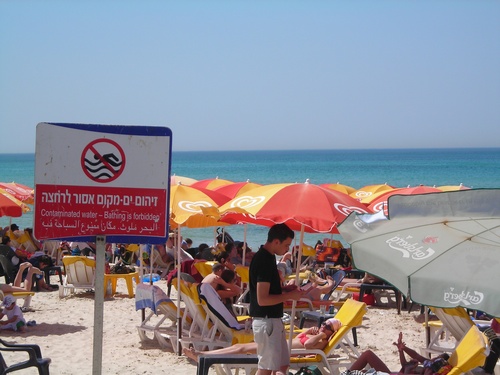
 Sign for polluted water at Israel’s beachfront: obvious in any language
Although much hype and attention is given to Israel’s contribution in the areas of clean technology, particularly solar energy and other forms of renewable energy more attention needs to be made on the country’s growing “contribution” to global warming.
Despite this small country’s efforts made in the fields of clean forms of energy, with 7.5 million people, it produces more than its share of air and water pollution, creating a growing carbon footprint problem.
In his blog Energy Inc David Levy explored Israel’s carbon footprint and what he thinks can be done to lessen it.
According to Levy, Israel suffers from both a growing air, ground and water pollution problem and also a worsening water problem, due to a projected decline in annual precipitation amounts of anywhere between 10 and 20% of what used to the annual rainfall average.
He pointed out that although Israel has reached a European level standard of living, it’s still classified as a developing country in regards to the Israeli government’s “historically low priorities” in dealing with environmental problems. For this reason, dealing with emissions and other forms of pollutions have not been high on government agendas; even during election years.
Levy did point out that more than half of the country’s population live mostly on the narrow coastal plain that is just “a few meters above sea level.” Although many of them have a growing awareness of environmental problems there has been too little attention by the government on emissions and other pollution problems until recently.
He lists ways in which Israel can improve its environmental qualities in the realms of energy security, economic development, its status within the international community, and in creating a cleaner environment.
Levy mentions Israeli clean tech companies such as BrightSource, one of the country’s leading solar energy companies; and Shai Agassi’s Better Place electric car company which has already attracted much attention from countries outside of Israel.
But in order of Israel to put its own environmental house in order, Levy outlines 4 basic steps that the Israeli government needs to take in order to do this. Actually his tips come from the McKinsey report, produced by the Israeli government (links to PDF):
1. Establish ambitious national GHG abatement goals as government policy.
2. Formulate Israel’s Low Carbon Growth Plan (LCGP) defining the mechanisms and timing of implementation.
3. Translate the national abatement plan into detailed operational measures including ways to finance the upfront investment.
4. Establish a central body to monitor progress in implementation.
Levy’s bottom line has to do with the Israeli public: they need to become more aware of their country’s environmental problems and as such be more involved in finding solutions.
He feels that Israeli businesses are not serious enough in respect to climate change and Israel’s contribution to global warming. More cooperation is needed among the general public, government agencies, and the business community in order to make the required changes to improve the local environment.
Perhaps the upcoming 2010 Eilat-Eilot Renewable Energy Conference could help make people more aware of ways to reduce the country’s dependence on fossil fuels. It will be held on February 16-18.
Photo via www.ynet.co.il
More on Israel’s environment and clean tech business:
Environmental Issues and Israel Election Results
Going on a Picnic to Tel Aviv’s Hiriya Garbage Mountain
Cooperative for Renewable Energy Invests in Clean Energy and Community in Israel


[…] torwards helping to clean up its part of the Mediterranean. This is especially true in regards to helping reduce the country’s regional carbon footprint that could become even “heavier” due to drilling of undersea natural gas and […]
What Israel can do to reduce carbon levels & promote awareness-a topic at the Feb Eilat #Renewable #Energy conf: http://bit.ly/lowerCarbon
Israel Can Do More Than Cleantech to Reduce Regional Carbon … http://bit.ly/8rvRcC
Israel is really a leader in clean-tech. Such a shame it doesn't take care of it's own environmental housekeeping. It's understandable though…since clean-tech is developed by private entities, and environmental awareness is the government's role. The Israeli government is lagging behind the world, ecologically speaking.
Israel is really a leader in clean-tech. Such a shame it doesn't take care of it's own environmental housekeeping. It's understandable though…since clean-tech is developed by private entities, and environmental awareness is the government's role. The Israeli government is lagging behind the world, ecologically speaking.
#Israel Can Do More Than #Cleantech to Reduce Regional Carbon Footprint; steps the Israeli gov't needs to take http://tinyurl.com/yfe8edl
RT @EarthAdapt #Green #Energy : Israel Can Do More Than Cleantech to Reduce Regional Carbon.. http://bit.ly/4wzm1E ; ) EarthAdapt.com: #G..
Israel Can Do More Than Cleantech to Reduce Regional Carbon …: He pointed out that although Israel has reached a… http://bit.ly/7rJjyU
Israel Can Do More Than Cleantech to Reduce Regional Carbon … http://bit.ly/5alp1l
Israel Can Do More Than Cleantech to Reduce Regional Carbon … http://bit.ly/8KR1ns
Israel Can Do More Than Cleantech to Reduce Regional Carbon … http://bit.ly/8rvRcC
Israel Can Do More Than Cleantech to Reduce Regional Carbon … http://bit.ly/8rvRcC
RT @ecologicearth: RT @EarthAdapt: #Green #Footprint על ישראל לפעול מעבר לתחום האנרגיה על מנת להפחית את הזיהום במזה"ת http://bit.ly/6SU8HY