

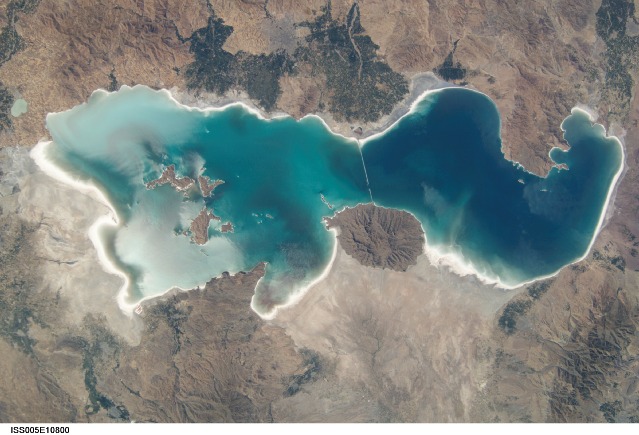
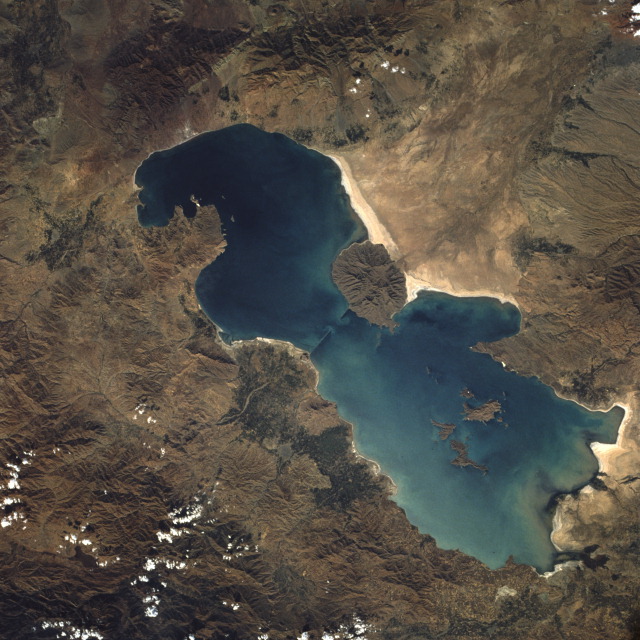
 A salt lake in Iran has given rise to a new species of algae for biofuel. This is the large salt lake “Urmia”.
Are the Iranians looking for biofuel alternatives such as algae to dangerous and polluting nuclear power? Iran Daily reports that researchers at Iran’s Shiraz University have succeeded to make biofuel from algae, a new kind of algae for biofuel Science Direct reports.
Either the threat of increased international sanctions is finally convincing the Iranians that so much emphasis in “going nuclear” is not good for them in the long run. Or, perhaps, the mullahs there are realizing that there are feasible alternatives to using enriched uranium to provide fuel, as well as for using their petroleum reserves which someday will be depleted.
The Iranian project leader Dr. Mohammad Hossein Morowvat (not listed on the university directory) said: “Iran and many other countries are seeking new energy sources like biofuels.”
The production of biofuels from algae and other sources is the only resource humans hope to have in future. During photosynthesis, algae and other photosynthetic organisms capture carbon dioxide and sunlight, and convert it into oxygen and biomass. These fuels do not affect freshwater resources, can be produced using ocean and wastewater, are biodegradable and relatively harmless to the environment if spilled. Algae farms can be hooked onto existing power plants and be used as huge carbon sinks.
Using algae as a biofuel doesn’t seem compatible with the Islamic Republic right now, vociferous for its nuclear ambitions. But it may be a means for the liberal people in the country to make change from within.
Turning this common aquatic plant into a good quality biofuel is the focus of several projects underway in Israel, including joint projects with NASA to fuel spaceships sending astronauts into space; and with the Chinese by utilizing “flue gasses” from power plants. And of course the country is home to the godfather of algae for biofuel, Isaac Berzin.
But the Iranian algae biofuel project is no joke: it’s being carried our by researchers at Teheran’s Shiraz University who succeeded in producing green fuel from the algae Chlamydomonas. The microalgae were isolated during a screening program from soil and water samples collected from paddy-fields of Fars province and the Maharlu Salt Lake, and the researchers registered their findings at the National Center for Biotechnology Information (NCBI) which is based in the USA, making the connection with biofuels from Algae in Iran even more bizarre. Or not?
Dr. Morowvat went on to say that Iran, like many other countries, is working on projects to find new energy form biofuels. Iran, which still has at least 10% of the world’s supply of oil, and whose government seems emphatic on developing a large scale nuclear energy program as well as possibly becoming a nuclear power, seems also to be exploring both alternative and renewable energy possibilities as well, and has even embarked in a solar energy project reported on Green Prophet a year ago. Not more has come of it though, as it seems.
Perhaps reason and sanity might eventually prevail in a country which seems determine to develop a potentially destructive genie, that once let out of the bottle could b e very disastrous for Mankind – especially for the State of Israel, Europe and the US – all entities which are very much involved in both alternative and renewable programs, including these “green” micro-organisms, that “capture carbon dioxide and sunlight, and convert it into oxygen and biomass” and which can be grown in both salt and waste water.
If only Iran’s more radical leaders, especially President Mahmoud Ahmadinijad, could be persuaded to pursue energy projects such as solar energy and biofuels, instead of nuclear energy.
According to this April, 2009 article, the Iranians are also interested in producing ethanol from plant waste. So far just talk and no action, that we can report on yet.
::Iran Daily
::Shiraz University
More on algae for biofuel:
Isaac Berzin enlist Israelis into the Business of Algae foe Bio Fuel
Expanding the Role of Algae: Algaenesis
Squeezing Energy From a Plant’s Metabolism at Tel Aviv University
Image via Pars Times.


[…] Shifra Mincer | May 6th, 2012 | Comment | Email this tweetmeme_url = 'http://www.greenprophet.com/2012/05/univerve-algae-biofuel/'; tweetmeme_source = 'GreenProphet'; tweetmeme_service = 'awe.sm'; service_api = '0c4b6af1aba54fb228c924aab3353dbbcb348cceabf15d2a0ce7b3f7efdbeaa3'; Share Late this February Israeli financial newspaper Calcalist, along with Israel Society for the Protection of Nature in Israel, hosted a competition to honor Israel’s leading cleantech start-ups. Among the 12 competition finalists, was UniVerve, an Israeli biofuel company that specializes in using microalgae to create oil. […]
[…] lonesome Isaac Berzin from GreenFuel who rejuvenated NASA’s strange idea; afterwards there is Iran formulating biofuel from algae (they didn’t answer a emails though); and Seambotic an Israel association rising a blurb algae […]
[…] covered Isaac Berzin from GreenFuel who rejuvenated NASA’s original idea; then there is Iran creating biofuel from algae (they didn’t answer our emails though); and Seambotic an Israel company launching a commercial […]
[…] projects that include its ongoing and highly controversial nuclear energy program, as well as biofuel projects such as one to create bio fuel from algae at the large Urmia salt lake in northwestern […]
[…] more on algae for biofuel: Iran Creates Algae for Biofuel Isaac Berzin enlist Israelis into the Business of Algae foe Bio Fuel Expanding the Role of Algae: […]
[…] biofuel from algae is now being worked on in many parts of the world; even in Iran where researchers connected with Shiraz University were able to create bio fuel from algae being grown in a salt lake in the country. Though when we sent them an email asking about their […]
[…] on this news site have shown the possibilities of producing biomass based fuel using everything from algae grown in special lakes in Iran to genetically altered algae to produce food as well as biofuel, and even the creation of biomass […]
[…] acquiring nuclear weapons. They do have some environmental projects, including one we reporting on bio-fuels from algae at a site near the large Maharlu Salt Lake in Fars Province. But Iran cannot hide its nuclear […]
[…] They do have some environmental projects, including one mentioned on Green Prophet that deals with making bio-fuels from algae at a site near the large Maharlu Salt Lake in Fars Province. As we have noted in several […]
So how comes an Eco Terrorist group is paying the JP to host its fantasy articles trying to disguise the fact the barbaric iranian regime is developing nuclear weapons which they claim are power plants.
So how comes an Eco Terrorist group is paying the JP to host its fantasy articles trying to disguise the fact the barbaric iranian regime is developing nuclear weapons which they claim are power plants.
RT @link2green: RT @GreenProphet Iran Creates Biofuel from Algae http://www.greenprophet.com/2010/01/08/15784/algae-biofuel-iran/
RT @GreenProphet Iran Creates Biofuel from Algae http://www.greenprophet.com/2010/01/08/15784/algae-biofuel-iran/
RT @link2green: RT @GreenProphet Iran Creates Biofuel from Algae http://www.greenprophet.com/2010/01/08/15784/alga… http://bit.ly/82AkdT
[…] noted some promising bio-fuel projects taking place in and around the Middle East, including one taking place out of bacteria from a salt lake in Iran using the microalgae, Chamydomonas. Another project, involving a company named MME New Diesel, will […]
RT @algaebiofuels Iran Creates Biofuel from Algae
– http://bit.ly/6fma1V: Iran Creates Biofuel
– http://bit.ly/6f… http://bit.ly/5jfp9A
RT @algaebiofuels Iran Creates Biofuel from Algae
– http://bit.ly/6fma1V: Iran Creates Biofuel
– http://bit.ly/6fma1V http://bit.ly/63oOuk
I think the US is afraid of Iran's megalomaniac leader.
Cool. Maybe if they went exclusively to algae bio-fuels the US would still want to invade them for oil.
Iran Creates Biofuel from Algae
-http://bit.ly/6fma1V: Iran Creates Biofuel from Algae
-http://bit.ly/6fma1V http://bit.ly/63oOuk
Why aren't more countries doing this? Bio fuel form algae sounds like win win to me.John R. Carlisle
RT @FueltheFuture: Iran working on biofuels from algae? http://bit.ly/7tcqcO
Iran working on biofuels from algae? http://bit.ly/7tcqcO
Iran Creates Biofuel from Algae
-http://bit.ly/6fma1V
Coastal Harvest™ – Emerald Crude™ – @GreenProphet Iran Creates Biofuel from Algae http://bit.ly/6Gvr8f: Coastal … http://bit.ly/6FtH9q
Very encouraging news. I heard Iranians are amazing scientists, especially in chemistry. I hope they continue to use their power in positive directions.