

 When we talk about water security in the Middle East, Israel could play a role in making water allocation a sustainable endeavour for this water-starved region. Partnering with the Strategic Foresight Group for its water series, Green Prophet interviews one of the most influential water company in Israel today: Mekorot.
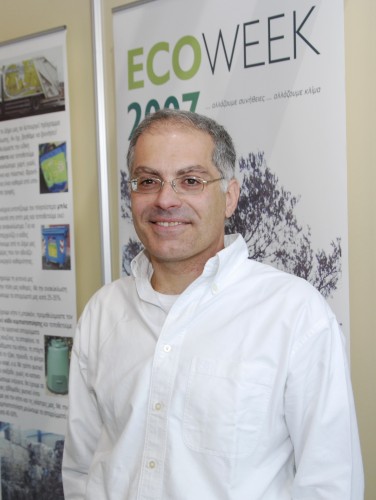
We talk with Eli Ronen, the chairman of the board at Israel’s National Water Company – Mekorot. Founded in 1937, Mekorot has set up hundreds of water projects all over the country, and also globally – most recently it’s announced its intentions to desalinate California. Mekorot is also a pioneer in the field of new water technologies, handled by its WaTech division. Here are Ronen’s answers to the 5 questions we posed to him.
Q1. Turkey and Israel have had talks about freshwater supply and purchase in the past. The Turkish government has been positive in its overall response so far but there is some opposition to this in the Turkish political spectrum. If the Turkish government were to agree to supply 1 BCM of freshwater to Israel, is there a possibility that Israel will agree in return to share this water with the Palestinian Authority (PA) and Jordan?
A1. The only way to purchase water from Turkey is by laying an underwater pipeline from Turkey to Israel. This solution was suggested to the Turkish officials, unfortunately there is no progress. If such pipeline is constructed, it will be possible to supply water to the entire Middle East: Lebanon, Syria, Jordan, P.A, Egypt and Israel. Bringing water by boats, as was suggested a few years ago, is neither efficient nor economical.
Q2. Israel is counting on desalination as a major source of its future water supply. However, there are limits to the growth of Israel’s water supply based on marginal water alone. What are the other ‘regional’ solutions that Israel can examine in terms of water cooperation with other countries?
A2. The most beneficial regional solution is to construct the Red Dead canal in order to produce fresh water through desalination by means of hydroelectric energy. This water can be supplied to Jordan, P.A and Israel. Furthermore, it can save the Dead Sea which is being diminished year by year.
Q3. Lebanon’s Litani River has a particularly high quality of water, with a very low quantity of chlorates and nitrates present. Water cooperation with Lebanon would therefore serve Israeli interests but in order for this to happen, political cooperation between these two parties is required; in addition Israel-Lebanon relations are inter-linked with the Israel-Palestine conflict. Is it worth it for Israel to find political cooperation with Lebanon in order to secure its water situation or is this not a practical option?
A3. –
Q4. Technical reports suggest that over-pumping is leading to the depletion of groundwater aquifers in the West Bank, both in terms of water levels as well as water quality. This could cause water shortages in the short-run and devastation of the eco-system in the long-run. What can be done to preserve these aquifers?
A4. In order to preserve the aquifers excessive water pumping needs to decrease. This can be accomplished only after finding alternative sources of water such as re-used water for agriculture, brackish water and rehabilitation of contaminated wells.
Q5. Israel has experienced a severe drought period in the recent past. With environmental neglect and the effects of climate change, this can be a frequent and imminent risk in the future. What can be done to minimize the impact of such a danger in terms of national measures as well as well as regional cooperation?
A5. The answer to this question is mentioned in answers 2 and 4.
More from our water series:
Gidon Bromberg on Water Security and Sustainability in the Middle East
Read our interview with Israel’s Water Commission
Interview with Israel’s past water commissioner, Shimon Tal
All the Water in Israel: Interviews with Government, Analysts and Researchers



[…] adjacent soil before it even reaches the sands. The plant, in combination with Israel’s national water company Mekorot, is working to improve its methods. Mekorot routinely pumps 130 million cubic meters of purified […]
[…] national water company, Mekorot (who we’ve interviewed here), is expanding with projects across the globe. It will build and operate two desalination plants in […]
[…] a result, Israel’s Mekorot Water Company estimates that by the year 2013, 75 percent of the country’s waster needs will come from […]
[…] to the Tel Aviv area. Seawater intrusion has reached epidemic levels in the south of Israel. Mekorot, the National Water Company, is developing a plan to restore aquifers near […]
[…] the one signed by SABESP and Israel’s national water company, the government-owned Mekorot (read our interview with Mekorot’s chairman here). “They signed an agreement, a framework agreement in various fields,” says Nir. […]
[…] and Sustainability in the Middle East 4. Read our interview with Israel’s Water Commission 5. Interview with Eli Ronen, chairman of Mekorot 6. Interview with Ranaan Borel, water consultant and activist 7. Interview with the Mayor of […]
[…] and Sustainability in the Middle East 4. Read our interview with Israel’s Water Commission 5. Interview with Eli Ronen, chairman of Mekorot 6. Interview with Ranaan Borel, water consultant and activist 7. Interview with the Mayor of […]
[…] and Sustainability in the Middle East 4. Read our interview with Israel’s Water Commission 5. Interview with Eli Ronen, the Chairman of Mekorot 6. Interview with Ranaan Borel (SPNI) on Water Security in Israel AKPC_IDS += "15881,";Browse […]
[…] Bromberg, a TIME Magazine environment hero, and regional water champion. And we can’t forget Eli Ronen, the chairman of Mekorot, the country’s national water […]
News:: Interview With Eli Ronen, Chairman of Mekorot, Israel's National Water Company http://bit.ly/6RHqlt
RT @greenprophet: ראיון עם אלי רונן, יו"ר מקורות – איך מפתחים מקורות מים מקיימים בישראל? http://bit.ly/6RHqlt #green #water