

Green Prophet had reported on Rawabi (for Hills), the first “planned” city for Palestinians back in 2007; We are not sure if the Israeli or American urban-style mortgage model is the one to follow for a sustainable community (as Daniella asks in her article about Palestinian malls).
Now Felice Friedson editor of The Media Line, the Mideast News Source, looks at new developments in the project:
For many Palestinians, the norm is tight-quartered living with barely a garden in sight, no defined sidewalks and a poor water system. But this is about to change with an ambitious plan for a new way of living.
Just six miles north of Ramallah, Palestinians have begun planting thousands of evergreen tree saplings as part of a major greening project to grow a forest to hug the edges of what will be the first planned Palestinian city.
The city is already named Rawabi, Arabic for “hills”. For Palestinians it presents a new kind of urbanism, which aims to draw middle-class professionals away from smoggy towns and villages towards a better way of life.
Besides being the first planned city, it also marks the first planting of a major forest by Palestinians in the territories since Israel took control 42 years ago. It is also the first time serious arrangements are being made to provide Palestinians with American-style mortgages.
Palestinian entrepreneur Bashar Masri is the force behind Rawabi. A chemical engineer by training, he is the human bulldozer who aims to turn his vision into a reality and modernize the heart of the Palestinian territories.
Building a sustainable city from scratch
“There is a great shortage of housing in Palestine,” Masri said during a tour of the planned site. “As you can see there is hardly anything here. That required setting the city up from scratch, which made the project much bigger and much more sophisticated and complicated, but we love it.”
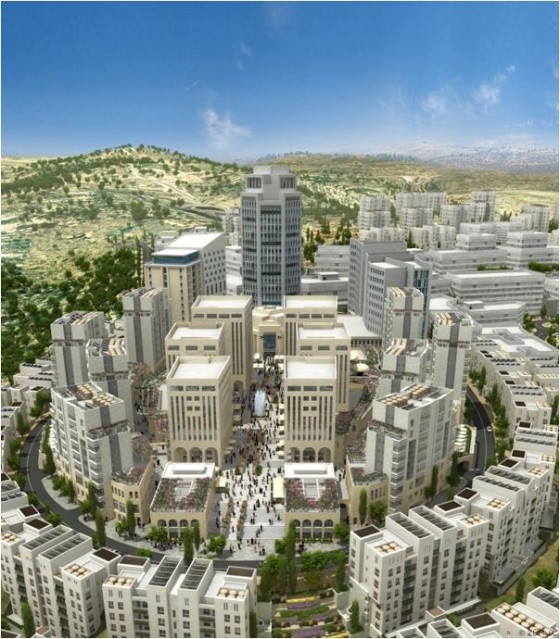
It will be home to about 40,000 residents who aspire to own an affordable apartment. Neighborhoods will be spacious and green. They’ll have sidewalks and parking garages, something unheard of in most Palestinian communities. The town center will be a hub of high tech, mainly IT businesses, to provide jobs for the educated but underemployed Palestinian work force.
“A project like this can create 8,000 to 10,000 jobs in construction alone,” Masri said. “In addition, we are working on creating permanent jobs (in Rawabi) so this won’t be a bedroom community […] dependent on political closures and checkpoints.”
According to Rawabi’s main designer, architect Shireen Nazeer, the city is breaking away from old urban traditions in many ways.
“Really we are creating history and we are also creating affordable houses for a new generation of Palestine,” Nazeer said. “We have integrated this new idea of how we can live in neighborhoods and how to share all the public and open spaces inside the neighborhoods”
Just as Israeli apartment dwellers in crowded cities like Tel Aviv opted for suburban living in areas that came under Israeli control after the 1967 war, Palestinians are looking for a more rural existence in Rawabi, where 60% of the town will be green areas.
Although not quick to admit it, several aspects of the Rawabi package, from environmental awareness to mortgages, mirror Israeli urban planning. Recently Moshe Safdie, the Israeli architect who designed Israel’s planned city, Modi’in escorted Masri’s staff around Modi’in to learn about the failure and successes of his city.
Agreeing to work on water cooperation
But Rawabi collegial cooperation with Israelis is not entirely a matter of benevolence. The city itself is to be constructed on land in Area A, which according to the Oslo Agreement is completely under the Palestinian Authority’s control and therefore needs no Israeli approval. Still, the city rests on Israeli permits to move forward, particularly regarding water allocation and access routes that pass through Area C, which is controlled by Israel.
According to Bayti Real Estate Investments Company, which oversees the Rawabi project, Israel’s Civil Administration in the West Bank has granted the permits necessary for the “Grow-for-Greener Palestine” project, which will see the planting of 25,000 trees.
The first 3,000 trees were provided by the Jewish National Fund, who also provided consultants on growing forests – an area the Palestinians have been unable to develop experience in.
“There are 170,000 dunams of (existing) forest in the West Bank and it has been illegal for Palestinians to plant until now” said Oren Blonder, Director of Agriculture, Water & Environment for the Peres Center for Peace.
Construction has yet to begin as Masri waits for Israel’s permission to move the jurisdiction of the necessary access road to the Palestinian Authority, a road that currently winds through Israeli controlled Area C.
Masri is open to Israeli co-operation on a business to business level.
“We realize Israel is one of the most advanced nations in the area, especially in technology and we will co-operate with them,” he said.
But that stops cold when it comes to Jewish settlers in the West Bank. Looking out across the valley Masri points out the Jewish community of Ataret.
“The only exception to that is Israelis who are settlers,” Masri said. “We will not deal with settlements. We will not work with settlements. Hopefully, that settlement will one day be a suburb of Rawabi and will be inhabited by Palestinians and will be welcome to Jews who want to live in a Palestinian state.”
This ambitious $800 million project is the largest to have been undertaken by Palestinians. It is funded by Qatari Diar Real Estate Investment Company and Massar International, of which Masri is chairman.
Five thousand inhabitants are expected to move in during the first phase. At that point a local mayor and council will be elected. Massar’s role ends here with the exception of the leasing of the town center.
Masri is trying to woo back Palestinians living abroad, which he estimates will account for 10% of the potential buyers of deluxe homes and boarding school places. Real estate prices will range from $140,000-$150,000.
Middle East mortgages, American-style
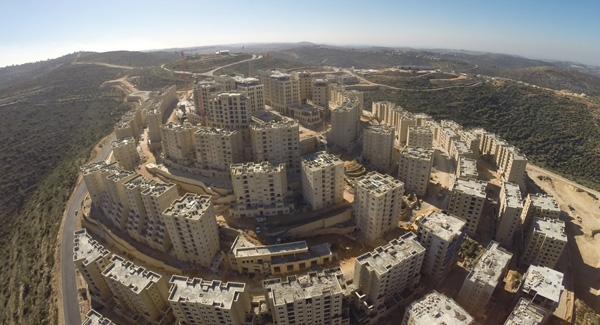
The home sales plan aims to transform the Palestinian clan based culture, which has traditionally seen men steadfast in their hometowns. The Middle East Investment Initiative is setting up the first American-style mortgage company to provide young Palestinians the opportunity to purchase affordable homes. With 10% down, the average monthly cost of a mortgage will be about $700 – approximately one-quarter of a typical monthly middle-class wage.
Mahmoud and Nora Ibrahim, potential Rawabi buyers, are look to the futures of their two young boys.
“Living in a crowded city like Ramallah it is not safe for us to keep our children anywhere, but we feel that Rawabi will mean a bigger home for us, having our children in safe places and public gardens,” Mahmoud Ibrahim said, but added he hoped the mortgage terms would be adequate.
“I hope we will find good offers from Rawabi that can meet our needs and capabilities as an average family in Palestinian society. I hope to see affordable prices and affordable payments,” he said.
Rawabi is home to a number of “firsts” for Palestinians — the first planned city, the first attempt at reforestation, and the first mortgage program for buyers – none of which come without risks.
“There are risks all over the project. There are political risks, commercial risks, and social risks,” Masri said.
Masri cautioned that lack of progress on the political front could deter investors, but that the project will continue regardless.
But Masri is betting that the lure of suburban life which is markedly safer and infinitely more aesthetically appealing will make Rawabi another “first” – the first of many planned cities to follow.
More on urban planning for Palestinians:
Rawabi Is First Planned City for Palestinians
Palestinian Mall in Jenin Could Bring Suburbia to the West Bank
(This story is printed with permission from The Media Line)


[…] Article continues: http://www.greenprophet.com/2009/12/06/14196/rawabi-palestine-planned-city/ […]
[…] parking garages and American-style mortgages, Rawabi would appear to have more in common with Israeli cities like Modi’in than with nearby Palestinian cities like […]
#Green #Construction Planned City “Rawabi” Draws on Palestinian Enterpri.. http://bit.ly/5YXMG6 ; ) EarthAdapt.com
News:: Planned City “Rawabi” Draws on Palestinian Enterprise and Israeli Experience http://bit.ly/74uyVg