
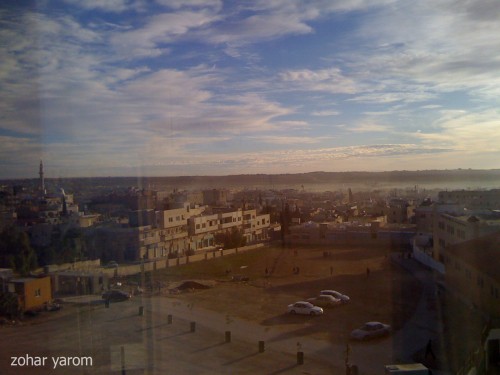

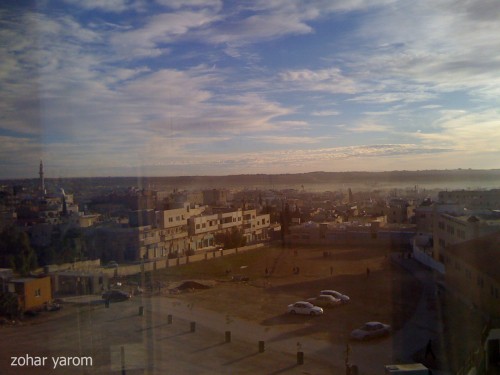
 Looking out the hotel window to the streets of Madaba, Jordan.
As the average tourist I received my first impression of Jordan with glimpses through the car window. I passed the border from Israel to Jordan through the northern border at Beit Shean.
The experience was very different from what I am used to: the experience was earthy, with an aroma of a simpler time. Narrow roads with no separation from the life alongside it; a variety of pedestrians, human and animal, market stands on the sides of the road with piles of seasonal vegetables and fruits. Imagine: I’m 32 year-old and today I got to meet Jordan, a neighboring country of mine, for the first time!
Before judging the sights and throwing a western point of view on what I saw, I decided to observe, smell, listen and pay attention to Jordan.
The ride and people along the way told me the story of transportation in Jordan. Appearing before me were mostly vans, trucks and cars for public transportation. Rickety roads and the driving culture all marked transportation priorities in this country.

After checking the numbers, I understood that Jordan is in a critical point regarding the attitude and planning of transportation in general, and the approach to the private car in particular. I learned that the number of vehicles per capita is 47 per 1000 people (# 81 highest per capita in the world); Israel has about 263 cars per 1000 people (#32 in the world), while the US leads (negatively) in this aspect with 765 vehicles per 1000 people.
Waking up: the morning time in Madaba made me envious of the people’s quality of life with so few cars seen in town. Below the window of the Madaba Inn hotel in central Madaba, I saw a small street and a school. There were more children walking to school than cars, and the sounds of the children playing overpowered any sounds that the cars made. At the same time in Israel in a similarly sized town on a similar street, there would have been a traffic jam.
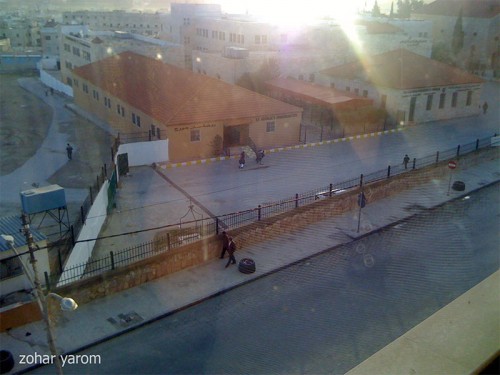
Another figure that supports the sensation I had in Madaba and its much fewer cars, relates to the amount of vehicles in the country compared to its population size. According to this statistic I found in Jordan there are 8 vehicles per square km (#57 in terms of density), while in Israel there are about 78 vehicles per square km (#11 densest in the world), almost 10 times more.
After leaving Madaba and heading to Amman, I saw a different story. There, the private car is close to winning the battle against the pedestrians. As for good examples in the world, looking at Curitiba, Brazil, for example, Curitiba, Brazil (links to Hebrew video) I see an opportunity for good public transportation in Jordan, and read the data of car use in Jordan with optimism. The western dream of development and its sanctity of the private car hasn’t impressed me for some time. The way the western culture has developed clearly favours cars over people. I hope that the Jordanian people and their leaders will recognize the importance of the human before the private car. Public transportation can make wonders in many areas including city health.
(Editor’s note: Zohar was part of Green Prophet’s Environment Bloggers Workshop in Jordan. Also: legislation in Jordan has slashed vehicle import taxes, according to a local source, which means that many more people are expected to be buying them in the near future. So far no news on a solid public transportation plan. )
 Zohar Yarom is an entrepreneur with experience in sustainable development in business and at home. She specializes in agenda marketing emphasizing green and social products. She is a graduate of the Environmental Fellows Program at the “Heschel Center” for environmental learning and leadership, has a B. Des. in industrial design from the “Bezalel Academy of Art and Design.”
Zohar is a mother of two, has been married for 9 years, and has been wondering about and searching within the environment issue since the age of 16. You can read more about her here on Green Change (in Hebrew) and here on Get Green (also in Hebrew).




My first post in English- have a nice reading
http://www.greenprophet.com/2009/12/26/14994/jordan-transportation-tourism/
#GTNews : From the Eyes of an Open-minded “Green” Tourist: Transportation in Jordan http://bit.ly/50MuEa
News:: From the Eyes of an Open-minded “Green” Tourist: Transportation in Jordan http://bit.ly/8yvpLe