

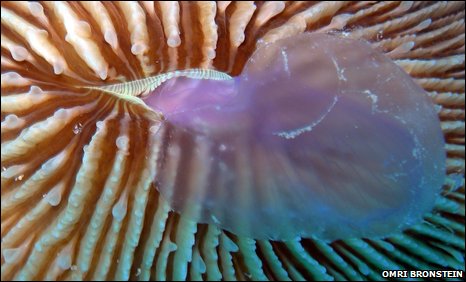
 Corals caught munching on jellyfish. Are they adapting to climate change?
It would seem that jellyfish, often referred simply to as “jellies” wouldn’t have any problem floating around near patches of coral – unless that coral just happens to be a predatory species known as mushroom coral, or fingia scruposa in Latin.
This unusual phenomenon was seen last March in the coral reefs near the southern Israeli city of Eilat, on the Gulf of Aqaba. The story was reported in a British environmental news site Earth News which is part of the BBC. It’s as though corals may be reacting to stressful conditions at sea by changing their eating habits.
Aquatic conditions appeared to have resulted in a “bloom” or influx of a large number of moon jellyfish (Aurelia aurita) which were floating in the coral reefs, looking for the small aquatic organisms that the jellies normally fed on. This time, however, the high protein jellies have become lunch for a number of mushroom corals, which unlike most coral formations, are able to move about and even have a mouth that can literally suck a hapless jellyfish inside.
As preposterous as this may sound; when you examine the biological make up of the mushroom coral, you can see that they are very different from the normal reef-building coral which are made up of hundreds of tiny polyps that only feed on microscopic organisms measuring about 0.2 mm to 0.4 mm in size. In the case of the mushroom coral, however, they consist of one single polyp measuring 12 inches (30 cm) or more in width; and which have a mouth capable of literally sucking inside a jelly measuring the same size as the coral itself (see above photo).
The discovery was made by a group of young Israeli college students who were studying the local Red Sea marine life as part of a research project for a marine biology class at Tel Aviv University. They were studying the effects to marine life in the area as a possible result of climate change and global warming, which is apparently resulting in the normally chilly waters of the Red Sea warming up enough to result in larger than average jellyfish blooms.
Although not mentioned in the article, another reason for the increase in jellyfish, and likewise their being a food item for the coral, is the enrichment of the water with nitrates caused by Eilat fish farms which were ruining the marine life of the Gulf and which were finally forced to relocate to the Mediterranean, near the Israeli city of Ashdod.
Whatever the cause, the rather unusual phenomenon may now result in studies being conducted in regards to increases in jellyfish populations being the result of both climate change and biological disturbances in the normal eco-systems of seas and oceans in a number of locations, including the Great Barrier Reef in Australia and in the Seychelles.
Significant increases in jellyfish populations are now common-place in the Mediterranean Sea, with large numbers of these creatures seen every summer off the coasts of Israel and Lebanon, as noted in a previous Green Prophet article last June.
In this article, marine biologists attribute the increase in Mediterranean jellyfish populations from an increase in water temperature and water salinity as well as a decrease in predatory fish populations such as sardines and herring that feed on jellyfish.
Whether similar factors are present in the Red Sea is still being studied. And good thing there will be a new research ship to paint the Red Sea green.
But in regards to the mushroom coral, their apparent appetite for jellies could be a silver lining in an environmental cloud as these coral would not only help control an over population of jellies, but help revive the coral populations in an area whose coral reefs have been seriously depleted by environmental factors, as well as human fondness for farm raised sea bream.
::BBC
Photo: Omri Bronstein




[…] Corals Feeding on Jellyfish: Adaption To Climate Change? […]
[…] Corals Feeding on Jellyfish: Adaption To Climate Change? […]
TITLE – “there's always room for jello”I wish people would stop beating the “climate change” drum. It's getting REALLY old. Look, this is how these critters eat, and probably always have, whether it's hot or cold out. You guys are like a broken record, and about as annoying to listen to.
TITLE – “there's always room for jello”I wish people would stop beating the “climate change” drum. It's getting REALLY old. Look, this is how these critters eat, and probably always have, whether it's hot or cold out. You guys are like a broken record, and about as annoying to listen to.
[…] long ago Green Prophet reported strange activity of corals eating large jellyfish, as a possible response to global climate change. A team of young Israeli scientists got the […]
Evolution wins again! http://bit.ly/8cGhls
News:: Corals Feeding On Jellyfish: A Strategy To Deal With Climate Change? http://bit.ly/7LPpva