

 A model of Al Reem Island in Abu Dhabi. A playground for foreigners or ecological nightmare?
Looking at this gigantic real estate project, one might wonder if there will ever be an end to all of the monstrosities that being erected on every piece of available land in the United Arab Emirates and other parts of the Persian Gulf.
Located on Abu Dhabi’s Al Reem Island, a mere 600 meters from the island of Abu Dahbi itself, the grandiose project called al Reem Island is being undertaken by three groups: Sorouh Real Estate PJSC , Reem Developers, and Tamouh Investments. The project has gained interest as one of the first free zones in Abu Dhabi, where foreign nationals can buy property as leasehold.
On Al Reem, some 600 meters from the coast, developers are building a large marina on the island, a central business district and a special entertainment center known as the City of Lights.
All of these projects, including two 300 meter high business and residential towers, are being undertaken on a piece of land of only about 6.33 square km. Marina Square alone, a project of 15 high rise buildings, is being built by a good portion of the 12,800 strong labor force that Tamouh brought to the island to construct their three major projects there.
 So taking all of this into account, it doesn’t take much expansion of one’s imagination to understand what this project alone is doing to the surrounding Gulf environment , especially the marine life – or what’s left of it any way.
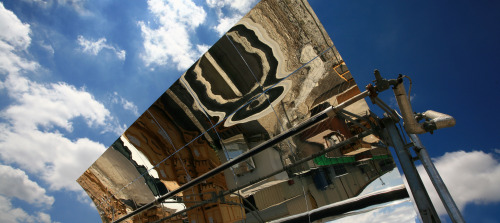
And at the construction sites themselves both air and soil pollution is definitely on-going (as shown in the photo left).
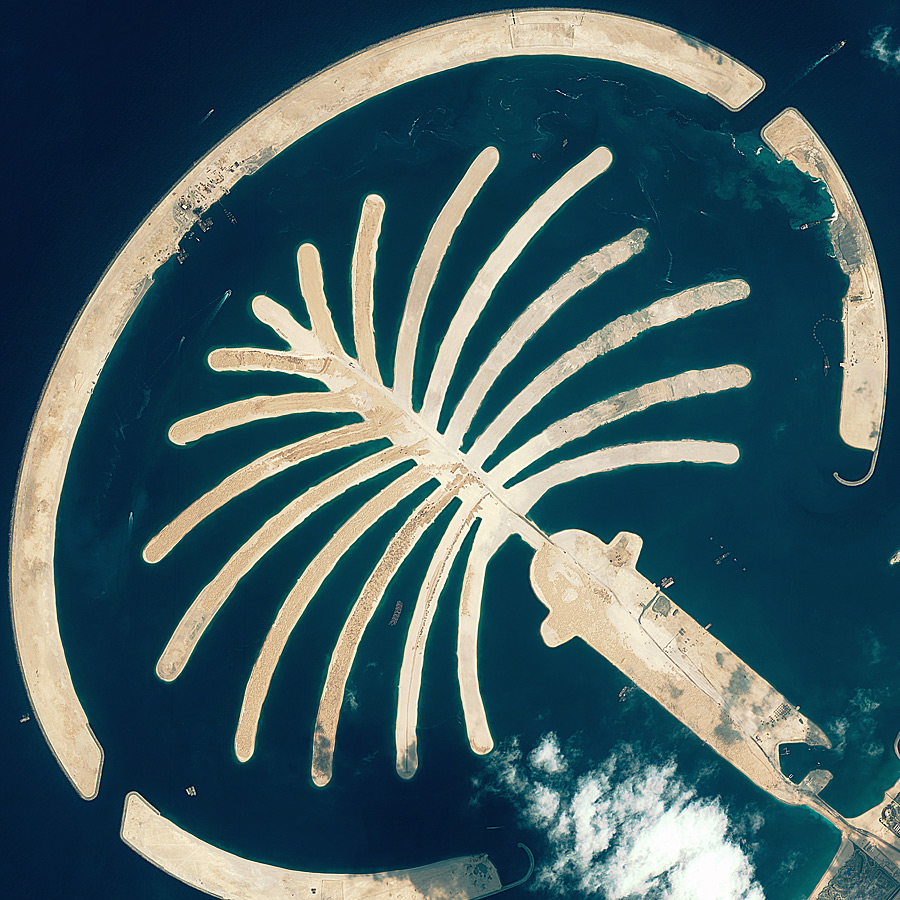
In previous Green Prophet articles on Palm Island in Dubai (pictured below), another one called The World, and what will be the world’s tallest building, the Dubai Burj Tower (a rotating skyscraper), give every indication that there is virtually no end to these developments, which one day might cover more than 90% of all available shoreline along an area stretching from Kuwait to Oman.
As environmentalists in the west rally to protect open spaces, there seems to be no stewards in the Arab world fighting to curb this unprecedented growth. Or maybe there are, but we can’t hear them?
There is good news that coral monitoring stations are going in place though.
As for the Al Reem Island projects, which will have a total of 147 high rise towers, housing as many as 65,000 residents – and connected with Abu Dhabi Island by no less than 7 highway bridges – the ecological damage that will result may be nothing less than catastrophic, to say the least.
And all of this is being generated by a combination of oil revenues and financial gains from the sale of real property and by profits made on various world stock exchange bourses.
If all this isn’t a better reason for concerned people to protest, as were the protests made at various world economic forums, including the recent G-20 Summit held in Pittsburgh P.A. USA in September, I don’t know what is. These projects are no way to save the planet.
Read more on the real estate developments in the Middle East:
Burj Dubai and the Tower of Babel
Dubai’s Wind Powered Skyscraper Is Building In Motion
Skyscraper Farming The Wave Of The Future In The Middle East?
Dubai Vertical Farmers Use Seawater In Skyscrapers To Water Crops
Urban Islands Mega-Projects Dubious Building Projects In Middle East
A Dubai Disneyland Coming to Lebanon (Fake Islands Project)?
Photo via www.skycrapercity.com
Top image via Creative Commons license




[…] region being threatened by pollution caused by over development of artificial islands, and other large real estate projects in both Abu Dhabi (Al Rheem Island); and in neighboring Dubai, where coastal erosion is taking its toll on the region’s […]
[…] “The World” which is threatening marine and coastal eco-structures; as well as Abu Dhabi’s Al Reem Island project, considered by many to be nothing more than “a playground for the […]
[…] concerns in the Middle East, especially real estate developers in countries like the UAE, Kuwait, Qatar, and Saudi Arabia are not being concerned enough about the environment, according […]
As far as the essential concept all the farming structure plans seem rational, but, what about societal psychology compatibility? The buildings seem low in appreciable design.I think these concepts are lacking in art and might induce culture shock some.I'm not sure what needs to be done to fix the appearance of these farming structures but the over all idea of these new farming skyscrapers is acceptable.The looks of the buildings seems too basic and not modern enough. Aside from comparing these futuristic buildings to contemporary designs I think the length of time people will appreciate the appearance of these current designs is too short, maybe not even 10 years.Thanks for the your serious efforts thus far, but, in my opinion, more industrial psychology science needs to be applied to these building designs in order for all the people to appreciate the building's facade.
As far as the essential concept all the farming structure plans seem rational, but, what about societal psychology compatibility? The buildings seem low in appreciable design.I think these concepts are lacking in art and might induce culture shock some.I'm not sure what needs to be done to fix the appearance of these farming structures but the over all idea of these new farming skyscrapers is acceptable.The looks of the buildings seems too basic and not modern enough. Aside from comparing these futuristic buildings to contemporary designs I think the length of time people will appreciate the appearance of these current designs is too short, maybe not even 10 years.Thanks for the your serious efforts thus far, but, in my opinion, more industrial psychology science needs to be applied to these building designs in order for all the people to appreciate the building's facade.
Green Prophet » On Abu Dhabi's “Al Reem Island” – Who's Protecting …: If all this isn't a better reason for c.. http://bit.ly/3pcsxL
.@greenprophet On Abu Dhabi’s “Al Reem Island” – Who’s Protecting (Artificial) Open Spaces http://j.mp/2TphQD http://j.mp/2uHln8
Green Prophet » On Abu Dhabi's “Al Reem Island” – Who's Protecting …: Located on Abu Dhabi's Al Reem .. http://bit.ly/1D71Z
News:: Abu Dhabi's Al Reem Island http://bit.ly/1LMcn1