

Biofuels are alternative energy fuels produced from living organisms or metabolic byproducts . If we could just find a more efficient way to unlock their energy, and to minimize the amount of land and water resources needed to grow them, they could replace the polluting and limited reserves of fossil fuels currently in use.
Now Kaiima Bio-Agritech believes that it has found a way to do just that.
“The oil is going to end,” Ariel Krolzig, product manager of Kaiima, tells ISRAEL21c. “It’s a question of time. In the last few years no new oil fields have been found. Why are countries like Brazil looking for alternatives?” he asks rhetorically.
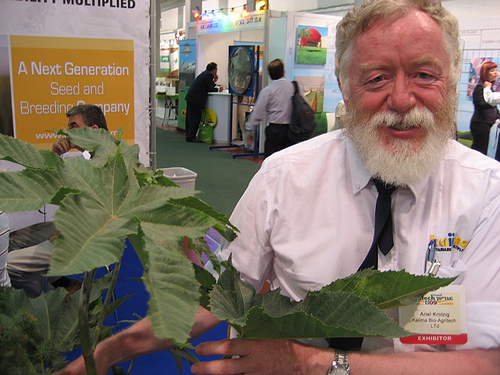
Sporting a sage-like beard, Krolzig is standing beside the star of his likely success story, a castor oil plant. He proceeds to describe the method developed by Kaiima that doubles a plant’s chromosomes from a set of two to a set of four.
This doubling results in higher cell activity, increased photosynthesis and better adaptation to local conditions in the field. Most importantly, it more than doubles the plant’s biofuel potential.
Castor oil could save the day
Companies around the world are now field testing Kaiima’s seeds for the castor oil plant. “There are about 120 different purposes for it,” says Krolzig, stressing that biofuel is among them.
The chromosome doubling that Kaiima can now induce may occur naturally in nature. When it does, the plants with four chromosomes typically show advantages over those with just two sets in each nucleus.
For some time now, plant breeders and scientists have been trying to encourage this doubling or “polyploidy” in certain plants with high economic value, using artificial methods including colchicine treatment, nitrous oxide treatment and temperature shock.
However, these methods have caused damage to the plants’ DNA and ultimately to the plants themselves. Using a biotechnology technique called CGM (Clean Genome Multiplication), Kaiima has found a way to create polyploidy in plants, without encroaching on their DNA.
Kaiima believes that its new castor oil plants (sold as seeds) will revolutionize the biofuel industry. By using its CGM technique, the company brings about dramatic increases in the plants’ yields and energy, while using less water and land.
Great potential, no drawbacks
And an added benefit, which should mollify the sizable resistance to organisms that are altered in any way: “It’s not transgenic, it’s not a genetically modified organism (GMO),” Krolzig asserts.
Explaining why the research was conducted on castor plants, Krolzig says that the castor plant, grown mainly in India and China, is widely utilized in the chemical, plastic and cosmetic industries and also as a lubricant that doesn’t break down under high temperatures, for use in high-speed cars and airplanes.
A non-edible crop, castor can be grown on poor quality land that isn”t suitable for other kinds of food crops. This means that growing it won’t influence global food prices on a large scale, unlike other biofuels such as sugarcane or corn.
Until now, the problem with castor oil has been that it is very expensive to produce, relative to its yields. Previously, the highest yield of oily beans from castor has been about 1.5 to 1.6 tons of beans per hectare, half of which is oil – about 750 kilograms.
“We have varieties that yield five to10 tons of seeds per hectare. At this yield, castor starts to be profitable as a biofuel,” Krolzig declares.
Before closing any big deals, prospective clients are testing Kaiima’s claims in Mexico, Spain, Argentina and other South American locations. “We just started selling now; the customers want to try them first,” adds Krolzig, explaining that living biological material may behave differently in different parts of the world.
Mitigating the dangers of global warming
Food crops that have undergone Kaiima’s CGM technique tend to show a greater tolerance to high temperatures and poor soil conditions. The company believes it will be able to produce rice varieties which can withstand ground temperatures higher than 35 degrees Celsius. This bio-technology may grant us some global food security if the dire predictions about global warming prove accurate.
In addition, Kaiima says that its plant varieties may even mitigate the dangers of global warming. Plants that undergo CGM can absorb twice as much CO2 per unit leaf area and their leaves are twice as big. They also use 20-30 percent less water per accumulated biomass unit, according to the company. Kaiima’s conclusion is that CGM can be used to effectively mitigate global CO2 emissions and save water.
Kaiima was founded in 2002, by Amit Avidov, an agronomist with 30 years experience in seed breeding. (The company was originally named Bio Fuel, but changed its name in 2006.) Prior to this, he worked for Morning Seeds and Top Seeds, and was chief breeder at De Ruiter Seeds, a Dutch seed company later sold to Monsanto.
At present, Kaiima is involved in projects to multiply the genomes and increase the yield of other plants for fuel and food. They are working with jatropha, rapeseed (canola), rice, wheat, sugarcane and eucalyptus.
Based in Ramat Yishai, Kaiima employs between 60 and 80 people and all its operations are in Israel. It is backed by the venture funds Draper Fisher Jurvetson and DFJ-Tamir Fishman, and recently raised $8 million in investment money.
Krolzig sums up the company raison d’etre: With biofuels we are “not disturbing the balance.”
(This article was first published on ISRAEL21c- www.israel21c.org – Image credit: Karin Kloosterman)
Read more on plants and biofuel:


[…] Kaiima […]