Syria and Jordan's Wihdeh Dam Will Cut Israel's Water Needs Out of the Picture

yarmouk-river

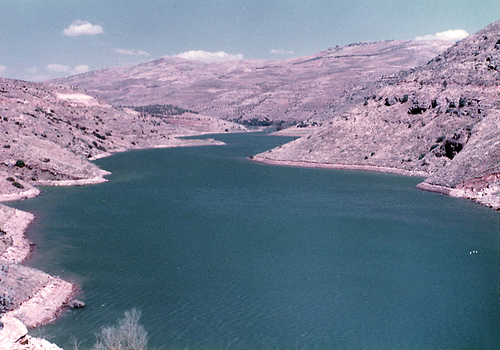
Little publicity appears to have been made in Israel regarding a proposed joint project between Jordan and Syria to construct a dam across the Yarmouk River.

The dam, known as the Wihdeh Dam, will be built on that part of the Yarmouk that is shared by the two countries before it reaches an area now under Israeli sovereignty.

One of the Jordan river’s main tributaries, the Yarmouk’s waters are shared by Syria and Jordan for a 40 km stretch which is also part of the boundary between the two countries, before it reaches the part of Golan Heights which is now under Israeli sovereignty where it then forms the boundary between Israel and Jordan. It is a tributary of the Jordan River.

The river at present provides Jordan with an annual water supply of 135,000 cm. Upon completion, a reservoir created by damming the river will result in a storage capacity of 220,000 cm.

The project was originally planned back in the spring of 1999 and is said to have connection with the 1994 peace agreement with Israel, when Jordan was allotted an annual amount of water as part of the peace agreement between the two countries.

It has been refuted by the Jordanian government that Israel objects to this plan, which will curtail the Yarmuk’s flow and deprive Israel of much of the Yarmuk’s flow. Due to reported violations by Syria of their using a part of the Yarmouk’s flow to water crops planted on the riverbank on the Syrian side, a study is to made to find out ways to prevent the depletion of waters of the Yarmouk River basin.

Tenders are presently being submitted to companies to carry out the study. A Turkish company was commissioned to build the dam, on which construction was to have begun in 2003. The study to be carried out by Jordan and Syria will entail the use of monitoring stations to measure the amount and quality of water that would enter the dam.

Jordan’s water problem is much more acute than Syria’s and violations by Syrian farmers are a concern for Jordan, which now depends on the Yarmouk for a portion of its total water supplies.

A similar article, in September, 2008 also mentioned discussions between the two countries concerning us of the water by the two countries, and that Syria had then expressed and understanding over Jordan’s acute water needs.

::Jordan Times

Maurice Picow
Maurice Picowhttps://www.greenprophet.com/
Maurice Picow grew up in Oklahoma City, U.S.A., where he received a B.S. Degree in Business Administration. Following graduation, Maurice embarked on a career as a real estate broker before making the decision to move to Israel. After arriving in Israel, he came involved in the insurance agency business and later in the moving and international relocation fields. Maurice became interested in writing news and commentary articles in the late 1990’s, and now writes feature articles for the The Jerusalem Post as well as being a regular contributor to Green Prophet. He has also written a non-fiction study on Islam, a two volume adventure novel, and is completing a romance novel about a forbidden love affair. Writing topics of particular interest for Green Prophet are those dealing with global warming and climate change, as well as clean technology - particularly electric cars.

LEAVE A REPLY

Please enter your comment!
Please enter your name here

TRENDING

Earth building with Dead Sea salt bricks

Researchers develop a brick made largely from recycled Dead Sea salt—offering a potential alternative to carbon-intensive cement.

Peace hospital opens between Jordan and Israel

The proposed medical centre, described by Emek HaMaayanot Regional Council head Itamar Matiash as “a centre for cancer treatment, so that people from Jordan or further away could come and receive treatment,” would become the flagship of a wider cluster of medical, academic and innovation-based services planned for the Israeli half of the zone.

Iran’s holiest city about to run dry as terror chosen over water management

Iran’s second-largest city, Mashhad, is facing an acute water emergency after dam reservoirs feeding the city fell below three percent capacity, according to Iranian state and local media. Officials warn that without rainfall or improved inflows from neighboring Afghanistan, the city’s supply could soon collapse.

Iran’s water mafia and thirst for war leaves the country on brink of being dry

Iran’s Lake Urmia, once the Middle East’s largest saltwater lake, has shrunk by 90 percent due to mismanagement, dams, and drought. As Tehran pours billions into foreign conflicts, water activists face repression at home. The crisis mirrors Syria’s drought-driven unrest, showing how water scarcity can destabilize entire regions.

How EcoPeace Uses Environmental Education to Bridge Borders in the Jordan Valley

In a region long marked by political divides, armed conflict, and environmental degradation, EcoPeace Middle East is quietly advancing the power of peacebuilding. Peace through education. Through its cross-border teacher tours in the Jordan Valley, EcoPeace is bringing together educators from Israel, Jordan, and the Palestinian territories to address critical environmental issues.

Qatar’s climate hypocrisy rides the London Underground

Qatar remains a master of doublethink—burning gas by the megaton while selling “sustainability” to a world desperate for clean air. Wake up from your slumber people.

How Quality of Hire Shapes Modern Recruitment

A 2024 survey by Deloitte found that 76% of talent leaders now consider long-term retention and workforce contribution among their most important hiring success metrics—far surpassing time-to-fill or cost-per-hire. As the expectations for new hires deepen, companies must also confront the inherent challenges in redefining and accurately measuring hiring quality.

8 Team-Building Exercises to Start the Week Off 

Team building to change the world! The best renewable energy companies are ones that function.

Thank you, LinkedIn — and what your Jobs on the Rise report means for sustainable careers

While “green jobs” aren’t always labeled as such, many of the fastest-growing roles are directly enabling the energy transition, climate resilience, and lower-carbon systems: Number one on their list is Artificial Intelligence engineers. But what does that mean? Vibe coding Claude? 

Somali pirates steal oil tankers

The pirates often stage their heists out of Somalia, a lawless country, with a weak central government that is grappling with a violent Islamist insurgency. Using speedboats that swarm the targets, the machine-gun-toting pirates take control of merchant ships and then hold the vessels, crew and cargo for ransom.

Leopoldo Alejandro Betancourt López Turned Ocean Plastic Into Profitable Sunglasses

Few fashion accessories carry the environmental burden of sunglasses. Most frames are constructed from petroleum-based plastics and acrylic polymers that linger in landfills for centuries, shedding microplastics into soil and waterways long after they've been discarded. Leopoldo Alejandro Betancourt López, president of the Spanish eyewear brand Hawkers, saw this problem differently than most industry executives.

Why Dr. Tony Jacob Sees Texas Business Egos as Warning Signs

Everything's bigger in Texas. Except business egos.  Dr. Tony Jacob figured...

Israel and America Sign Renewable Energy Cooperation Deal

Other announcements made at the conference include the Timna Renewable Energy Park, which will be a center for R&D, and the AORA Solar Thermal Module at Kibbutz Samar, the world's first commercial hybrid solar gas-turbine power plant that is already nearing completion. Solel Solar Systems announced it was beginning construction of a 50 MW solar field in Lebrija, Spain, and Brightsource Energy made a pre-conference announcement that it had inked the world's largest solar deal to date with Southern California Edison (SCE).

Related Articles

Popular Categories