
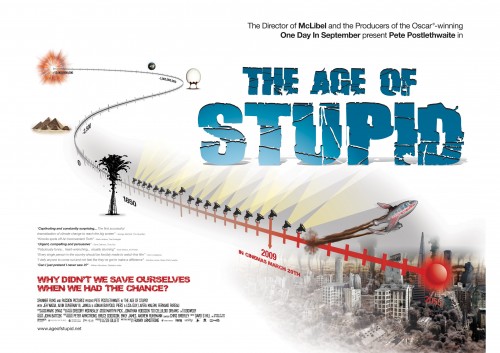


‘The Age of Stupid’ is an ambitious new Independent British green documentary.
As a fellow filmmaker and activist, I salute director Franny Armstrong and her dynamic team for the passion and vision shown in creating this film, pulling together funding from diverse and various sources, creating the ‘Not Stupid’ brand and the big campaign that is promoting the film.
I’ve been following the film’s progress over the last few months as the team prepared for its launch (which was held in a portable solar cinema in London recently), got politicians and ‘green’ celebrities on board, launched YouTube teasers, a ‘Not Stupid’ campaign to advance the issues raised by the film, and enticed supporters with Franny’s frantic and funny emails from her film-related travels and hectic life. Finally I got to see it this week in Cambridge, UK, and a Q&A with campaign co-ordinator, Daniel Vockins, followed the screening.
The plot, or small plot around which the core of the film hangs, centres on the archivist (played by actor Pete Postlethwaite), who in the year 2055 has created a archive of humanity in a tower in the sea, some 800 miles off Norway.
In this retreat he has gathered every species, every book and manual ever written, and a vast acreage of footage (real footage from bona fide news channels is used) that he uses to illustrate the destruction of the planet and humanities ignorance and ambivalence towards it, between now, and then.
[youtube]http://www.youtube.com/watch?v=DZjsJdokC0s&feature=PlayList&p=B8D76CD6FCA6389B&index=0&playnext=1[/youtube]
Around a selection of clips (sample the trailer above), Postlethwaite narrates a sombre meditation upon the warnings nature has shown during its rapid heating up, past the tipping point of 2 degrees, resulting in Hurricane Katrina, the North Sea ‘boiling’ (how far off is this scenario?), and of course human greed: the arrogance and destructiveness of petrochemical companies in Nigeria, the nimbyism (‘not in my backyard’) of protestors against a proposed wind farm in the UK, and the destructive power of capitalism expanding the road and transport systems everywhere.
Several real-life characters are used to establish a narrative and create some narrative tension: an Indian entrepreneur building a cheap Indian airline; a young woman in Nigeria who surveys the damage caused by petrol greed and struggles to become a doctor to heal her community; an elderly activist in France who has witnessed the disappearance of the glaciers in the Alps; a retired petrochemical engineer in New Orleans who rescued survivors during the hurricane; Iraqi kids who are refugees in Jordan due to petrol greed, and a British wind technology entrepreneur who is thwarted at every turn.
Together, these characters do represent all the human dimensions of how we are contributing to the warming of the planet. Balancing the demands of capitalism, and the belief in economic growth, all the characters in some way are contributing to both the debate, and some of the action needed.
Even the airline manager, who is at odds with the others, is shown to have a personal investment in charity work, despite wishing to get the “[so many million] million Indians who use trains daily, onto aeroplanes instead” (which would contribute to an immense and unsustainable rise in carbon emissions from India, currently one of the lowest national emitting groups).
The human history of advancing capitalism, attempted socialism and communism, and our march into warfare over virtually anything and everything, weaves between the news footage and interviews as a montage of choreographed animation.
The ongoing war in Iraq as blatantly a war about oil resources, with children made into refugees as a result, is portrayed as our current political and environmental evil, with which I agree. The oil companies flaring of gas across Nigeria, instead of converting it for local domestic use is also shown as a very stark example of colonial dominance.
I was woken from a slightly complacent slumber toward the end of the film, when the narrator muses “did we as a species really care about our annihilation? I think we didn’t really care – we wanted to wipe ourselves out.”
Of course this is the point and purpose: humans are hurtling toward our own destruction with our damage to the planet, and we are ignoring the warning signs.
Books reviewed on this site, including the excellent ‘World Without Us’ by Alan Weisman , indicate that as a species we cannot extinguish the planet – we may take many species down with us, and we may well destroy most of the resources and leave it too hot and scarred for much to survive, but over eons of time, the planet will renew itself and continue.
New life forms will emerge from the swamp… but we will have lost the battle with our own blind ignorance, and killed ourselves off in the middle of this century’s technological developments, with our wifi networks, iphones, fast jet travel, SUV’s, and all the paraphernalia that we’re all absorbed in.
This was best summed up by the anti-wind farm protestors, jubilant after the Bedfordshire Council (not far from where I’m writing) had rejected the application for 15 wind turbines to be placed on unused land, next to a gas guzzling speedway track, said: “of course we recognise we must all go green, but….”
It’s this gigantic ‘but’ that I believe is the core of the film. Will a sequel, made in 2055, portray the great efforts we made to reverse the effect of carbon upon the planet? Or will this ‘but’ have wiped us all out?
‘The Age of Stupid’ takes its place amongst ‘An Inconvenient Truth’ and ‘The Eleventh Hour’ as a cinematic effort to shunt and shock us into co-ordinated personal and community action. I truly hope the film and the ‘Not Stupid’ campaign achieves this noble aim.
(Writers note: as my memory is not so sharp, I’ve written the quotes as I remembered them.)


[…] Exploring Human Apathy in the Age of Stupid AKPC_IDS += "70727,"; __spr_config = { pid: '4ef1a3d5396cef53f100007b', title: 'The Lorax Brings a Muddled Environmental Message to the Mideast', ckw: 'environmental art,movie review', chan: 'lifestyle-culture', no_slide: '', slide_logo: false, pub: '2012-04-14 06:50:08', url: 'http%3A%2F%2Fwww.greenprophet.com%2F2012%2F04%2Fthe-lorax-brings-a-muddled-environmental-message-to-the-mideast%2F', header: 'RECOMMENDED FOR YOU' }; var content = document.getElementById('simplereach-slide-tag').parentNode, loc; if (content.className){ loc = '.' + content.className; } if (content.id){ loc = '#' + content.id; } __spr_config.loc = loc || content; (function(){ var s = document.createElement('script'); s.async = true; s.type = 'text/javascript'; s.src = document.location.protocol + '//d8rk54i4mohrb.cloudfront.net/js/slide.js'; __spr_config.css = 'document.location.protocol + '//d8rk54i4mohrb.cloudfront.net/css/p/4ef1a3d5396cef53f100007b.css'; var tg = document.getElementsByTagName('head')[0]; if (!tg) {tg = document.getElementsByTagName('body')[0];} if (tg) {tg.appendChild(s);} })(); […]
[…] used up this way and have consistently switched off the monitor on my computer ever since watching ‘The Age of Stupid’ (reviewed here). I don’t have a television, although, I freely admit there are days when I would love to do […]