

Antibiotics From An Underwater Drugstore

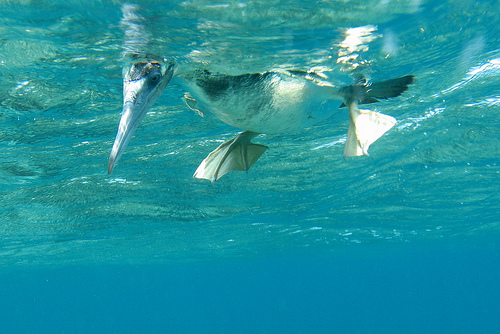
duck underwater photo

No matter how sophisticated modern medicine becomes, common ailments like fungal infections can outrun the best of the world’s antibiotics. In people with compromised immune systems (like premature babies, AIDS victims or those undergoing chemotherapy for cancer) the risk is very high: contracting a fungal infection can be deadly.

Now Tel Aviv University zoologists are diving deep into the sea to collect unique chemicals — drugs of the future — to beat unnecessary death by fungal infection. And their secret weapon is the common marine sponge.

Prof. Micha Ilan from the Department of Zoology at TAU, who is heading the project, has already identified several alternative antibiotic candidates among the unique compounds that help a sponge fend off predators and infections. He and his graduate students are now identifying, isolating and purifying those that could be the super-antibiotics of the future.

The research group at TAU has found and isolated thousands bacteria and fungi, including a few hundred unique actinobacteria. So far, several tens hold promise as new drugs.

From the Sea to the Lab
Photo: Prof. Micha Ilan, Tel Aviv University“Resistance to antibiotics has become an unbelievably difficult challenge for the medical community,” says Prof. Ilan. “Sponges are known for hosting an arsenal of compounds that could work to fight infections. We’re now culturing huge amounts of microorganisms, such as actinobacteria, that live in symbiosis with marine sponges.”

Marine sponges were recently made famous by the popular Nickelodeon TV cartoon SpongeBob SquarePants, which features a sea sponge who lives in a pineapple beneath the ocean.

In real life, sea sponges are animals whose bodies consist of an outer thin layer of cells and an inner mass of cells and skeletal elements. The sedentary creatures don’t really have the sort of adventurous life that the cartoon depicts.

Marine sponges can’t move. Glued to the seafloor, they must rely on the flow of water through their bodies to collect food and to remove waste. This has led to a unique adaptive response to enemies and competition. Sponges don’t have teeth, or shells, but protect themselves by building associations and partnerships with bacteria and fungi. Tel Aviv University is tapping into these relationships — looking at the same chemicals that the sponge uses for defense to fight infection in humans.

Research Combines Several Fields of Study
Drug developers have known for decades about the potential goldmine of pharmaceuticals in the marine environment, particularly among sedentary life like marine sponges.

“One of the major problems is that these novel and natural compounds are found in very small quantities,” Prof. Ilan explains. Collecting and extracting such large amounts of these unique chemicals would require huge quantities of animals to be sacrificed, a practice which is not in line with zoological conservationist values.

So Prof. Ilan takes cultures from sea sponges with minimal damage to the natural environment. He then grows their symbionts and tests them in a “wet” laboratory. The methods Prof. Ilan has perfected can now be used by other scientists developing pharmaceuticals from marine sponges.

“Our research is unique in that we take both an agricultural and microbiological approach — not found often in the drug discovery community,” says Prof. Ilan.


1 COMMENT

LEAVE A REPLY

Please enter your comment!
Please enter your name here

TRENDING

Earth building with Dead Sea salt bricks

Researchers develop a brick made largely from recycled Dead Sea salt—offering a potential alternative to carbon-intensive cement.

Farm To Table Israel Connects People To The Land

Farm To Table Israel is transforming the traditional dining experience into a hands-on journey.

Remilk makes cloned milk so cows don’t need to suffer and it’s hormone-free

This week, Israel’s precision-fermentation milk from Remilk is finally appearing on supermarket shelves. Staff members have been posting photos in Hebrew, smiling, tasting, and clearly enjoying the moment — not because it’s science fiction, but because it tastes like the real thing.

An Army of Healers Wins the 2025 IIE Goldberg Prize for Peace in the Middle East

In a region more accustomed to headlines of loss than of listening, the Institute of International Education (IIE) has chosen to honor something quietly radical: healing. The 2025 Victor J. Goldberg Prize for Peace in the Middle East has been awarded to Nitsan Joy Gordon and Jawdat Lajon Kasab, the co-founders of the Army of Healers, for building spaces where Israelis and Palestinians — Jews, Muslims, Christians, Druze, and Bedouins — can grieve, speak, and rebuild trust together.

Peace hospital opens between Jordan and Israel

The proposed medical centre, described by Emek HaMaayanot Regional Council head Itamar Matiash as “a centre for cancer treatment, so that people from Jordan or further away could come and receive treatment,” would become the flagship of a wider cluster of medical, academic and innovation-based services planned for the Israeli half of the zone.

Qatar’s climate hypocrisy rides the London Underground

Qatar remains a master of doublethink—burning gas by the megaton while selling “sustainability” to a world desperate for clean air. Wake up from your slumber people.

How Quality of Hire Shapes Modern Recruitment

A 2024 survey by Deloitte found that 76% of talent leaders now consider long-term retention and workforce contribution among their most important hiring success metrics—far surpassing time-to-fill or cost-per-hire. As the expectations for new hires deepen, companies must also confront the inherent challenges in redefining and accurately measuring hiring quality.

8 Team-Building Exercises to Start the Week Off 

Team building to change the world! The best renewable energy companies are ones that function.

Thank you, LinkedIn — and what your Jobs on the Rise report means for sustainable careers

While “green jobs” aren’t always labeled as such, many of the fastest-growing roles are directly enabling the energy transition, climate resilience, and lower-carbon systems: Number one on their list is Artificial Intelligence engineers. But what does that mean? Vibe coding Claude? 

Somali pirates steal oil tankers

The pirates often stage their heists out of Somalia, a lawless country, with a weak central government that is grappling with a violent Islamist insurgency. Using speedboats that swarm the targets, the machine-gun-toting pirates take control of merchant ships and then hold the vessels, crew and cargo for ransom.

Leopoldo Alejandro Betancourt López Turned Ocean Plastic Into Profitable Sunglasses

Few fashion accessories carry the environmental burden of sunglasses. Most frames are constructed from petroleum-based plastics and acrylic polymers that linger in landfills for centuries, shedding microplastics into soil and waterways long after they've been discarded. Leopoldo Alejandro Betancourt López, president of the Spanish eyewear brand Hawkers, saw this problem differently than most industry executives.

Why Dr. Tony Jacob Sees Texas Business Egos as Warning Signs

Everything's bigger in Texas. Except business egos.  Dr. Tony Jacob figured...

Israel and America Sign Renewable Energy Cooperation Deal

Other announcements made at the conference include the Timna Renewable Energy Park, which will be a center for R&D, and the AORA Solar Thermal Module at Kibbutz Samar, the world's first commercial hybrid solar gas-turbine power plant that is already nearing completion. Solel Solar Systems announced it was beginning construction of a 50 MW solar field in Lebrija, Spain, and Brightsource Energy made a pre-conference announcement that it had inked the world's largest solar deal to date with Southern California Edison (SCE).

Related Articles

Popular Categories