

Tel Aviv “City Rats” Give New Ideas to Urban Planners

city rats in Jerusalem New Orleans or New York image
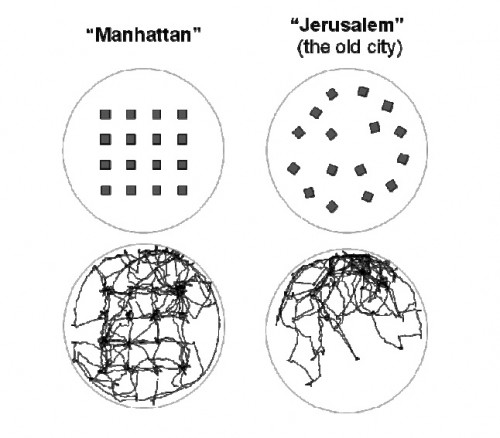
“Rat tracks” made by rats in two city plans: Manhattan-style (left) and New Orleans or Jerusalem-style (right). In both plans rats cover the same distance, but rats in the “Manhattan” grid cover more territory.

Rats Say: Manhattan Rules!
Before “green” urban planners build that new sub-division, neighborhood, city street, or town, they might want some invaluable advice that can spare years and millions of dollars from going down the drain. They just need to ask the rats.

Researchers at Tel Aviv University have found that if you leave it up to the rats, New York City beats the Old City of Jerusalem or New Orleans any day.

This surprising finding comes from new research by TAU zoologists and geographers, who are working together to invent a novel way to test urban designers’ city plans. Instead of using humans as guinea pigs, the scientists went to their nearby zoo and enlisted lab rats to determine the functionality of theoretical and existing plans.

They’ve already tried their theory in the academic setting by blindfolding human biology students to confirm that human orientation strategies and instincts are similar to those of their fellow four-legged city dwellers.

“We’ve found that routes taken by rats and other members of the animal kingdom tend to converge at attractive landmarks, the same way people are attracted, for example, to the Arc de Triumph in Paris,” says Prof. David Eilam from TAU’s Department of Zoology. “Our research takes the art used by humans to create their towns and cities and turns it back to the animal world for testing. We can look at how rats will react to a city’s geography to come up with an optimal urban plan.”

A Rat Race on a Straight Track
By building mini-models of city layouts at the Tel Aviv University Research Zoo, Prof. Eilam and his colleagues found that grid-like city layouts ― like that of Manhattan ― are much more rat- and people-friendly than cities with unstructured and winding streets, like those in New Orleans.

“We’ve built an environment to test city plans, so that ‘soul-less’ and ineffective new neighborhoods won’t be built,” Prof. Eilam says. “Using our model of rat behavior, it takes just a few minutes for city planners to test whether a new plan will work. It’s a way to avoid disasters and massive expense.” He expects that the choices the rats make will eventually be optimized and plugged into a computer tool.

Prof. Eilam and Prof. Juval Portugali, a geography researcher, based their study on the fact that rats build cognitive maps to help orient themselves in nature. In essence, this cognitive “rat map” works to help them know where they are in space and time.

“Manhattan” Navigable, “New Orleans” Disorienting
“We put rats in relatively large areas with objects and routes resembling those in Manhattan,” explains Prof. Eilam. The rats, he found, do the same things humans do: They establish a grid system to orient themselves. Using the grid, the rats covered a vast amount of territory, “seeing the sights” quickly.

In contrast, rats in an irregular plan resembling New Orleans’ failed to move far from where they started and didn’t cover much territory, despite travelling the same distances as the “Manhattan rats.”

Prof. Eilam and his colleagues say that urban planners can use this rat behavior model to test how the public will respond to new objects ― such as tall buildings or cooperative housing ― in the real world.

1 COMMENT
  1. […] Rats flourish in warm weather.  As snows on the nearby Alborz mountains start melting, water levels rise,  forcing rats from their subterranean habitat.  They migrate to roadside streams along Ali Asr, the Middle East’s longest street.  The popular thoroughfare is home to restaurants and food stalls, and threads it’s way from North Tehran’s expensive neighborhoods to poorer southern suburbs, where the rat population is reportedly six times greater than the human population. […]

LEAVE A REPLY

Please enter your comment!
Please enter your name here

TRENDING

What is the Jewish Climate Trust?

Jewish Climate Trust has quickly attracted the attention and support of some of the most influential voices in Jewish philanthropy, drawing backing from prominent family foundations and business leaders connected to the Bronfman and Schusterman philanthropic networks, alongside climate-focused investors and community builders aligned with founding leader Nigel Savage. Together, these donors have committed many millions of dollars to build a serious, long-term climate platform for the Jewish world — not as a symbolic gesture, but as a strategic intervention in one of the defining challenges of this generation.

Luxury tower in Jerusalem ruins its sacred heritage and eco-architects are worried

Critics of a new set of luxury towers including Israeli-Greek architect Elias Mesinas, warn that the scale of the towers, loss of public green space, and creeping luxury-led gentrification risk undermining Jerusalem’s historic skyline, community fabric, and long-standing planning principles — raising a fundamental question: not whether Jerusalem should densify, but how it can do so responsibly while preserving what makes the city unique.

Microplastics Are Becoming Superbug Highways — New Study Warns Beachgoers to Wear Gloves

Prof. Pennie Lindeque added that microplastics “act as carriers for antimicrobial-resistant bacteria, enhancing their survival and spread… each particle becomes a tiny vehicle capable of transporting pathogens from sewage works to beaches, swimming areas and shellfish-growing sites.”

Who gave the first kiss?

When you experience your first kiss you might feel like you are the first in the world to feel that way. Kissing, scientists say, occurs in a variety of animals (even if today it's not in every culture), and it presents an evolutionary puzzle: kissing, a learned behavior, carries high risks, such as disease transmission like herpes and hepititis, while offering no obvious reproductive or survival advantage.

Biodiversity Blueprint Set for 2026

If we seize this moment, the 2026 review can catalyse a new wave of finance (see Green Finance mechanisms in the UAE), innovation and policy coherence — and move us closer to the vision of a nature-positive world by 2050. If not, the checkpoint risks becoming another missed opportunity while ecosystems, livelihoods and economies continue to degrade.

Qatar’s climate hypocrisy rides the London Underground

Qatar remains a master of doublethink—burning gas by the megaton while selling “sustainability” to a world desperate for clean air. Wake up from your slumber people.

How Quality of Hire Shapes Modern Recruitment

A 2024 survey by Deloitte found that 76% of talent leaders now consider long-term retention and workforce contribution among their most important hiring success metrics—far surpassing time-to-fill or cost-per-hire. As the expectations for new hires deepen, companies must also confront the inherent challenges in redefining and accurately measuring hiring quality.

8 Team-Building Exercises to Start the Week Off 

Team building to change the world! The best renewable energy companies are ones that function.

Thank you, LinkedIn — and what your Jobs on the Rise report means for sustainable careers

While “green jobs” aren’t always labeled as such, many of the fastest-growing roles are directly enabling the energy transition, climate resilience, and lower-carbon systems: Number one on their list is Artificial Intelligence engineers. But what does that mean? Vibe coding Claude? 

Somali pirates steal oil tankers

The pirates often stage their heists out of Somalia, a lawless country, with a weak central government that is grappling with a violent Islamist insurgency. Using speedboats that swarm the targets, the machine-gun-toting pirates take control of merchant ships and then hold the vessels, crew and cargo for ransom.

Leopoldo Alejandro Betancourt López Turned Ocean Plastic Into Profitable Sunglasses

Few fashion accessories carry the environmental burden of sunglasses. Most frames are constructed from petroleum-based plastics and acrylic polymers that linger in landfills for centuries, shedding microplastics into soil and waterways long after they've been discarded. Leopoldo Alejandro Betancourt López, president of the Spanish eyewear brand Hawkers, saw this problem differently than most industry executives.

Why Dr. Tony Jacob Sees Texas Business Egos as Warning Signs

Everything's bigger in Texas. Except business egos.  Dr. Tony Jacob figured...

Israel and America Sign Renewable Energy Cooperation Deal

Other announcements made at the conference include the Timna Renewable Energy Park, which will be a center for R&D, and the AORA Solar Thermal Module at Kibbutz Samar, the world's first commercial hybrid solar gas-turbine power plant that is already nearing completion. Solel Solar Systems announced it was beginning construction of a 50 MW solar field in Lebrija, Spain, and Brightsource Energy made a pre-conference announcement that it had inked the world's largest solar deal to date with Southern California Edison (SCE).

Related Articles

Popular Categories