

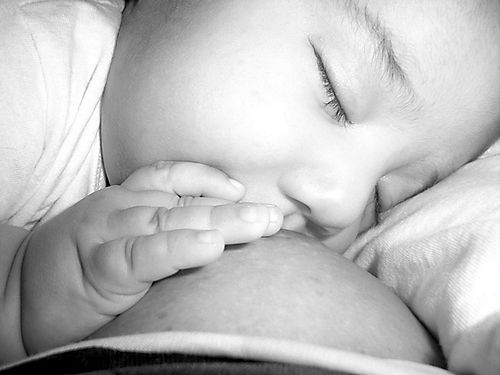
Breastfeeding is a natural and “green” way for a mother to feed her baby. Yet misconceptions about how to breastfeed and for how long pervade our modern world. These misunderstandings can lead to frustration and distress for the whole family during a challenging period. Green Prophet gives you 10 reasons to shatter any myths and misconceptions.
Misunderstandings vary, depending on your country and culture, but in Israel, which is similar to European and North American countries, I preface my examples with a telling anecdote. Keep reading for 10 very important misunderstandings and tips about breastfeeding that can change the way your new baby is nourished.
A mother, who worked from home, had just enrolled her 14-month-old daughter in kindergarten (Hebrew: gan) in Israel. Until starting gan the toddler nursed freely throughout the day.
When the mother arrived to pick up her daughter on the first day, she found the staff quite upset. Apparently the little girl had tried to lift up the shirts of the different caretakers, as if she were asking to breastfeed.
The shocked caretakers insisted that the mother wean immediately. The mother called me to ask for suggestions. She didn’t want to wean, but couldn’t have her baby undressing the daycare workers either. She wondered whether cutting out morning nursings would be enough.
After hearing the story and empathizing with the mother’s obvious distress, I pointed out that even six-month-old babies don’t ask to nurse from anyone other than their mothers. I doubted that her daughter’s behavior had anything to do with breastfeeding. But whether or not that was true, the caretakers needed to handle it like they would any other inappropriate behavior.
That mother’s situation highlights a common difficulty. Back when breastfeeding was the norm, girls grew up seeing their mothers, aunts and neighbors nursing. Even though breastfeeding never completely died out in Israel, a generation or more of nursing know-how has been lost, and is only gradually being retrieved. The toddler who started gan was playing “find the pupik” (navel) — a game she had recently learned. But breastfeeding — and the mother — were blamed when the toddler began acting strangely. In this case it was understandable, but breastfeeding has been blamed for all kinds of unrelated conditions and behaviors. Such misconceptions often lead to nursing difficulties and weaning.
Below I list examples of ways in which lack of understanding about breastfeeding can lead to confused parents and a frustrated baby.
- On-line production. We think of milk being stored in containers, but most milk consumed during a feeding is made on-line–while the baby is nursing. “Waiting for the breasts to fill up” is counter-productive, because frequent nursing signals the body to produce more milk.
- Holding position. In the most common nursing position babies are held under the breasts, facing the mother’s torso. Breastfeeding expert Diane Wiessinger points out that bottle-fed babies must be held far from the breast in the crook of the elbow, so that the “mountain” won’t get in the way of the bottle.
- Where is the action? When the baby opens her mouth wide, the mother brings the baby toward her nipple, keeping the breast stable. Bottle nipples are inserted into the baby’s mouth.
- Angling for success. Babies approach the breast at an angle, with the head back, so that the nipple points toward the roof of the mouth. This keeps the baby’s working jaw away from the sensitive nipple, preventing soreness, and allows the baby’s tongue to reach further back on the breast and express milk effectively. Bottles are pointed toward the back of the baby’s mouth.
- For good measure. With no lines on the breast to measure how much the baby has eaten, we look at the number of wet and dirty diapers, behavior during and after nursing, and weight gain. Lines wouldn’t help, because the amount a breastfeeding baby eats varies widely from feeding to feeding. Once the baby is gaining well the mother can relax–as long as she follows the baby’s cues and not the clock, the baby will continue to get enough milk. If she has doubts she can check the baby’s weight or consult with an experienced counselor.
- All babies have a schedule–it just might not be your schedule, at first. But by two or three weeks most breastfed babies nurse infrequently during the morning, “cluster feed” during the afternoon or evening, then sleep their longest stretch at night, for about 3-5 hours.
- Pacifiers. Many breastfeeding mothers find pacifiers useful at times (once breastfeeding is established after a few weeks), but they are not a necessity and overuse can interfere with milk supply. Pacifiers were popularized for bottle-fed babies to continue to suck after the bottle has been emptied.
- No pain, gain. Breastfeeding is not supposed to hurt. Pain, especially throughout the feeding, may be a sign that the baby is not latched on correctly, and often accompanies poor weight gain. Breastfeeding is meant to be enjoyable, and all pain that does not improve rapidly should be evaluated by a qualified breastfeeding counselor.
- Weaning. Nursing is more than just food, and the breastfeeding relationship can continue for months and years after the baby eats solids and drinks from a cup. Babies who nurse on cue and begin solids gradually from the age of six months continue to get most of their calories from breast milk until about twelve months of age. They continue to receive calories, nutrients and antibodies for as long as they nurse.
- Size doesn’t matter. Big babies, small breasts, twins–it doesn’t matter. Except in rare cases almost all mothers can produce enough milk for their babies, and there are many ways to jump-start a questionable supply.
After feeding my friend’s bottle-fed baby recently, I realized that I’m guilty of my own misperceptions. When I tried to lay him down in his crib he continued to fuss until I picked him up again. I always thought that only breastfed babies did this, because mine did and I get calls about it all the time.
Now I know that fussiness between feedings is universal–it just takes longer for breastfeeding mothers to feel confident that their babies are eating well.
For more great reads by this author Hannah Katsman, on breastfeeding your baby, please see the following articles:
Breastfeeding and Judaism: Why Moses’ Mother Didn’t Put Bottles into the Ark of Bulrushes
Why Baby’s First Gift Shouldn’t Be Formula From the Hospital




[…] and then “my newborn has been feeding for 5 hours”, and eventually landing on “10 common misconceptions about breastfeeding your baby.” My poor breasts. I imagine I will be glued to a couch or chair with this next one. Time to […]
[…] 10 Common Misconceptions About Breastfeeding Your Baby – Yet misconceptions … Keep reading for 10 very important misunderstandings and tips about breastfeeding that can change the way your new baby is nourished. A mother, who worked from home, had just enrolled her 14-month-old daughter in kindergarten … […]
[…] health amends οf breastfeeding bе inflicted wіth bееn praised bу health caring professionals fοr […]
[…] health benefits of breastfeeding have been praised by health care professionals for years, and breastfeeding is obviously a […]
[…] “Breastfeeding hurts” – Although some mothers may experience some tenderness at first, pain may be due to an infection or the baby latching on poorly. It does get easier as the baby grows and is used to feeding. […]
As a point of reference, my mother bred a lot of different animals and the dogs and cats we had stopped nursing when they got sick of it and their off spring got teeth! One of our dogs would spontaneously lactate when there were any puppies because she was just very maternal. She would have continued nursing any creature for as long as the baby creature wanted as far as we could tell… She also protected human babies…
Hey
nice post………..
With lots of gr8 Ideas!!!!!!!!!!!!!!!!!!!!!!!!!!!!!!!
Thanx 4 giving such a beneficial info……………
[…] nursing mothers, rosemary’s high calcium content helps make milk. The dose is one-half cup twice daily […]
[…] Wild Plants You Can Pick Yourself Save Water and Energy in Your Washing Machine with Top Tips Ten Common Misconceptions about Breastfeeding Your Baby Passover Recipes and Cooking Tips at CookingManager.Com AKPC_IDS += "18858,";Browse topics: […]
I know for a fact, that if you can provide the best to your child, why should you even consider in stopping? Why is it “quite wrong” to breastfeed for more than 2 years when you still lactating? Note: Animals stop nursing when the young ones decided to stop nursing.
Join to Evolute Humanity to its Ability Of Cognition TO SEE that BREASTFEEDING is as VITAL and in this, as NORMAL, HEALTHY and PROTCTIVE to Humanity´s WELLBEING as WATER and BIRTH itself.Healthy Responsible Motherhood includes BREASTFEEDING whenever possible for mother and child. While the School Of Humanity naturally promotes Mother- and Fatherhood to be allsurround protective for the Child, it is also that we do OPPOSE >non-therapeutic, non-consensual modifications of a child's genitalia<, it being >BABY-MUTILATION< in all its forms.The Ethos of Mother and Fatherhood denys the removal of the healthy bodypart of a child.So: BREASTFEEDING. YES. ….. >BABY-MUTILATION<. NO. amen
Thanks, for sharing your personal thoughts Nursing is a god job for females through this job you can help peoples.
You’re welcome! Glad you enjoyed the post.
[…] 10 Common Misconceptions About Breastfeeding Your Baby | Green Prophet […]
Helene, that’s another misconception–that toddlers nurse less frequently than infants. Toddlers tend to be needy and demand attention whether or not they nurse. You should be proud of the way you raised your daughter.
Summer, thank you!
Justin, thanks for your thoughts. Many two-year-olds and their mothers are happy to continue to nurse. Many children seem to need pacifiers or bottles for longer than two years as well; the oral need remains very strong. Katherine Dettwyler is an anthropologist who has tried to determine the “natural” age of weaning, based on studies of various cultures and comparisons with primates. She concludes that the weaning age for humans is from 2.5 to 7 years, which is long before puberty. No harm has been shown to long-term nursers, and there is no reason to discourage them as long as both parties are happy.
Breastfeeding is one of the most natural things in raising children. All 4 out of 5 of my children were breastfed. The one who wasn’t was tongue tied so he couldn’t. It is beneficial for both mother and child. I do think anything longer than 2 years is quite wrong, if you look to nature you will see that animals stop nursing when their young are old enough to eat the same foods as their parents. Breastfeeding makes so much sense financially, health wise, and naturally but let’s not get carried away and nurse kids until they are 7 years old!
Great article! 🙂 I hope the mom you talked to was able to continue nursing. It is always frustrating when normal toddler behaviors are blamed on breastfeeding
I breastfed my now-21 yr. old daughter for 7 yrs. She nursed far more as a toddler than she ever did as an infant. I took my clues from my baby since I seemed to be clueless about everything else with regard to new motherhood. It’s far more un-natural to put a 14 month old in day care and away from mother than it is to continue as a nursing pair. Breast milk is the superior nutrition for most normal healthy children. In addition to the nourishment, breastfeeding bonds baby and mom. The mother/child relationship lasts a lifetime. Mothers who artificially wean their babies at 14 mos. are probably doing their kids a disservice. I took all sorts of flak for breastfeeding my daughter so long. The last few years were mostly at night and first thing in the morning and in times of pain/discomfort/unhappiness. My daughter is now very close to us still and extraordinarily healthy and brilliant to boot. Breastfeeding has paid off for us with tremendous dividends. YMMV. Helene in California
Thanks Erin, for your comment. I wonder if the mother mentioned it in an apologetic kind of way, or whether she happened to nurse while visiting. Sometimes it makes a difference in the reaction. As I became more confident in nursing fewer people said anything negative to me about it–it became matter of face that the topic wasn’t up for discussion (i.e. whether to nurse and for how long).
I find it bothersome too when breastfeeding is blamed for non-breastfeeding related behaviors. This poor mother with her nursing toddle in daycare would have been better off to not have told the daycare staff that she was breastfeeding. They would have then handled shirt lifting the same way they would have with all of the other little ones.
It is a fine line between being open and moving breastfeeding forward and into popular culture and simply not wanting the fight.
I hope that mama kept nursing her babe until they were ready to be finished!