

For those readers about to participate in tonight’s Yom Kippur fast, Green Prophet Daniella Cheslow offers up many reasons why we need to think again about food production in this weeks ‘eco-reads’ review:
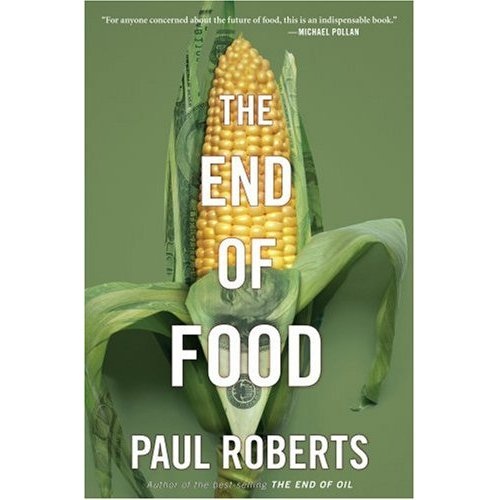
Paul Roberts may be the only food writer capable of swinging from prehistoric man gathering berries to a doomsday scenario ten years from now when avian flu slaughters humans by the millions. In The End of Food (390 pp) Roberts takes the long route through the history of food domestication and industrialization to see how humans built a modern system that has created a billion obese people even as another billion are starving.
If Michael Pollan’s The Omnivore’s Dilemma was about how he felt upon looking at towering corn silos and polyculture farms, Paul Roberts’s The End of Food is about how different elements of American and global food production are all enmeshed in one massive system lurching toward disaster. He writes about Africa’s enduring food crises:
“For decades, the operating assumption of the aid community was that no matter how dysfunctional a country’s food system might be, it would eventually respond to the right combination of policies and technologies and join the global food system. Such an outcome may still be possible for a country like Kenya. But we also now understand that food insecurity comes not simply from bad government, fickle aid strategies, and postcolonialism, but also from the pressures of a burgeoning population coming up against natural constraints such as poor soils, scarce water, and a changing climate.”
Roberts is an expert weaver of economic numbers with journalistic storytelling. He goes where few food writers have gone before, such as Chinese agricultural expos and Japanese rice paddies fertilized by duck manure. He also details the Cuban agriculture devolution, which occurred in the late 1980s as the Soviet Union stopped exporting cheap oil and oil-based fertilizers to the Caribbean island, leaving it to retool the food economy for local production.
Another strength Roberts has is analyzing how Western aid to poorer nations, especially in Africa, doesn’t always actually help. He shows how American aid programs largely profit American seed companies, some of whom even experimented with terminator genes into their merchandise to make it unusable beyond one generation.
And further, Roberts takes apart genetic engineering of plants and animals, explaining the history of this practice and why it is controversial. Moreover, he goes over how food companies hawk higher calories with a higher market to an already saturated American market:
“Food companies, although they no loner deny that larger portions are a key marketing strategy, vigorously resist any suggestion that these larger portion sizes actually encourage consumers to eat or drink more – a denial that has to qualify as one of the most laughable claims in the entire obesity debate.”
Roberts manages to present the burning issues of the modern food economy through exploring both sides – the Luddite-leaning organic movement against the modernized, industrial factory farming approach. Ultimately, he finds that neither extreme properly grasps the food crisis we face, which is an addiction to meat and a reliance on unsustainable farming methods that denude topsoil, contaminate water and push an endless cycle of more food, faster, for less money and thus less quality, safety and environmental stewardship.
The book is solid – if a bit fact-packed – for all of its ten chapters. But in the epilogue, Roberts lost me a bit. He sketches out a doomsday scenario in mind-boggling detail of what would happen should the devastating Ugandan wheat rust haunt the crops of Saudi Arabia and eventually China, followed by human epidemics. Naturally, this wreaks mayhem that all countries are ill-equipped to deal with. While he is certainly creative, I found his picks of exact dates, such as “late September 2018” for the outbreak of a whopping bout of avian flu, to be off-putting.
Further, Roberts settles on fish farming as a way to provide cheap protein that uses less food-per-ton than conventionally raised cows. To avoid pollution, Roberts recommends deep-sea fishing. But this seems to miss the point that in a world of deep-sea fishing, the last frontier of the earth’s resources will also be cordoned into farming plots, much as has been done on land. Roberts surprisingly swallows the promise of fish farming without his trademark grain of salt.
Despite a disappointing ending, though, The End of Food offers an intricate and comprehensive take on the many forces that have joined to create our food system that pushes excess calories to already overweight Americans even as we squeeze the rest of the world dry through monopolizing seed technology, setting an example for unsustainable meat consumption, and stripping forests to grow the soy and corn that will feed the ever expanding herd of animals we intend to devour. Roberts’s latest work is an excellent read for those who want to back up their understanding of the food chain with statistics and anecdotes from around the world, and a terrific source of further reading recommendations.
For more on the topic of food see:
Michael Pollan’s In Defense of Food review
Ordering a Half or Whole Steer in New York



I found your blog via Google while searching for avian flu map, thank you for posting a Relishes ‘The End Of Food’ by Paul Roberts | Green Prophet!
I have to say, that I could not agree with you in 100%, but it’s just my opinion, which could be wrong.
Car Rental Offers…
Just dropping in to say hi, thanks for writing….
‘The End of Suburbia’ is already here – in the shape of a film about peak oil.
‘Luddite’ is a term generally used to denigrate sceptics of technological progress (without necessarily defining ‘progress’ itself). Technology may be fantastic for mobile phones and computers, but other so-called ‘advances’ have been disastrous in agriculture, not to mention flying in the face of scientific evidence.
Science has been as much of a guiding light to the organic movement as ecology or farmers’ knowledge – beginning with scientific studies such those carried out in the 1930s and 40s by Lady Eve Balfour and Innes Pearce in the UK, as well as Sir Albert Howard’s work in India on compost and natural resistance to foot and mouth disease. Sadly, much of this research has never been followed up.
Solving world hunger requires a deeper solution than any single farming system can offer. But if we’re talking about increasing food supply where it’s most needed (e.g. developing countries), then industrial farming’s record on ‘feeding the hungry’ is poor. There’s plenty of research showing that that organic methods dramatically increase yields in the developing world (but that’s a story for another post…)
Chag sameach!
Michael – Considering how organic farming seeks to turn away from the last decades of chemical advances in fertilizer and pesticides, I would say there is something Luddite (and tasty and environmentally friendly) about the organic movement, which Roberts rightly points out may not be able to feed all six billion of us.
Adam – You have to wonder what the next “End of” is going to be…suburbia? Factory farming? Wal-Mart? He could really take this in a lot of directions.
“Roberts manages to present the burning issues of the modern food economy through exploring both sides – the Luddite-leaning organic movement against the modernized, industrial factory farming approach”
There’s nothing ‘Luddite’ about organic farming, which is only around 60 years old itself – just as young as it’s prematurely-ageing industrial cousin.
Paul Roberts’ book seems to be a continuation of the “End of” theme that he started with his book “End of Oil”. Roberts’ narrative style and attention to details makes him an author that easily brings the complex world of world sustainability problems to the reader’s lap.
“End of Oil” is the text book for my class: Energy Policy in a Carbon Constrained World.