
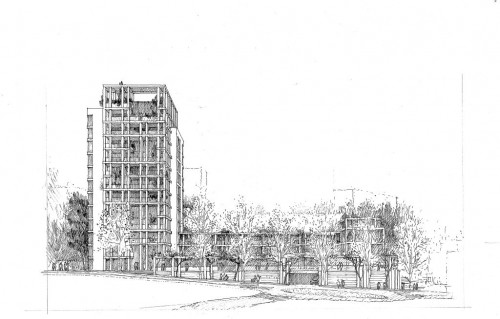
Building Green: Jerusalem’s First Sustainable Housing Development

green building leeds project jerusalem image

Roasting in the summer, freezing in the winter? Welcome to life in my Jerusalem apartment, and thousands of others like it. But if buildings are built according to environmental and climatic principles, it doesn’t have to be that way.

“Jerusalem has virtually the perfect temperature for houses,” explained green architecture consultant, Valentina Nelin when I met her recently. “If your house is oriented correctly, you don’t have the ‘greenhouse effect’ in the summer [causing houses to absorb excess heat and warm-up].”

Sensible, and often simple, design can make the temperature much more bearable, which is good for people and good for the environment, making air conditioners and gas guzzling heaters – which use 75% of the energy in an average household – redundant for most of the year.

Sadly, most homes in Israel aren’t built like that, but a new development in Jerusalem’s Katamon neighbourhood aims to set a green example. Developer Gideon Neumann and architects Carlos Prus and Dafna Alexandroni have designed the homes to reduce household energy consumption via correct orientation to the sun, good insulation and passive solar heating devices. The 36-unit housing project at 11 Shai Agnon Street is applying for the Israeli “Green Building” Standard 5281 and, if successful, will be the first residential project in the country to gain accreditation. The standard encourages environmentally-sustainable building practices covering energy, water, land and other environmental issues including air quality and the building process.

There are various green building projects in Israel, including individual houses in the north and neighbourhoods in the Negev desert, but this marks one of the first private housing developments to take sustainability seriously. Nelin, who is also working on the Shai Agnon project, describes it as “a high standard of living with a low environmental impact.”

The green roofs which will be planted with vegetation are not just to look pretty, but also to improve thermal insulation. In a unique initiative, wildflowers found on the site have been temporarily moved to Jerusalem Wildflower Sanctuary in Neve Yaakov and will be transplanted in their original home once the building is complete.

Although the concept is rising in popularity (the Israeli chapter of the International Initiative for a Sustainable Built Environment (IISBE) was established in 2000), sustainable “facts on the ground” are still few and far between. A list of worthy examples can be found here, courtesy of the Ministry of Environmental Protection.

:: Jerusalem Post, Green Light for Green Construction.
:: Jerusalem Post, A REAL Viable Solution.
:: Israeli Ministry of Environmental Protection.
:: Hegedus House: Jerusalem’s First Solar Home.

Michael Green
Michael Greenhttps://www.greenprophet.com/
Born into a family of auto mechanics and engineers in east London’s urban sprawl, Michael bucked the trend and chose a bicycle instead of a car. A relative newcomer to Jerusalem, he works as a freelance journalist writing for the Jerusalem Post and other publications. Before moving to Israel, he worked for an environmental NGO in England where he developed a healthy obsession with organic vegetables and an aversion to pesticides and GMOs. Michael’s surname is pure coincidence. Michael can be reached at michael (at) greenprophet (dot) com.

LEAVE A REPLY

Please enter your comment!
Please enter your name here

TRENDING

Luxury tower in Jerusalem ruins its sacred heritage and eco-architects are worried

Critics of a new set of luxury towers including Israeli-Greek architect Elias Mesinas, warn that the scale of the towers, loss of public green space, and creeping luxury-led gentrification risk undermining Jerusalem’s historic skyline, community fabric, and long-standing planning principles — raising a fundamental question: not whether Jerusalem should densify, but how it can do so responsibly while preserving what makes the city unique.

Blackdot’s painless AI-based tattoos will make inked skin less taboo?

Blackdot’s AI-powered tattoo machine promises precision and less pain, but sparks debate over health risks, artistry, and spirituality. From religious prohibitions to smart tattoos, the future of ink is being rewritten by technology.

Battling the Blaze: Israel’s Wildfire Response

On a dry, windy afternoon in late April 2025,...

How SPNI is Rewilding Cities and Rebuilding Resilience

In the heart of Jerusalem, a city often defined...

From the Ka and Ba to the Ka’bah – A Universal Path of Unity and Sustainability

Today, we’ll explore the intriguing connections between Ka and Ba from Egyptian mysticism, Merkabah mysticism in Kabbalah, and the Ka'bah in Saudi Arabia, and how these ancient ideas may hold valuable lessons for a sustainable future.

Qatar’s climate hypocrisy rides the London Underground

Qatar remains a master of doublethink—burning gas by the megaton while selling “sustainability” to a world desperate for clean air. Wake up from your slumber people.

How Quality of Hire Shapes Modern Recruitment

A 2024 survey by Deloitte found that 76% of talent leaders now consider long-term retention and workforce contribution among their most important hiring success metrics—far surpassing time-to-fill or cost-per-hire. As the expectations for new hires deepen, companies must also confront the inherent challenges in redefining and accurately measuring hiring quality.

8 Team-Building Exercises to Start the Week Off 

Team building to change the world! The best renewable energy companies are ones that function.

Thank you, LinkedIn — and what your Jobs on the Rise report means for sustainable careers

While “green jobs” aren’t always labeled as such, many of the fastest-growing roles are directly enabling the energy transition, climate resilience, and lower-carbon systems: Number one on their list is Artificial Intelligence engineers. But what does that mean? Vibe coding Claude? 

Somali pirates steal oil tankers

The pirates often stage their heists out of Somalia, a lawless country, with a weak central government that is grappling with a violent Islamist insurgency. Using speedboats that swarm the targets, the machine-gun-toting pirates take control of merchant ships and then hold the vessels, crew and cargo for ransom.

Leopoldo Alejandro Betancourt López Turned Ocean Plastic Into Profitable Sunglasses

Few fashion accessories carry the environmental burden of sunglasses. Most frames are constructed from petroleum-based plastics and acrylic polymers that linger in landfills for centuries, shedding microplastics into soil and waterways long after they've been discarded. Leopoldo Alejandro Betancourt López, president of the Spanish eyewear brand Hawkers, saw this problem differently than most industry executives.

Why Dr. Tony Jacob Sees Texas Business Egos as Warning Signs

Everything's bigger in Texas. Except business egos.  Dr. Tony Jacob figured...

Israel and America Sign Renewable Energy Cooperation Deal

Other announcements made at the conference include the Timna Renewable Energy Park, which will be a center for R&D, and the AORA Solar Thermal Module at Kibbutz Samar, the world's first commercial hybrid solar gas-turbine power plant that is already nearing completion. Solel Solar Systems announced it was beginning construction of a 50 MW solar field in Lebrija, Spain, and Brightsource Energy made a pre-conference announcement that it had inked the world's largest solar deal to date with Southern California Edison (SCE).

Related Articles

Popular Categories