


Notice anything strange about this scene?
Said Leemor Chandally, who sent us these photos, “I was passing by Rabin Square, when I noticed this situation and had to laugh. A bunch of people were waiting for a bus, but nobody was waiting inside the bus stop, which was obviously brand new. Instead, everyone was crouching behind it, trying to stay in the shade.”
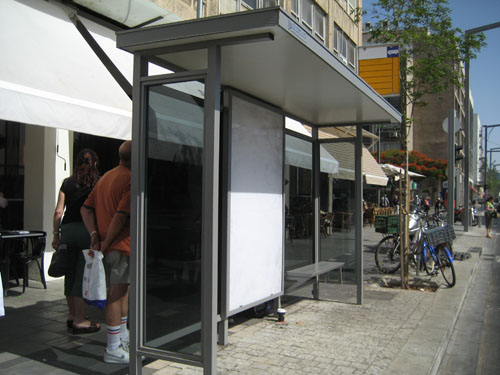
This shiny new bus stop is part of a massive project to upgrade Ibn Gvirol Street in Tel Aviv. As part of the project, the trees which lined the sides of the street were uprooted, in order to make way for new bike lanes, fresh asphalt and new sidewalks. The trees, which have been part of the street for generations, played a central role in making Ibn Gvirol a pleasant place to be. Even during the hot afternoon hours, these trees provided shade for sidewalks, soaked up pollution from traffic and lowered temperatures by a couple of degrees.
By removing these trees from the urban environment, the city exposed the street’s sidewalks to the intense Israeli sun, creating a hostile environment for pedestrians during much of the day. The young trees that were planted in place of the mature trees that formerly graced the street will take years to grow large enough to provide any shade and cool off the street’s sidewalks.
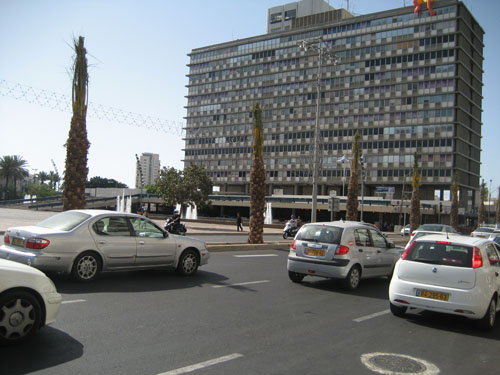 Above: Newly planted palm trees in the middle of Ibn Gvirol Street, in front of City Hall. Chosen because they require limited water and maintenance, the palms provide no shade and do not clean the air or change with the seasons, but are apparently especially fatal when drivers crash into them.
This particular bus stop is representative of so many urban “improvement” projects in Tel Aviv and other Israeli cities. What usually happens is that a decision is made to make some improvement, following which the city closes off an area, tears something down, and builds something new in its place. The problem is that too many times the end result actually creates more problems than existed before the city’s intervention.
These projects also require massive inputs of planning, money, manpower, energy and materials, and tend to inconvenience people who live and work in the area for long periods of time. The light rail project in Jerusalem is one example of a worthy project that, because of the way it was executed, made an entire city into a traffic nightmare for years.
The good news is that, with a little bit of forethought (and the humility to listen to city residents, who generally have their own opinions about what they want/need in the urban environment) we can make our cities much better places to live. Perhaps the answer, as Israeli New Urbanism NGO “Merhav” has argued, lies in better urban planning, or perhaps it is just a matter of people becoming more involved in decision-making in the place where they live.
In any case, the time has come for urban improvement projects to abandon the “copy-paste” approach, in which what is good for one place is good for any other place, and begin to use simple, intelligent, good design that will actually improve our cities and the way they function.
Photos courtesy of Leemor Chandally.



Tell me about those new bus stops!!!
The new ones on Dizengoff must have been designed by a total twat who’s Daddy is part of the Municiplaity Maffia.The cramped little 3 seater bench has a metal bar sticking right into your back and as mentioned before no protection from the shade or rain due to the idiotic angle of the roof.Typical Israeli architecture.Appauling!!!
I think this somes it up very well:
That’s right! There’s a difference between knowing and KNOWING.
Sabras are only at their best when their backs are really against the
wall.
Otherwise, they are generally quite paltry and mediocre: blase, over-
confident, arrogant, ungrateful, easily sidetracked and none too
smart!
And that includes ALL Sabras: Jews, Arabs, left wing, right wing,
charedi, frum, professors, professionals, chilloni….! If it wasn’t
for the constant threat from the outside plus the constant stream of
new immigrant Jews, Israel would quickly degenerate into a farrago!
The Kabbalah says that “Israel was only given to the Am Yisrael in
order for it to be cleansed of the Seven Bad Character traits (Lust,
Gluttony, Greed, Laziness, Wrath, Envy, Pride) that still soak it
from the days of the original bad Seven Canaanite Nations”!
I’ve been experiencing this in Israel for YEARS.
I saw the same thing yesterday at the corner of Ussishkin and Narkis St in Jerusalem…
Nice post….
does anyone have suggestions to “fix” this problem?
I can think of (I) subway, and (II) placing putting solar panels on top of every bus stop, powering one or two “ceiling fans” inside the bus stop, and then perhaps enclose the whole bus stop with some see-through glass that blocks the sun.
🙂
Great post Jesse. I hope you’ll be playing a part in designing Israeli cities of the future. What are your thoughts on the Eden Hills project Michael blogged about?
Karin