Why Doesn't Tel Aviv's Carmel Market Compost (or Recycle)?

Late Friday afternoon at the Carmel Market in the center of Tel Aviv. Shabbat is approaching, and the “shook” is winding down for the weekend. Vendors are hawking the last of their merchandise, heavily discounted, to the few remaining stragglers. Straining to yell over cantorial Oriental music, the vendors ask each other what time Shabbat begins this weekend. “Seven-something,” one replies.

Everything that is not sold is either packed up and trucked out, or scavenged by Chinese and Filipino workers. Some fruits and vegetables are salvaged by a group of activists collecting donations for the African refugees living in south Tel Aviv’s improvised shelters, while other goods are given away for various Shabbat dinners. What remains becomes trash.
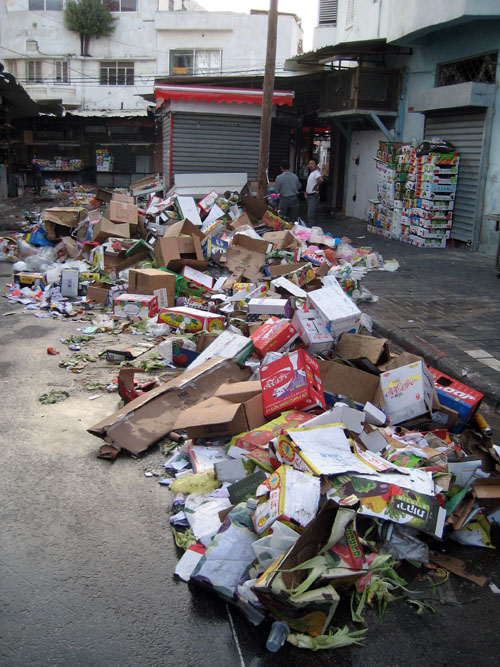
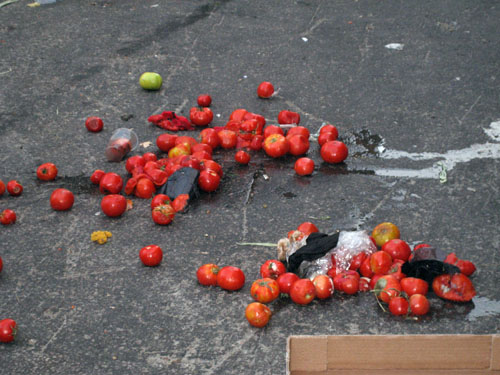
Several small mountains of trash begin to appear around the Carmel Market on Friday evenings, after the shopkeepers sweep their vegetable stands clean. Plastic bags, cardboard boxes, vegetable peels, grapefruits whose juice was squeezed out hours ago and the plastic cups that they were squeezed into – all are heaped together between the shops into piles of garbage.
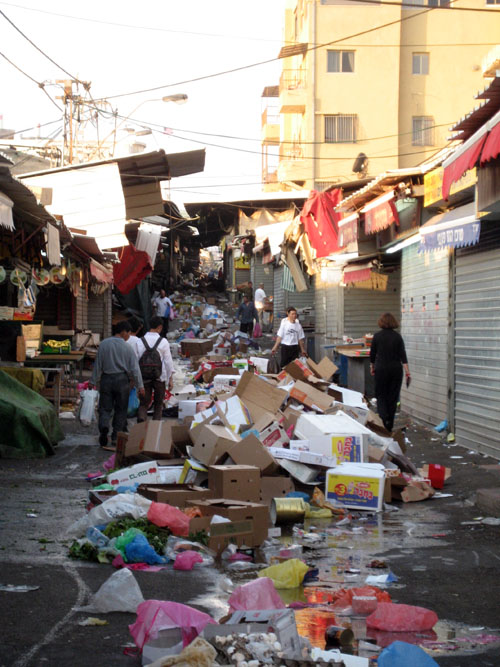
The market’s sloping main street becomes a river of refuse, with the water flowing downhill toward the parking lot carrying with it the remains of all sorts of things. After all of the stands have been boarded up, and the vendors have all disappeared, only this river remains.
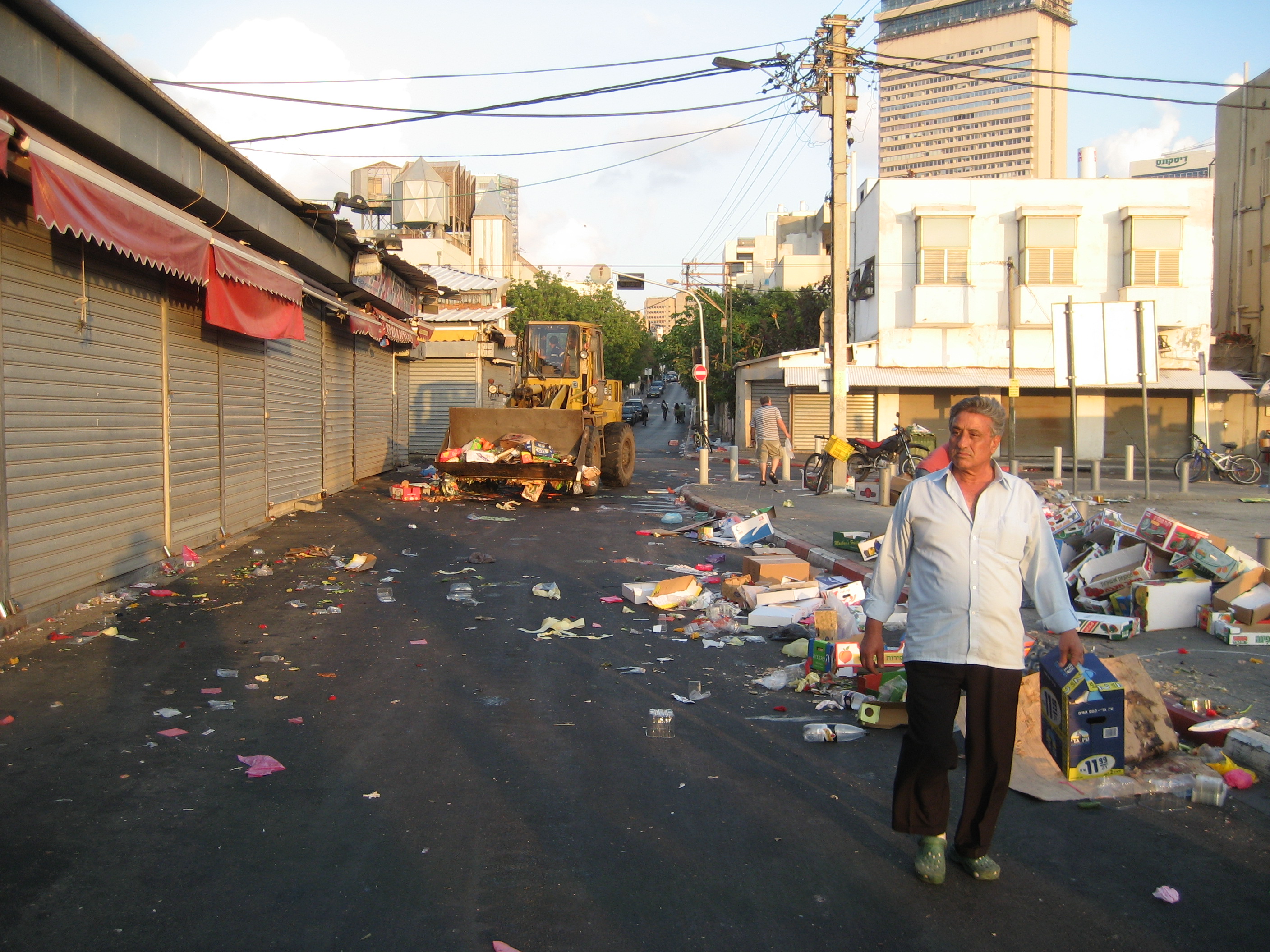
Soon enough, a tractor shows up and begins clearing out the rubble, even as a handful of Chinese are still poking through it. After he finishes his work, and hauls out all the trash, someone else comes and sprays everything down with a high-pressure hose.
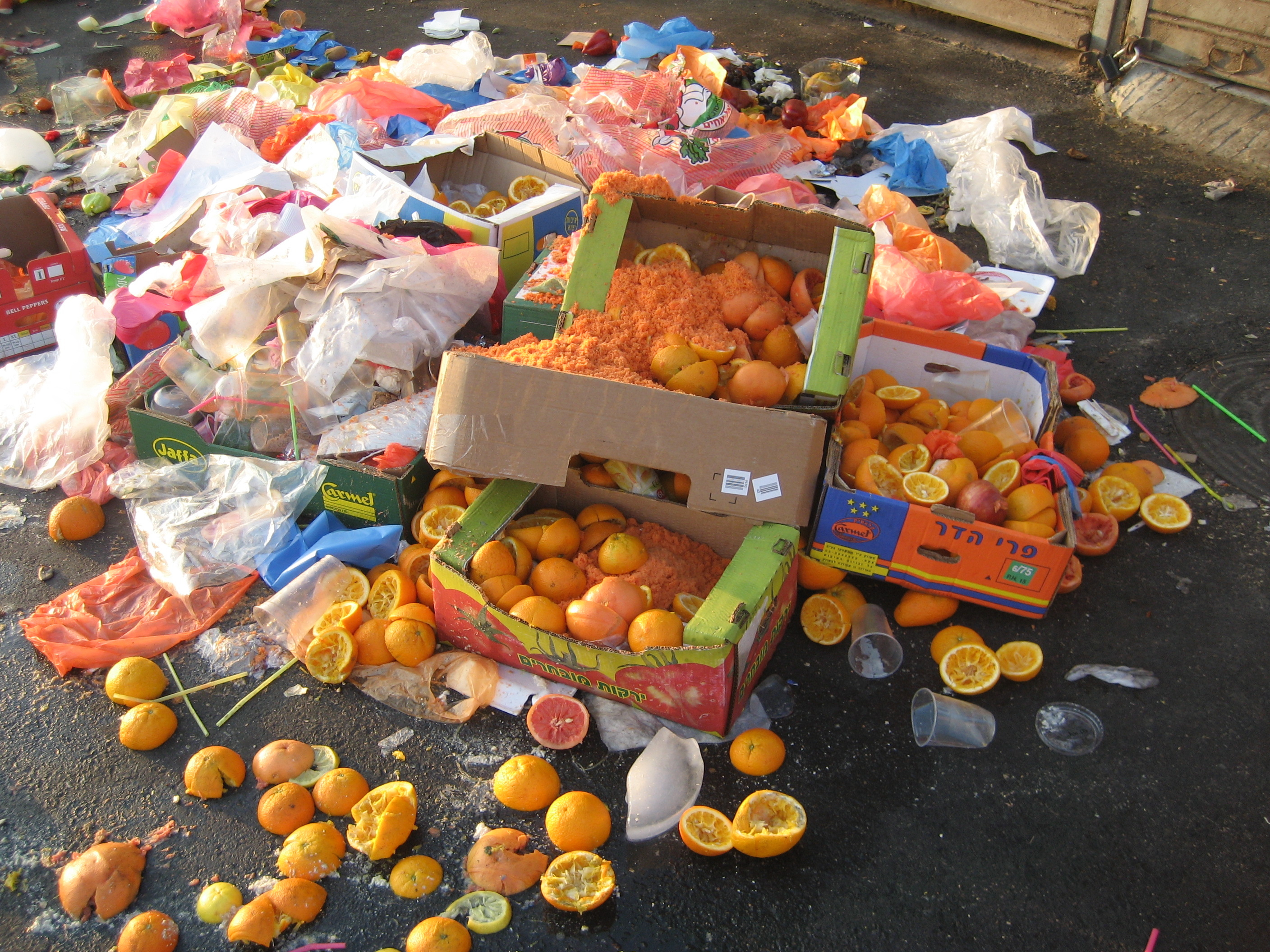
Does all of this waste have to end up in Israel’s landfills, most of them already filled up to the brim? Vegetable peels, squeezed fruits, even cardboard are all compostable materials. If all of the organic waste (organic in the sense that it was once alive) was separated out from the rest, piled up somewhere and left alone for a couple of months, the result would be fertile, organic compost (organic this time meaning chemical-free).

The Carmel Market has its own merchants’ organization, which has plenty of contacts among the agriculturalists with whom they do business. Why not come to some sort of arrangement in which the farmers receive back their agricultural waste, either as raw compostable material or as the finished product?
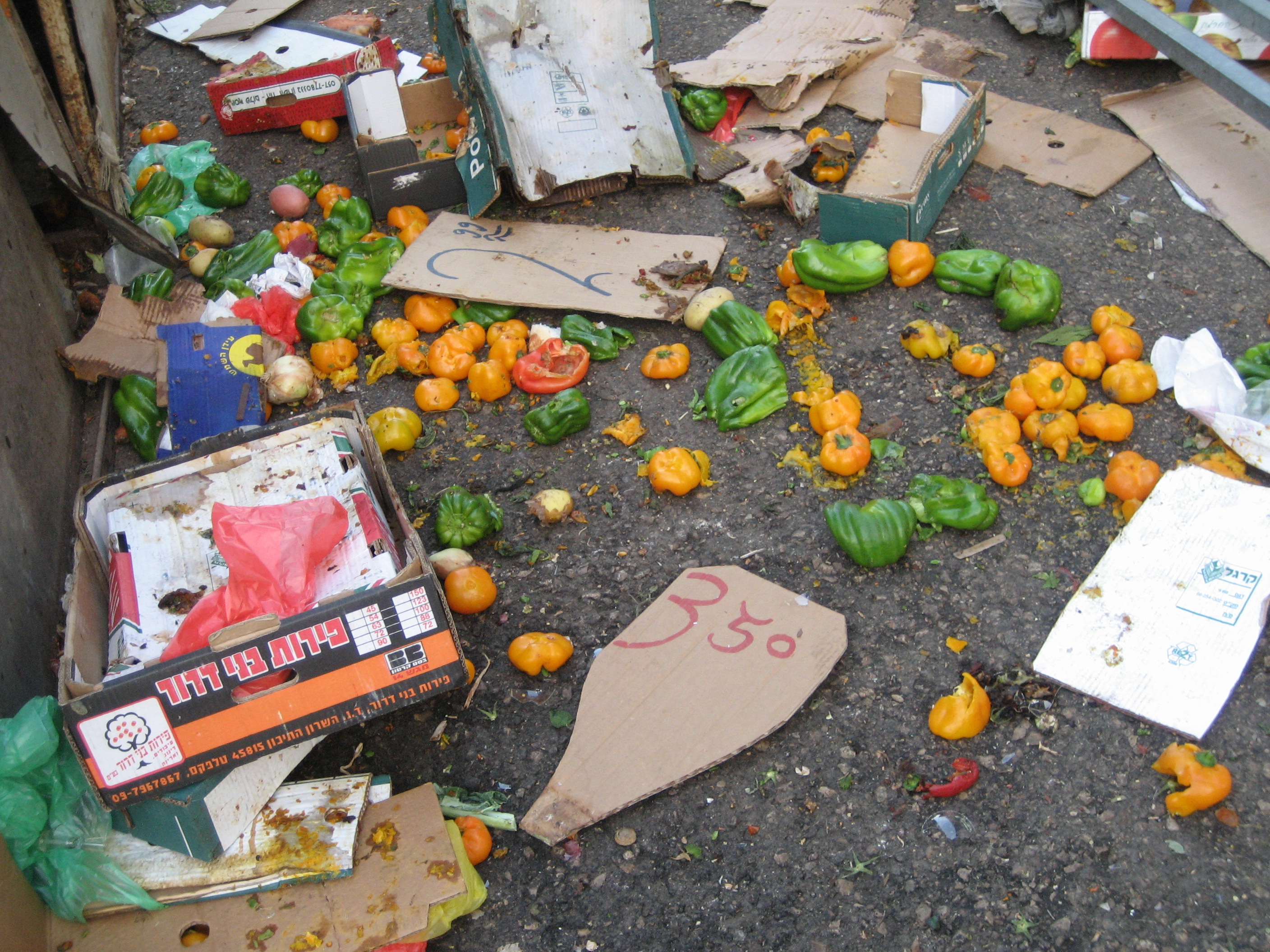
After all, Israel has one of the highest rates of recovered wastewater usage in the world. If raw sewage can be treated and turned into a valuable resource which serves the needs of the country’s farmers, why should organic waste from its vegetable markets be thrown into a trash can – especially when it has the potential to become compost that, if marketed wisely, could even replace some of the agrochemicals currently used on Israel’s farms.


Jesse Fox
Jesse Fox
Jesse Fox is hoping to complete a graduate degree in urban planning at the Technion sooner rather than later. In the meantime, he is working at green NGO’s,volunteering with African refugees and writing as much as he can to try and get the word out. He is also a regular contributor at TreeHugger.com. Originally from North Carolina, Jesse has lived in Memphis, Boston, Quito and the Arava before finally settling down in Tel Aviv. There he can occasionally be found chilling at the beach. Jesse can be reached at jesse (at) greenprophet (dot) com
4 COMMENTS
  1. I was wondering the same thing last year. I am looking at fellowships and gathering research if this is a something I could ignite. Any new NEWS?

  2. Great piece Jesse. I love photo essays … how can we use this piece to start pressuring the Carmel Market Traders Organisation (and that at Mahane Yehuda here in Jeru, and green grocers everywhere…) to start composting? A great opening salvo – I feel a campaign coming on!

LEAVE A REPLY

Please enter your comment!
Please enter your name here

TRENDING

Quintin Tarantino walks on a bike lane in Tel Aviv

Quentin Tarantino lives in Israel now, quietly blending into Tel Aviv life (which is pretty loud and late night!) — until Tel Aviv, of course, notices him.

All 13 Tel Aviv Beaches Reawarded the Prestigious ‘Blue Flag’ for 2025

Reaffirming its leadership in sustainable coastal management, all 13 of Tel Aviv-Yafo’s public beaches have once again earned the prestigious Blue Flag certification for 2025. This honor, awarded by the International Blue Flag Committee and the Foundation for Environmental Education (FEE), recognizes beaches that meet exceptional standards in water quality, safety, accessibility, and environmental education.

Tel Aviv’s mayor Huldai is taking smart phones from schools – his irony in education

Waldorf schools, created by Austria's Rudolph Steiner, are the fastest-growing school system in Israel because of their focus on arts and crafts and their avoidance of technology in the classroom. It’s ironic that Huldai is being praised for pushing a tech-free school environment while his administration shattered a community that has been practicing this philosophy for over a decade.

Tel Aviv is giving away free fruit trees to turn the city into an urban edible forest

Orange trees are everywhere in Jaffa. So are grapes, loquats, and olives. The city is giving away free fruit trees so the entire city will be an edible urban forest

Wave power collector opens at ancient port city on the Mediterranean

Developed by the company Eco Wave Power, the station was built in collaboration with EDF Renewables. The power station is recognized as “pioneering technology” by the Ministry of Energy.  For the first time, electricity generated from sea waves will power the country's national grid—a historic milestone in the country’s renewable energy progress. 

Qatar’s climate hypocrisy rides the London Underground

Qatar remains a master of doublethink—burning gas by the megaton while selling “sustainability” to a world desperate for clean air. Wake up from your slumber people.

How Quality of Hire Shapes Modern Recruitment

A 2024 survey by Deloitte found that 76% of talent leaders now consider long-term retention and workforce contribution among their most important hiring success metrics—far surpassing time-to-fill or cost-per-hire. As the expectations for new hires deepen, companies must also confront the inherent challenges in redefining and accurately measuring hiring quality.

8 Team-Building Exercises to Start the Week Off 

Team building to change the world! The best renewable energy companies are ones that function.

Thank you, LinkedIn — and what your Jobs on the Rise report means for sustainable careers

While “green jobs” aren’t always labeled as such, many of the fastest-growing roles are directly enabling the energy transition, climate resilience, and lower-carbon systems: Number one on their list is Artificial Intelligence engineers. But what does that mean? Vibe coding Claude? 

Somali pirates steal oil tankers

The pirates often stage their heists out of Somalia, a lawless country, with a weak central government that is grappling with a violent Islamist insurgency. Using speedboats that swarm the targets, the machine-gun-toting pirates take control of merchant ships and then hold the vessels, crew and cargo for ransom.

Leopoldo Alejandro Betancourt López Turned Ocean Plastic Into Profitable Sunglasses

Few fashion accessories carry the environmental burden of sunglasses. Most frames are constructed from petroleum-based plastics and acrylic polymers that linger in landfills for centuries, shedding microplastics into soil and waterways long after they've been discarded. Leopoldo Alejandro Betancourt López, president of the Spanish eyewear brand Hawkers, saw this problem differently than most industry executives.

Why Dr. Tony Jacob Sees Texas Business Egos as Warning Signs

Everything's bigger in Texas. Except business egos.  Dr. Tony Jacob figured...

Israel and America Sign Renewable Energy Cooperation Deal

Other announcements made at the conference include the Timna Renewable Energy Park, which will be a center for R&D, and the AORA Solar Thermal Module at Kibbutz Samar, the world's first commercial hybrid solar gas-turbine power plant that is already nearing completion. Solel Solar Systems announced it was beginning construction of a 50 MW solar field in Lebrija, Spain, and Brightsource Energy made a pre-conference announcement that it had inked the world's largest solar deal to date with Southern California Edison (SCE).

Related Articles

Popular Categories