
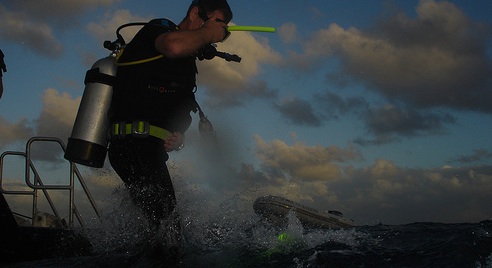


“At a time when steadily increasing atmospheric CO2 concentrations, coupled with the acidification of the ocean’s waters, precipitate the ongoing process of global warming, the importance of following long-term changes and trends in aquatic photosynthesis increases dramatically,” say Dr. Ilana Berman-Frank and Prof. Zvy Dubinsky, of Bar-Ilan University.
This is important since about 50% of global photosynthesis takes place in the oceans, which therefore are the major sink for atmospheric CO2, mitigating its mankind-driven increase.
Later this month, the Bar-Ilan team and colleagues from around the world will gather at a workshop at the Inter University Institute for Marine Sciences, on the shores of the Red Sea in Eilat, in order to monitor these trends – an important process they began thirty years ago.
“Any changes in the well-being and rates of primary productivity (photosynthesis) in the oceans have a feedback loop on the atmospheric levels of greenhouse gases,” says Prof. Dubinsky. “The honing of methods for correctly estimating aquatic primary productivity is essential for following any future trends and forestalling and controlling any deleterious effects under various global climate change scenarios,” he adds.
The workshop will enable scientists to conduct measurements simultaneously, comparing different methods by applying cutting-edge instrumentation that they bring along. The results produced by the workshop will allow better inter-calibration and improved quality control needed for creating a synoptic view of processes related to changes in global aquatic primary productivity on a worldwide basis.
Held from March 30-April 8 in Eilat – home to extremely diverse aquatic systems, such as the oligotrophic, nutrient poor waters of the Gulf of Eilat/Aqaba, seagrass meadows, seaweeds, intense algal cultures, salt ponds, and corals – participants in the workshop come from the United States, Canada, Belgium and more.
Prof. Dubinsky is no stranger to the southernmost region of Israel. Together with Dr. David Illuz, of Bar-Ilan University, they lead the Israeli side of a NATO-funded joint Jordanian-Turkish-Israeli project focusing on the impact of dust storms reaching the Red Sea and the Gulf of Eilat — from deserts as far away as the Sahara — on different life forms in the Gulf of Eilat.
Global warming, he says, has led to a wide-scale desertification process, resulting in an increase in the frequency and intensity of dust storms. “This collaboration of marine scientists in monitoring changes in the quality of the waters of the Gulf is aimed at the conservation and restoration of the region’s spectacular coral reefs, while underscoring the value of peaceful collaboration with our neighbors,” says Prof. Dubinsky.
Green Prophet related :: Green Inspiration from Diving :: The Politics of Water: Study it Dead or Red
Image credit: Shayan



The latest news about climate change is so alarming (the right wing would say alarmist) as to make many people want to plant their aching heads in the sand. Some scientists using advanced computer models now argue that if we want to stop the Earth from warming, the amount of carbon we should be emitting is … none. None? As in, zero? As in, shutting down the global industrial economy? After all, global energy demand is expected to accelerate until at least 2020. Yet attempts even to slow the rate of increase of carbon emissions have paralyzed world politics for more than a decade.
is this the ‘ocean seeding’ programme that is so controversial? Was it Jim Lovelock, father of the Gaia Theory, who developed this in the 60’s …. I’d be interested to find out more about this ……………………