

Tesla CEO Elon Musk introduced the “latest” in electric car technology – battery pack swapping for the company’s Model S – to a gushing crowd and an even more fawning press. “Really, it’s one of those things you need to see,” wrote Chris Velazco in TechCrunch before linking to a video of Thursday’s event complete with flashing lights and space age music.
I guess Valazco never saw the now-bankrupt Israeli electric car company Better Place do pretty much the same thing. Nor must have the crowd, which whooped it up like they were at a particularly skillful gymnastics exhibition.
Looking more carefully at the demonstration, though, the numbers are a bit deceiving and the business model seems as convoluted as Better Place’s.
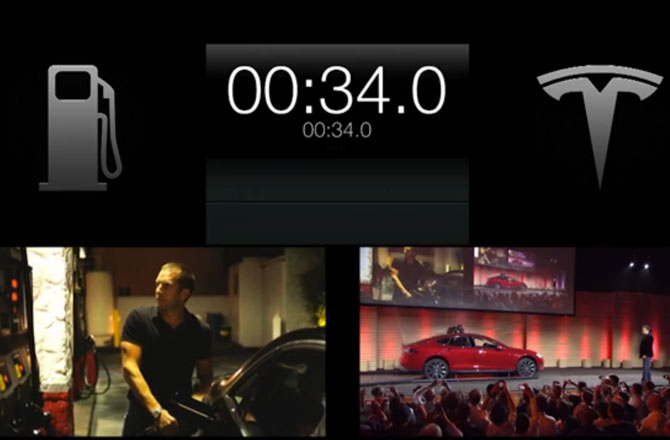
One of the centerpieces of the just announced Tesla system is that battery swapping can be done in 90 seconds (at first blush, far less the 5 minutes or so it takes at a Better Place swapping station). A digital clock timed the Tesla on-stage swap, then a second car pulled up and clocked in at even less time. A video showed someone pumping gas and not finishing before the two Tesla’s pulled away.
All very impressive until you factor in what Tesla wasn’t showing – namely, the set up process.
As a Better Place car owner in Israel, I can tell you that the actual time that it takes to physically swap a battery is not that much more than 90 seconds. Most of the time is spent while the system is identifying the car as it arrives, moving the vehicle into place, preparing the battery, and then double checking its math before opening the gate. All we saw at the Tesla show was the swap itself. And the battery was probably pretty close by – when a robot has to pick a battery from several dozen waiting in the station, that may also go slower.
Better Place had been criticized for having an unsustainable business model – charging a monthly subscription, like a cell phone, for charging, whether at home or at a swap station. And it’s true that Better Place was completely reliant on battery swaps while Tesla plans to offer that in addition to supercharging.
But Tesla’s model is, if anything, even more bizarre.
When you buy a Tesla Model S, you own the battery, so your swap is really just a “loaner.” You have to return the battery back to the station on your return journey and/or pay an as yet unspecified “transport fee.” If the new battery has more juice, you can choose to keep it and make up the difference by credit card. And the swap itself will be the equivalent of 15-16 gallons of gas ($60-$80), Musk said. (Supercharging will remain free for Model S owners; the stations will be co-located, Musk said.) With all those options, the Better Place monthly fee and charge or swap anywhere approach looks surprisingly simple by comparison.
Musk said that stations will cost about $500,000 to build. Unless Tesla sells a whole lot of cars (and keeps its price high, in the current range of two to three times that of the Renault Fluence Z.E. that Better Place markets), or raises a whole lot more money, it’s going to take a long time before the US is blanketed with swap stations. And a limited number of stations means that drivers will have to plan their routes accordingly, which may be different than what they really want. That’s part of what I wrote previously plagued Better Place. It will trip up Tesla too. Even with its longer battery range than Better Place, Tesla hasn’t exactly reinvented swapping technology. They’ve just created a better dog and pony show…for now.
I’m not against the battery swap solution – I bought a Better Place car and learned to live with and ultimately even love the limitations. Battery swap is all we have for the moment…and it could be a fairly lengthy moment until fast charging gets down to 90 seconds. But even the high flying Tesla won’t solve the inherent problems with electric cars this way. It makes for good media. Getting consumers to buy in will be an entirely different matter.
Brian Blum, owner of a Better Place car, is a guest poster on Green Prophet



[…] 100 percent electric cars an acceptable range. (You can read my analysis of Tesla vs. Better Place here.) How long will this go on? Even Renault, which makes the only model Better Place sells, favors […]
” Drivers who opt for the swap will have to eventually return to the station to get their original battery back, and they’ll have to pay for the service once again.
If they don’t return, they can pay to have the 1,000-pound battery shipped back to the service center nearest their home, or they can keep the new battery they’ve had installed”
Riiiiiiiiiight.
So, in other words, this whole cockamamie battery-swapping scheme is nothing but a sick joke and a ridiculous publicity stunt.
At a half mil per station, I can only assume that Elon is expecting uncle sugar daddy Obama to “loan” him the money to build the stations.
[…] Green Prophet gives us the perspective of a Better Place car owner who questions how successful Tesla will be with this venture. Better Place was the first to […]
[…] 100 percent electric cars an acceptable range. (You can read my analysis of Tesla vs. Better Place here.) How long will this go on? Even Renault, which makes the only model Better Place sells, favors […]
Brian, as a Renault ZE owner, I admire Elon Musk’s and Telsa’s recent successes. I think they help us as electric car owners. I also envy Tesla’s range. If I had Tesla’s range, most of the time nighttime charging at my home “charge stand” would suffice – even in the hilly, long distances of the Golan, where I live. I would only have to charge once on the way to “the Mercaz” (Tel Aviv, Modiin, Bersheva or Jerusalem) and once back (as opposed to the current six times round trip). While it is true that Tesla includes the battery in its price, unlike Better Place, the $ 10,000 for the battery is equivalent to about 6 and a half years of gasoline (petrol) purchases assuming 30 mpg at a $ 3.20 price per gallon. Perhaps what Tesla could do is to sell the battery at $135 a month for 78 months and then the battery would be tantamount to a replacement of the $ 135 a month an average American pays for petrol.
I think it is brilliant that Musk is offering flexibility to counter “range anxiety”. A Tesla owner usually will drive under 200 miles a day and charge at night while asleep each day. Should he have to travel on an interstate road trip he would chose between time and money. If he was travelling on a business trip, time may be more important and he would choose to use the changing station for $ 60. If he was travelling on vacation (holiday) money may be important and he would chose a free 30-minute supercharger. Brilliant. Of course given Tesla’s superior range, it would not require as many changing stations per square mile as Better Place had.