
Miriam sees Israel’s most famous open-air market through new eyes.
When I lived in Jerusalem, the Machane Yehuda shuk (market) was my grocery store. Vegetables, grains, fruit, chicken for Shabbat, the Jewish day of rest. There were nuts and sweets…everything we ate came from the shuk. (Read about 5 Israeli shuks here.)
My kids grew up eating the freshest, most colorful and flavorful food in the city, and since prices are lowest at the Machane Yehuda shuk, I was saving money.
Intent on my shopping and on getting home, I never gave the mixture of imported and local foods a thought. While I happily observed the growing number of tempting new fruits and vegetables, it didn’t occur to me to ask if they were grown locally or flown in from far away.
As eco-awareness became part of the way I think, I began to make more conscious choices. But a tour of Machane Yehuda with Rabbi Yonatan Neril of of the Jewish Eco Seminars organization showed me what “globalized food” means. And how organic food struggles to compete in Israeli markets.
The bustling Machane Yehuda shuk isn’t a farmer’s market. The produce is trucked in from nurseries and farms around the country. Some of it is flown in from Europe or the States. Although historically it’s the biggest food supplier for the Jerusalem working class, in recent years hip eateries and fancy stores have sprung up inside the the shuk, attracting the spendier middle class.
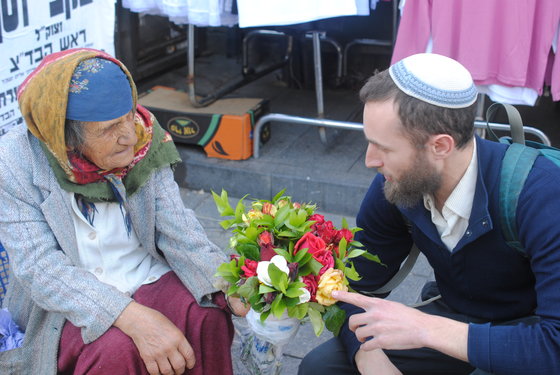
The Machane Yehuda’s shuk’s a wild, crammed mix of traditional ethnic and western-style modern foods. And people. Neril pointed out the contrasts. We watched affluent folks selecting French and Dutch cheeses at an upscale fromagerie, while across the way an Ethiopian woman calculated the cost of green beans with a worried frown.
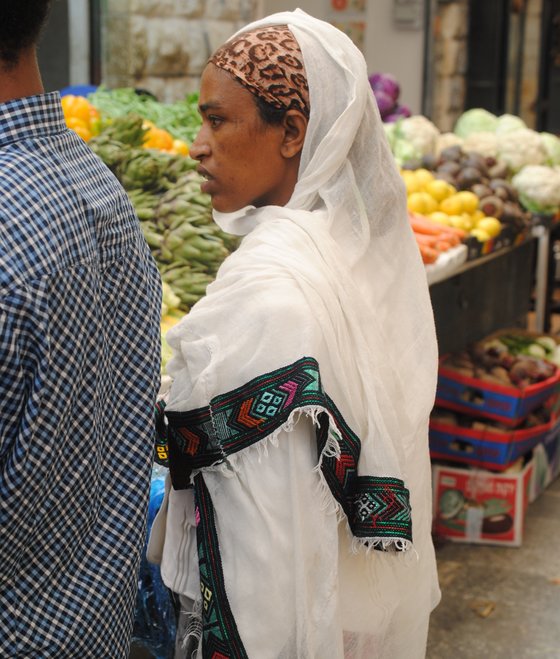
A young worker hoisted a tray of hot pitas, while on the next corner, we could take our choice of breads at a “natural” bakery. The shelves loaded with organic whole wheat, rye, and spelt breads seemed like a miracle of abundance.
 Indeed, Neril asked us to think about this abundance. We eat more, and more kinds of foods today, than humanity has ever known before. But are we paying attention to where our food comes from?
To drive his point home, Neril asked us to name Israel’s iconic food – the dish everyone associates with eating in the street while standing up.
Falafel, of course, the portion of fried chickpea balls covered in tahini sauce and crammed into a split pitta with chopped tomato and cucumber. Falafel is touted as “nature’s junk food,” for its healthy combination of protein-rich grains and vegetables.
- The wheat milled into Israeli bread flour is flown in from Kazakhstan.
- The chickpeas come from Argentina.
The sesame seeds ground into tahini come from Turkey, in spite of the political disagreements between the two countries.
The spices are imported from India.
Only the chopped vegetables come from local farms.
Surprise! Falafel is nowhere near as green as you’d think.
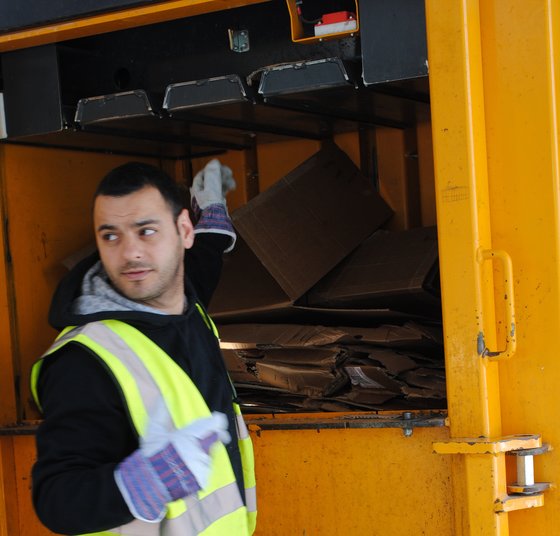
Right outside the bakery, we almost walked past a machine that compresses cardboard boxes for recycling without noticing it. Neril made sure we saw it – and noticed the produce waste getting dumped, ultimate destination a landfill, right next to it. On one hand, modern eco-awareness; on the other, more methane gas in production.
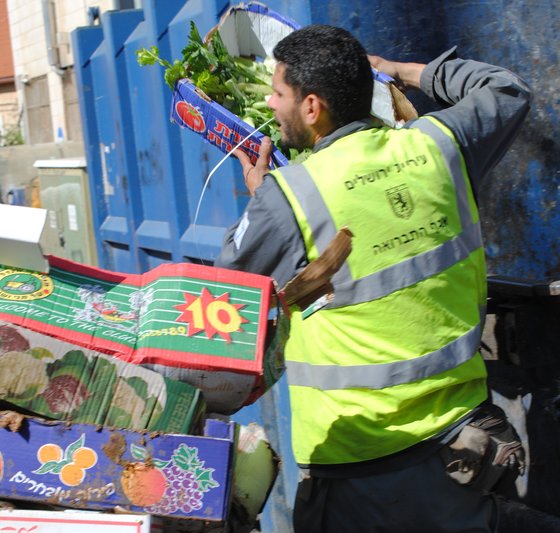
Settled on a stoop, an elderly man sold fiery home-made pickles and relishes he makes himself, using recipes his Iranian grandparents brought to Israel on donkey back, one hundred years ago.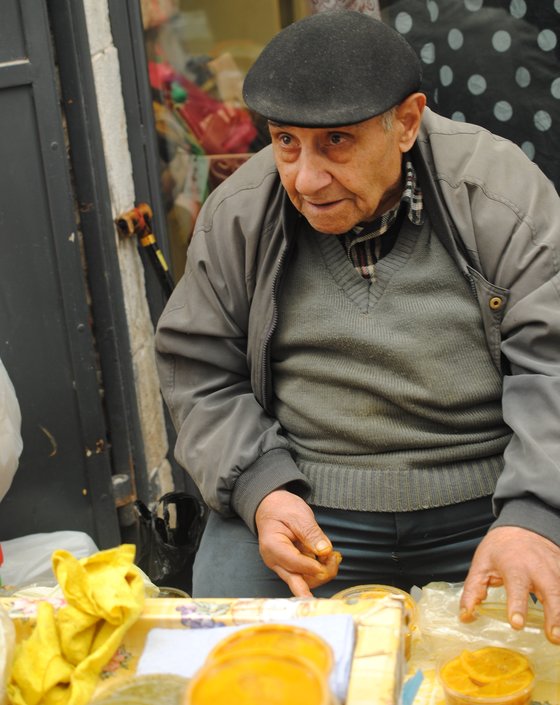 One more contrast we wouldn’t have noticed except that Neril pointed out: the vendor was selling pickles the same way he’s been doing for the last 40 years, right in front of an upscale clothing boutique.
With today’s bewildering choice of tempting edibles, it’s the easiest thing in the world to overbuy, overcook, and throw lots away in the end. We need to consider how our food choices contribute to the load Earth sustains to feed us.
The choices are to eat more modestly; that is, forgo the fancy imported goods, even if they’re “healthy.” Cook at home rather than eating out or sending out. Go vegewarian as often as possible. As Rabbi Neril said, the greatest single act that an individual can do to affect the environment is giving up meat.
Think about it. Our food choices are having a direct effect on how much our children and grandchildren will have to put in their mouths.
And it would be great if someone would set up stands selling reuseable eco-bags in the shuk, to replace the plastic bags.
More on Israel’s open-air markets:
- How To Eat Your Way Through Machaneh Yehudah
- Tasty But Elitist In Tel Aviv’s Farmer’s Market
- Gleaning The Shuk
Photos by Miriam Kresh.

Evelyn Tenne, I’m rather dismayed by YOUR comments! Are you saying that “disfranschisement” is a justification for Bedouin theft of Jewish property??? Charedi Meah She’arim was “disfranschised” for years, yet they never resorted to stealing. When Jews were disfranschised in Yemen, do you think they stole? How do you know that Bedouin theft from Jews is political? Are you making assumptions w/no evidence? I’ll bet that even if there was the “respect” you claim they (AND the Arab cattle rustlers in the Galil region) are not receiving, that both of these groups would still steal. I’ve seen this before during racial riots in America where even middle class people took because THEY COULD! Allah doesn’t give special dispensation for theft or other crimes under the guise of your “no peace without respect.”
I really appreciate this article. I wish Israeli supermarkets would label where the produce comes from. I also hope and pray Israel will prioritize the value of the Land and encourage more farming so we can be more self-sufficient in food production. The Negev is under-utilized and lack of developing it for farming is creating a void that Muslims are quickly discovering and illegally exploiting. I’ve visited a Jewish farm there, which is very lonely, and subject to Muslim stealing of livestock. The government may give the land to us if we want to farm, but how many have the chutzpah to work hard to settle the land when in one night, Arabs can come and steal all our sheep? We shouldn’t have to have all-night watches with armed guards at every farm. Moshavim are one answer, but the government must start the ball rolling. It’s terrible that we can’t grow our own wheat, corn and chickpeas at the very least.
I’m rather dismayed at the irrelevant use of the terms “Muslim” and “Arab” in “Praying”s comment, and of ignoring the other side of the story, especially on this Green Prophet site, whose point you seem to have missed.
In any discussion of the Negev the term “Bedouin” is the relevant one. Stealing of equipment and livestock indeed is a terrible problem. Have you also visited the Bedouin townships, both recognised and unrecognised, in the Negev? Do you realise the detrimental results of disfranchisement to both sides?
Are you aware of the cynical attitudes of officialdom not caring to learn about or deal with the Bedouin communities in these changing times? Ignoring for decades recommendations of professional reports for outline plans and strategy?
There shall be no peace without respect.
Co-operation between authorities and all of the area’s social groups to develop the Negev, which as you rightly say is under-utilized, is the only way to an ecological prosperity and happiness, with a plethora of home-grown organic produce in the Machane Yehuda market.