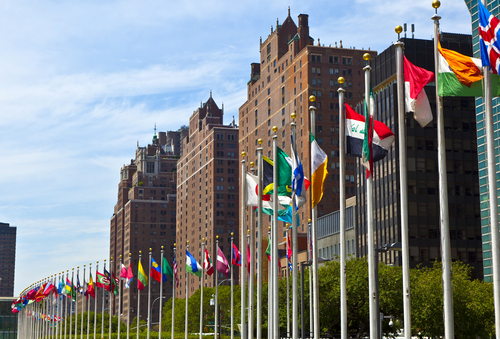
The Dan Region Wastewater Treatment Plant, known in Israel as Shafdan, is among the thirty projects from around the world chosen by the UN as global role models for how local authorities can deal with environmental problems.
Shafdan utilizes the surrounding environment, the nearby sands of Rishon Letzion and Yavne, as natural filters for part of the water purification process. There are still kinks in the system that need to be worked out. Insufficiently purified water can damage adjacent soil before it even reaches the sands. The plant, in combination with Israel’s national water company Mekorot, is working to improve its methods. Mekorot routinely pumps 130 million cubic meters of purified sewage water into the sands. The resulting water is pure enough to be used for irrigation in Israel’s southern desert region, the Negev.
Shafdan is just one of many Israeli innovations that explores how to harvest natural resources for wastewater treatment. Just a few months ago young, Israeli students designed a solar-powered water treatment system that can be used at home.
Israel hopes to use this bounty of innovation and creativity to change its public image. It recently launched an advertising campaign on CNN International to coincide with the Rio+20 United Nations Conference, seeking to brand Israel as a “green county.” The tiny nation of Israel is indeed one of the world’s biggest producers of clean technology. But calling it a green country is problematic.
Israeli settlements in the West Bank have starkly different environmental practices than communities within the green line. In May, Dr. Yousef Abu Safief, Chairman of the Environment Quality Authority of Palestine, wrote an article in Aljazeera denouncing Israeli settlers for wasting water and illegally discharging wastewater, causing massive pollution.
He cited a study by the Applied Research Institute in Jerusalem (ARIJ) that reported: “around 80 per cent of the solid waste generated by the [Israeli] colonists is dumped…within the West Bank.”
In preparing for the Rio+20 United Nations Conference, Israeli Environmental Protection Minister, Gilad Erdan, expressed concern that Palestinian and Iranian leaders would draw the focus away from Israel’s innovation and concentrate exclusively on the ongoing occupation, referred to in Israel as “the situation.”
In general, Israelis feel that the UN is biased against them, even deliberately demonizing them in front of the world. Since its creation, the UN Human Rights Council has devoted 41.12 percent of its country-specific resolutions to condemning Israel. To put that in perspective, 4.67 percent of such resolutions condemned human rights abuses in the Democratic Republic of the Congo and 5.61 percent addressed human rights abuses in Syria.
Despite the vast amount of innovation emerging from Israel, over the past few years only a handful of Israelis have managed to pass the tests for the UN’s Young Professionals Program. Out of the UN’s 70,000 employees, only between 60-80 are Israelis.
The UN’s recognition of Israeli successes, like Shafdan, is therefore significant both for its environmental know-how and its political potential. The human rights abuses of the occupation and Israel’s environmental problem solving are not mutually exclusive conversations. But so far Israel has responded to international pressure with self-imposed isolation.
Acknowledging, rewarding, and cooperating with Israel’s successes are crucial to the UN’s legitimacy and ability to influence policy in the region. Israel needs to feel humanized by the UN, acknowledged just like any other nation for both its fiascos and its accomplishments. Maybe then it would dare reconsider its public relations priorities and focus that national creativity on resolving the situation.
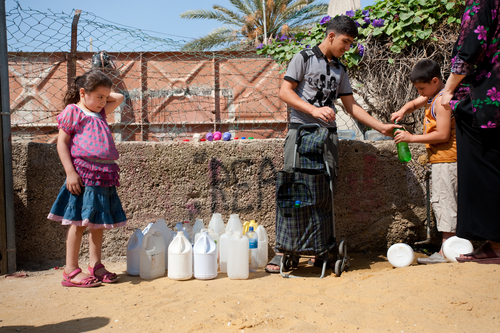
Environmental reports like the one published by the UN, which appreciated Shafdan, maintain a global perspective because the planet is interconnected. Environmental damage in a neighboring nation will cross borders; it cannot be kept at bay with checkpoints or walls. Therefore policies that stop at the borders are a hindrance to real, sustainable solutions.
We can only hope that Israel will recognize inconsistent policies as insufficient, and see all the work it has poured into preserving natural resources as yet another reason for finding local solutions to its regional conflicts.
Read more about Israeli wastewater innovation:
Joint Israeli-Palestinian Project To Tackle Sewage Problems
An Israeli Sewage Plant is a Hot New Art Venue for Passover
Israel’s Mekorot Builds Global Connections Through Water