

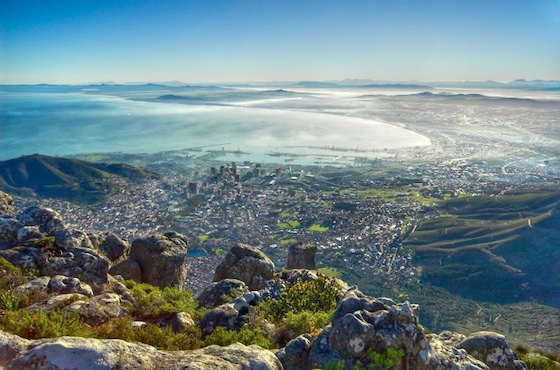
South Africa, among the biggest emitters of greenhouse gases worldwide, plans to introduce its own price on carbon next year.
The Treasury said this week that South Africa, which is the continent’s biggest polluter, plans to introduce a carbon tax on annual emissions for all the industrial sectors responsible for greenhouse gas emissions, including electricity, petroleum, iron, steel and aluminium, to reduce greenhouse gases.
South Africa was the host of last year’s climate talks at Durban that yielded the first international agreement to put a price on greenhouse gases to be worked out by 2015 and operational by 2020.
In putting its own price on pollution ahead of time, South Africa will be joining the $500 million dollar economy of the EU, New Zealand and Australia (the world’s largest coal exporter) California (the fifth largest economy in the world) the ten northeastern RGGI states (comprising almost half the US population) and four Canadian provinces (covering half of Canada’s greenhouse gas emissions) – that have done so already.
With around 500-million tons of greenhouse gases emitted yearly, the country ranks third in the world on a total emissions per capita basis. It is one of the BASIC nations (Brazil, South Africa, India and China) responsible for most new greenhouse gas pollution.
So South Africa’s carbon tax is a very encouraging development.
Most of these nations, states and provinces are using not a carbon tax, but cap & trade to cap emissions and ratchet them down. For example, RGGI reduces the cap by 2.5 percent per year over the next four years so that in 2018 there is a 10 percent reduction from the baseline emissions. Australia’s price on pollution begins as a carbon tax next year, and transitions into a cap & trade program.
South Africa’s draft policy of a carbon tax would be published later this year. It has not been easy. It has been the subject of much controversy and industry pushback.
In the South African plan every industrial sector that pollutes will be covered from the start. (The failed 2009 Waxman Markey climate legislation in the US would have begun only with stationary sources emitting over 25,000 tons of CO2 annually – essentially covering only coal power plants to start with.)
To slow the impact of the new tax, it would initially be required for only one third of each company’s emissions, starting in 2013. Then gradually, over the next 7 years, the amount would be increased by 10% a year until 2020.
For emissions above the capped amount, companies would pay a carbon tax on each ton of CO2e (carbon dioxide equivalent) of 120 rand or about $US 16.
But all industrial sectors except electric power production would also be able to claim additional relief of at least another 10%. That is because in South Africa, nearly all electricity is supplied by a monopoly coal power company, Eskom, so heavy industries have no options to switch to cleaner electricity sources like wind or solar to cut their emissions.
Perhaps it is time that these South African industries should start reading Green Prophet and other green tech news to learn from their North African neighbours like Morocco and Egypt, that are moving in leaps and bounds in developing clean energy.
From combined heat & power from companies like Israel’s 72% Efficient ZenithSolar to solar thermal for steam production like GlassPoint Solar, there are lots of clean energy solutions to reduce or eliminate dirty coal power, even at the company level.
Perhaps, South African industrial leaders could travel north to MENASOL 2012 (16-17 May, Abu Dhabi) where they can find out about all of the wonderful clean tech solutions available as alternatives to reliance on dirty coal.
Related:
Middle Eastern Oil Companies Try Solar CSP to Boost Oil Production
Did GlassPoint Get the Glass House Idea in the Middle East?
ZenithSolar Makes Solar Power Affordable



The grouping you talking about is called BRICS and not BASIC like it says in your piece of writing!! You must be related to the Bush family…kan die man nou so dom wees en hy het seker ‘n graad in iets!!
Gerrit, as jy wil iets nare om te se, se dit in engels, neh? Maar dit is beter om vriendelik te wees as ons is net mense soos jy. Baie dankie.