

Sweat and Sahara sand had forced my eyes closed so that, even as I stood in front of one of the seven wonders of the ancient world, I saw nothing. My eyelids were a back-lit sandy-orange in the sun’s glare. I pried them open and squinted up at the shapes the pharaohs and their slaves had conjured out of the desert 4500 years ago. The Great Pyramid of Cheops towered over the camels and tour buses on the outskirts of Cairo. It was a sight I will never forget and yet in the beginning I saw nothing.
Visitors often see the desert in this way, as an endless stretch of sun and sand and nothing. But when German-born 3D Designer Markus Kayser first set his eyes upon the Egyptian desert, he saw possibilities. He imagined harnessing the resources which existed in great abundance here, sunlight and sand. And here he talks with Green Prophet about his 3D printer that runs on sun and sand.
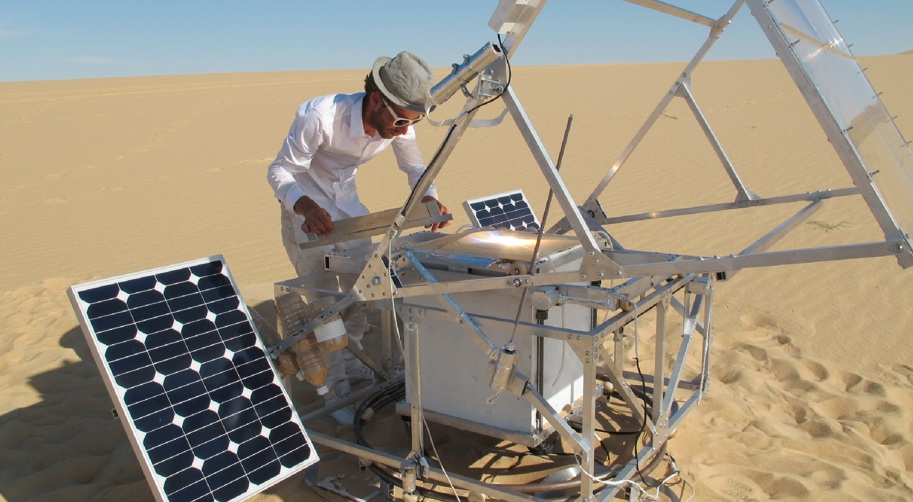
 First object printed from a 3D file with the Solar Sinter, Photo by Amos Field
Markus Kayser didn’t need tens of thousands of slaves to conjure something out of the desert. He used his own ingenuity to design and build a machine called a Solar Sinter. This machine uses photovoltaic panels to power a computer and the electromechanical workings of a 3D printer.
The print head holds a lens which concentrates sunlight from a larger Fresnel lens onto a tray of sand. This focused beam reaches temperatures of over 1400°C which sinters (melts) the sand to form a glass or ceramic object. The idea isn’t entirely new. In the June, 1933 issue of Modern Mechanix, W.W. Beach envisioned giant lenses bur
Solar Sinter in the Saharan desert near Siwa, Egypt, Photo by Amos Fieldning roads and canals into the desert. Markus Kayser took the first steps towards making this dream possible.
Markus earned a BA in 3D Design from London Metropolitan University and a MA in Design Products at the Royal College of Art in London. He is busy with the next phase of his project but he was kind enough to allow me to interview him for Green Prophet:
GP: What changes would you like to see in the way products are manufactured and consumed?
Markus Kayser: The Solar Sinter project is all about a potential which questions current manufacturing in a positive way. I would like to see changes in the way energy is used which in this case means to use the immense power of the sun in a more direct way than just the conversion to electricity. I think there is a basic logic, which is that sunlight is ‘powering’ this earth as a whole and that this energy can also be used to produce the products or even buildings.
GP: Given your imagination, sunlight, sand and enough financial resources– how would you improve the environment in the Mideast?
Markus Kayser: I would try to develop the material to be able to replace concrete as a building material. I would concentrate on architecture and water distribution as well as sanitary products.
GP: Note that the production of concrete releases large amounts of CO2, consumes fossil fuels and requires large amounts of water. Solar sintered sand does not.
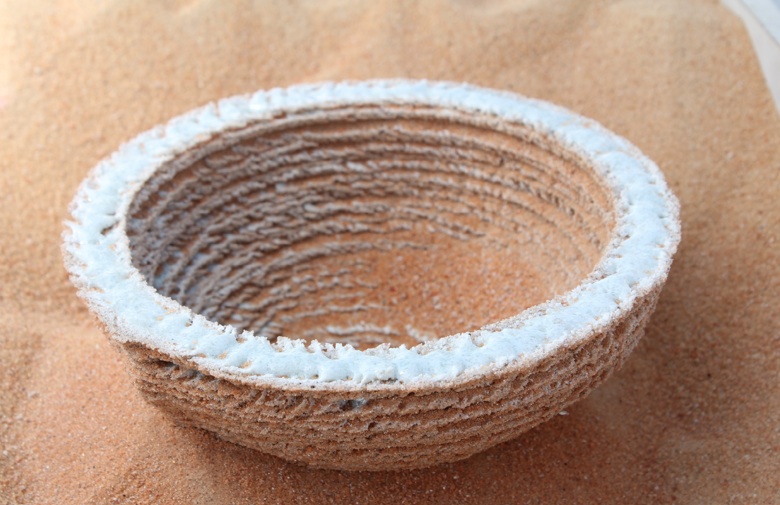
A bowl made by Markus Kayser’s solar sinter out of Saharan sand.Do you ever see a mass-produced product and say to yourself, “I could make that out of sand and sunlight?“
Markus Kayser: I think there are plenty of glass and ceramic objects which could be produced with the Solar Sinter. Of course, the Solar Sinter as it is now is not developed into a manufacturing process but is a prototype for industry to get inspired to look in that direction. I also see a great potential in architecture and infrastructure (sanitary, water canals) for the process.
GP: Your project shows potential for desert manufacturing and architecture. Can it scale or should it always remain a small scale project for producing unique art?
Markus Kayser: Yes I think it can be scaled given enough funds to experiment on a large scale. I think it has already moved out of the ‘unique art’ context even though that’s what it is producing today. I hope that it influence on industry will show in the future. At the moment I’m sponsored by a big ceramic manufacturer (KOHLER) who are interested and supportive of the process as they see its potential for the future manufacturing. I think that’s a small start in involving industry to really start thinking in this direction.
GP: What were the practical problems you encountered? Was it difficult to find the right kind of sand? Was it difficult to keep the sand from clogging the machine?
Markus Kayser: The problem with the first Solar Sinter was that there was very little time to experiment in the desert – only about two weeks. So to get it working in that timescale was a challenge, which thankfully just worked out. Heat is of course one of the biggest problems with electronics involved. Finding the right sand was not an issue as desert sand in Egypt and Morocco worked without previous tests. I have build the machine fairly robust but lightweight for traveling and the mechanics are designed slightly oversized so that the sand cannot do any damage.
[youtube]http://www.youtube.com/watch?v=ptUj8JRAYu8[/youtube]
GP: How will 3D printing change the relationship between consumers, manufacturers and the environment?
Markus Kayser: 3D printing is moving in two directions – desktop DIY printers and prints on demand for so called ‘mass-customization’ of products. I think both will have a great impact in how products are consumed as well as on manufacturing. If for instance I can modify the product to my personal needs before I buy it, it might have an impact on the way I feel about the product, its usability and I might think twice before throwing it away as I was part of its ‘creation’. This again could lead to less consumption. Also the way in which DIY 3D printers are looking at recycling the printed products, reusing the once printed but now unwanted products to make new ones at home.
GP: How will 3D printing change architecture?
Markus Kayser: In a way architecture has changed already through 3D printing as models of buildings are churned out by the hour in large architectural practices.
This means a building can be analyzed very quickly. 3D printed full scale architecture is just emerging with works by Fosters+Partners and Enrico Dini (among others) and it could bring about more ‘intelligent’ materials, which include walls with cavities for all wiring etc. as well as materials with insulating thermal properties with possibly ever changing qualities copied from natural processes. (see Neri Oxman, MIT)
GP: What will you do next?
Markus Kayser: At the moment I’m working on a new improved prototype as the first Solar Sinter is on exhibition tour. I will be traveling to the desert again in March to produce new work with the Solar Sinter.
Many thanks to Markus Kayser for helping us see the resources of the desert with new eyes. Photos by Amos Field.


GREAT article, Brian!
GREAT project, Markus!
I’m curating an expo: “T-minus-10 to the Colonization of Mars” for Burning Man this year, and I’d love to have the Solar Sinter present as an exhibit. I’ll contact you!
What’s up i am kavin, its my first time to commenting anyplace, when
i read this article i thought i could also create comment due to this
good post.
Here is my page :: Melba
I discovered your website internet site online and check a couple of your early posts. Always keep inside the excellent operate. I just additional your Rss to my MSN News Reader. Seeking forward to reading far more from you finding out down the road!…
This is Amazing,i wonder if this could make inter-locking bricks too?that way we dont need cement,sand,water,etc to make small scale buildings.
Thx
http://www.excitingegypt.co.uk
That’s eventually the idea. To create building materials completely from sand.
Useful for building Lunar/Martian buildings too?
Fascinating concept. The video is a must-see.