
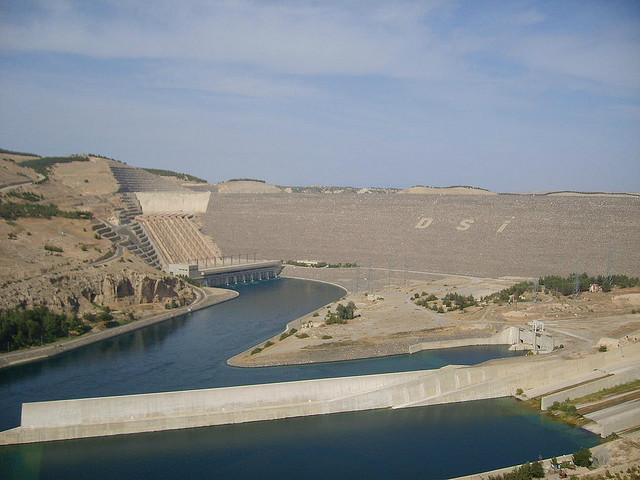


Turkish dams don’t just affect Turks — they cut off access to water in Iraq and Syria as well, forcing entire populations in those countries to resettle.
Hydropower seems like the perfect solution to Turkey’s escalating energy demand: a clean form of energy and an irrigation source that can be harnessed from the many rivers that flow through the country. But the real cost of hydropower in Turkey has long been apparent. Building a hydraulic dam requires acres of land around the site to be torn up and clear-cut, displacing local residents, destroying local habitats, and often submerging settlement sites that date back to ancient times.
Turkey’s government has long been aware of these issues, and mostly ignored them. But a new report submitted to the United Nations Committee on Economic, Social and Cultural Rights puts an international slant on Turkey’s destructive dams. Turkey’s dams, the report alleges, have failed to abide by “international guidelines designed to prevent human rights violations through development and infrastructure projects.”
Tensions are already high between Turkey and Iraq over the amount of water that Turkey releases from its section of the Euphrates into Iraq. Just last week, Iraqi government officials decried Turkey’s monopolization of the river, calling it “unacceptable” and placing economic sanctions on Turkey until a more equitable water policy is developed.
In arid Iraq, water is an extremely crucial political issue. The country’s vast marshlands, once home to extraordinary biodiversity and a whole culture of “marsh Arabs”, were destroyed under Saddam Hussein’s regime and are just now beginning to make their recovery. The outcome of that process depends on how much water the area receives in coming years.
Combined with the severe droughts that Iraq has been experiencing, Turkey’s planned dams on the Tigris and Euphrates rivers don’t bode well for the future of Iraq’s marshes.
In the next twelve years, Turkey plans to build an additional 1,700 dams, nearly doubling the total number. Virtually every river in the country will be affected. The UN report notes with alarm that the Turkish government has conducted no assessment of the environmental and social impacts of these dams, perhaps because they mostly affect already marginalized groups:
Although the vast majority of the affected population belongs to vulnerable groups like the rural poor, nomads, Alevi or Kurds, the State party fails to address this issue in violation of art. 2.2 of the Covenant. The State party also fails to fulfil its extraterritorial obligations in respecting the right to food and water in Iraq, where… it has failed to conclude an agreement with the neighbouring country on a fair and equitable sharing of the water.
Of particular concern to the authors of the UN report is the planned Ilisu Dam on the Tigris river. The project will force the resettlement of 58,000 – 70,000 people, according to the report, but there is no plan in place for how this will occur: a fact the report calls “utterly disturbing”.
In Iraq, the Ilisu dam would severely diminish the water supply upon which thousands of Iraqis rely, and worsen the quality of the water that remained. The report calls this a violation of Turkey’s “extraterritorial obligations to respect the right to water of the farmers and other residents in Iraq depending on the Tigris river.”
So what hope remains? Intense local and international activism has so far seemed to be the only way to force a halt to Turkey’s hydraulic construction activity. In February, a dam planned for the country’s only biosphere reserve was canceled thanks to the high-profile opposition it faced.
The UN committee can, at this stage, do little more than strongly recommend that Turkey revise its planned hydraulic projects. But by drawing international attention to Turkey’s irresponsible dams and the damage they wreak beyond Turkey’s borders, this report will hopefully ignite the type of opposition that can make a real difference.
:: UN Committee on Economic, Social and Cultural Rights
Read more about water issues in Mesopotamia:
Hydropower Could Meet More of Turkey’s Energy Demand – But At What Cost?
“The Garden of Eden Had Been Turned Into the Ashes of Hell”
“Dam” Victory For Turkish Environmentalists
Image via turkisjean


Living in Izmir prior to the building of dams, I can only comment that they haven’t even cleaned up Izmir bay from dumping pollution directly into the merging agensea…teskeriderium, my name is su, that’s how you say water in turkish…
hello i hug trees